
#On the Classification's Origin
Operational Classification 7-G is the instrument by which the Synod taught a torque key to testify.
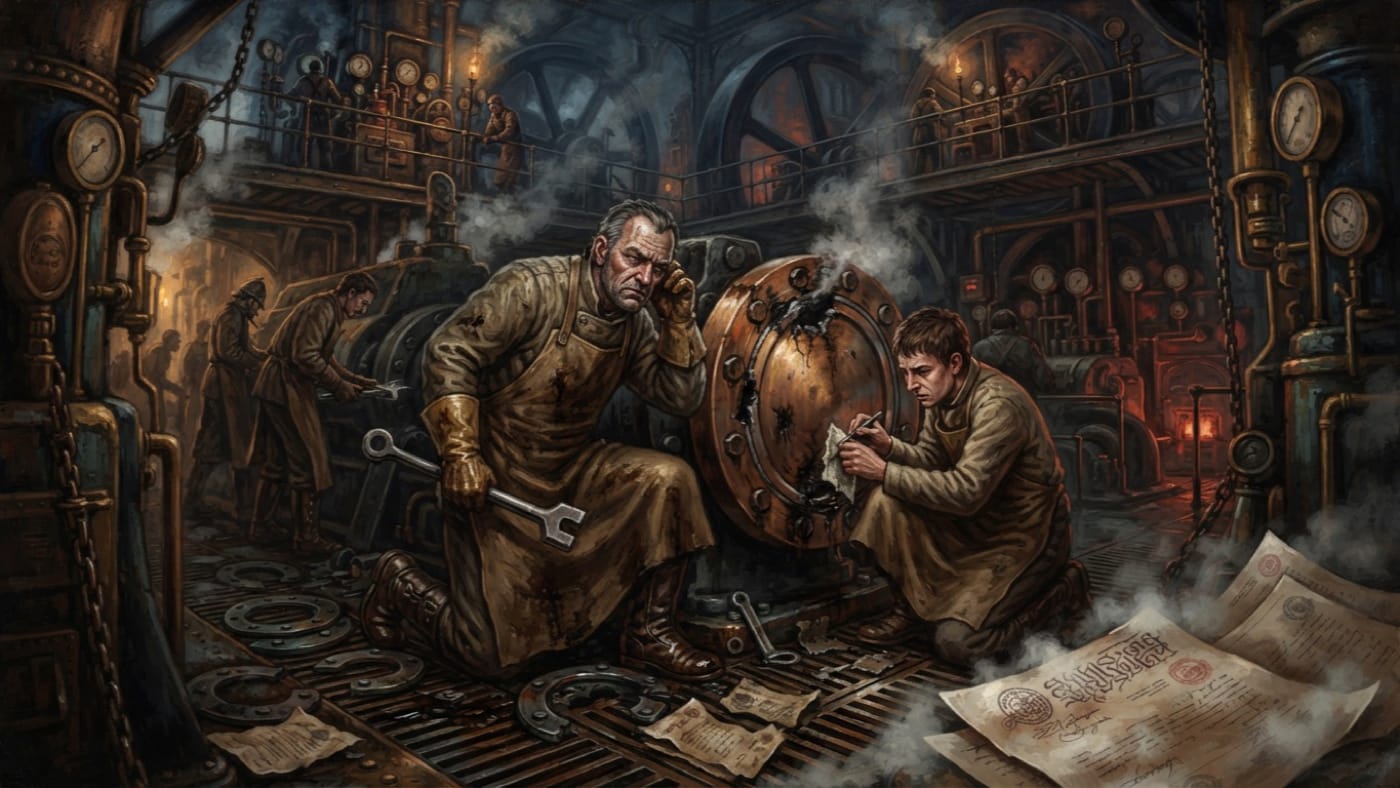
A joint commission of the Bureau of Engineering and the Bureau of Doctrine issued it in A.S. 164, after the Split-Ring Disaster at Bastion-Przemyśl. The commission needed only a few facts. In the lower works feeding the Wire Orchard's western pylons, a senior mechanic shortened the cleansing verse. Residual wax stayed in four gasket grooves, so the gaskets seated almost flush. Seventeen engine pits failed over nine hours, and forty-three workers died. The plate on the disaster records the double shifts, the supervisors' watches and the late stock. The instrument records the shortened verse. A verse can be regulated. A supervisor's watch has never once been immured.
Engineering lists the mechanic as Master Seal Mechanic Corven Aul. Mark the title. It belonged to the craft as it stood before the commission sat. It was a rank among working men who had learned their sequences the way infantry learn the drill for a jammed breech: by repetition, under heat, among people who had seen the alternative. Aul held no licence, because no licence existed. He was judged by a standard that his own failure brought into being.
The classification did three things. It licensed the Gasket-Hymn Mechanic as a formal profession. It made the repair sequence mandatory. It classified undocumented repair on a critical seal as sabotage. The Sabotage Reforms followed within the year and were built on this foundation.
The Bureau of Engineering's first report attributed the Przemyśl failure to "material fatigue in substandard gasket stock, provenance under investigation."
Withdrawn. The stock was standard-issue and purity-certified. Had the first theory stood, 7-G would have been written against suppliers.
#On the Nine Movements
The sequence is older than the law. Veteran engineers assembled it from failure, heat and vibration long before any Bureau blessed it. 7-G took a workman's memory and made it enforceable. It enforces the nine movements in this order.
Diagnose. The mechanic reads the failed joint before touching it: the witness marks on the bolt heads, the shape of the weep, the smell of rubber that may not be rubber.
Cleanse. Solvent and chalk-salt scour the groove and lift the old wax. Apprentices call it erasing the lie. This is the movement Aul shortened. Wax left in a groove becomes a ridge beneath the new ring, and pressure treats a ridge as permission.
Align. Pins go in, and the flange faces are checked for warp under heat. A flange that has run hot for a decade has its own ideas about flatness.
Seat. The gasket is laid dry and untwisted, in the correct orientation. Wax comes later. Waxing first is a novice's sin and a counterfeiter's habit.
Recite. The prescribed lines are spoken.
Torque. The bolts are drawn down in a star pattern. The recital is timed to the torque steps, so the mouth keeps count while the hands keep the crush even. In practice the two run together. In the enumeration they remain separate movements, and an auditor will tell you which one you botched.
Seal. The mechanic applies the wax stamp, purity tag and signature.
Verify. The joint gets a pressure test and a vibration test, and the mechanic presses an ear to the warm flange to listen for knock-back.
Document. The rite sheet records what was used, who worked and who watched.
Most of this is sound engineering, though the Bureau rarely lets me say so. Cleansing prevents false seats. Alignment prevents the uneven crush that splits a ring at its thinnest arc. Star torque keeps a flange from cocking. Verification catches what the others missed. Doctrine adds only that the Creator was watching the torque key throughout, which costs nothing and bills generously.
#On Proof of Repair
Under 7-G a repair exists twice, once in iron and once on paper. Only the paper can be cross-examined.
The auditable account has several parts: the rite sheet, the witness signatures, the torque record or diagram, the wax stamp and the purity tag. Beside them sit the chalk-white witness marks painted across every bolt. Clerks confuse the two kinds of witness, and they should be corrected with a ruler. A witness mark is a painted line across bolt and flange. If the bolt turns afterward, the line breaks and the metal confesses. A witnessed signature is a person putting their name to having watched. You cannot bribe the line. Signatures can be bought and sold.
The legal summary preserved on this office's disaster plate is plain. A critical-seal repair without verse, witness, torque record, wax stamp and rite sheet is legally the same as enemy action. An unauthorised abbreviation of the sequence is a sequence breach. That distinction protects the mechanic for exactly as long as the tribunal chooses to honour it.
Inspectors audit in the order that suits them. They check stamps and witness marks first, because these can be read at a glance. Rite sheets come next. Then comes the craftsman's part of the inquisition: comparing the recorded torque pattern with the vibration damage on the joint. A star pattern wears a flange one way, and a hurried circle wears it another. Inspectors love finding a missing line more than they love a seal that held.
The weaknesses were known from the start, and the books record them as practices rather than scandals. They include counterfeit stock, purchased signatures, borrowed stamps, gaskets reused "one more time" during shortages, and double wax: extra stamping laid over a flawed seat to give it the look of sanctity. Each one beats a paper audit. Pressure eventually beats each one.
Two consequences follow, and the Bureau likes neither. A repair can hold and still be unlawful. A repair can be lawful in every particular and still fail under a load it was never designed for. At Przemyśl, a pressure door sealed in full sequence lifted when the failure next door hit it through the wall. 7-G judges the paper. The flange answers to pressure alone.
Whatever the sheet says, the tribunal chooses the penalty. In no copy I have handled does a single sentence attach to every breach. Tribunals pick from a familiar shelf: demotion to wax hand, reassignment to trenchline generators, ritual penance, immurement, erasure.
#On the Reforms That Followed
7-G was the first stone. The Sabotage Reforms of the same year required full documentation for every critical seal, which made the paperwork as load-bearing as the ring. Lazy clerks and devotional printers often fold two later instruments back into 7-G.
Summaries of the A.S. 164 settlement, including this office's own plate on the Split-Ring Disaster, list Bell verification among the immediate consequences of the Reforms.
Corrected. Living-hymn authentication, in which a Bell-Accountant tests wax with a tuning fork, was introduced by the Bureau of Doctrine after the Counterfeit Wax Plague of A.S. 178. It was no part of the instrument of 164.
The Counterfeit Wax Plague of A.S. 178 exposed the flaw in 7-G's logic. If the stamp proves the seal, whoever holds the stamp holds the proof. During the shortages, certification became a currency. Purity immured fourteen suppliers at Przemyśl, and counterfeit wax was back within six months. Doctrine answered with the fork.
Standing Order 14-Q, in its A.S. 199 revision, requires written authorisation for any change to the sequence. 7-G prohibited abbreviation without authority. 14-Q settles what authority looks like, and it looks like paper. The older instrument, as worded on this office's plate, admits retroactive compliance under sealed dispensation. The later order is much colder toward permission granted after the fact. How the two sit on one shelf I leave to the canonists, who are paid by the hour.
The craft has split along the old fault. The Line-Purists read 164 as proof: the verse was shortened, men died, so no verse may be shortened. The Field Pragmatists read the same plate and see three weeks of double shifts and stock that came late. They argue that a mechanic who understands why each movement exists can adjust it for conditions the rite sheet never imagined. Both carry the same torque keys, and both recite the same Boundary Litany at the start of a shift. Both claim Saint Orla of the Seventh Line, who died refusing to omit a verse while the engine room flooded. Purists cite her refusal. Pragmatists cite the flood.
#On Present Application
As of A.S. 201 the classification is still in force at Bastion-Irongate, where the Danube gorge narrows between cannon-crowned cliffs. The fortress breathes through pressure doors, and the Gasket Choir keeps its seals in voice. Picture an ordinary night there, of the kind no plate records. A door seal weeps during a load spike. The gallery behind it holds a shift of workers and the only warm air for a hundred yards. The Boundary Foreman has a wax-stained glove on the flange, a torque key in the other hand, and a rite card in its sleeve, its edges going soft from the steam.
The foreman can shut the door and leave the gallery cold. The foreman can open the flange hot and run all nine movements while the gauge climbs, with the full cleansing verse, the star torque and the two signatures. The second watcher is three galleries away, and the craft's own proverb, two witnesses or none, exists because audits make short work of a lone signature. Or the foreman can do the work and sort out the paper afterward, which 7-G calls sabotage.
No general emergency exemption appears in any copy I have been shown. Further down, a Ward-Seal Artificer may know a quicker way through. Officially, no such knowledge exists.