
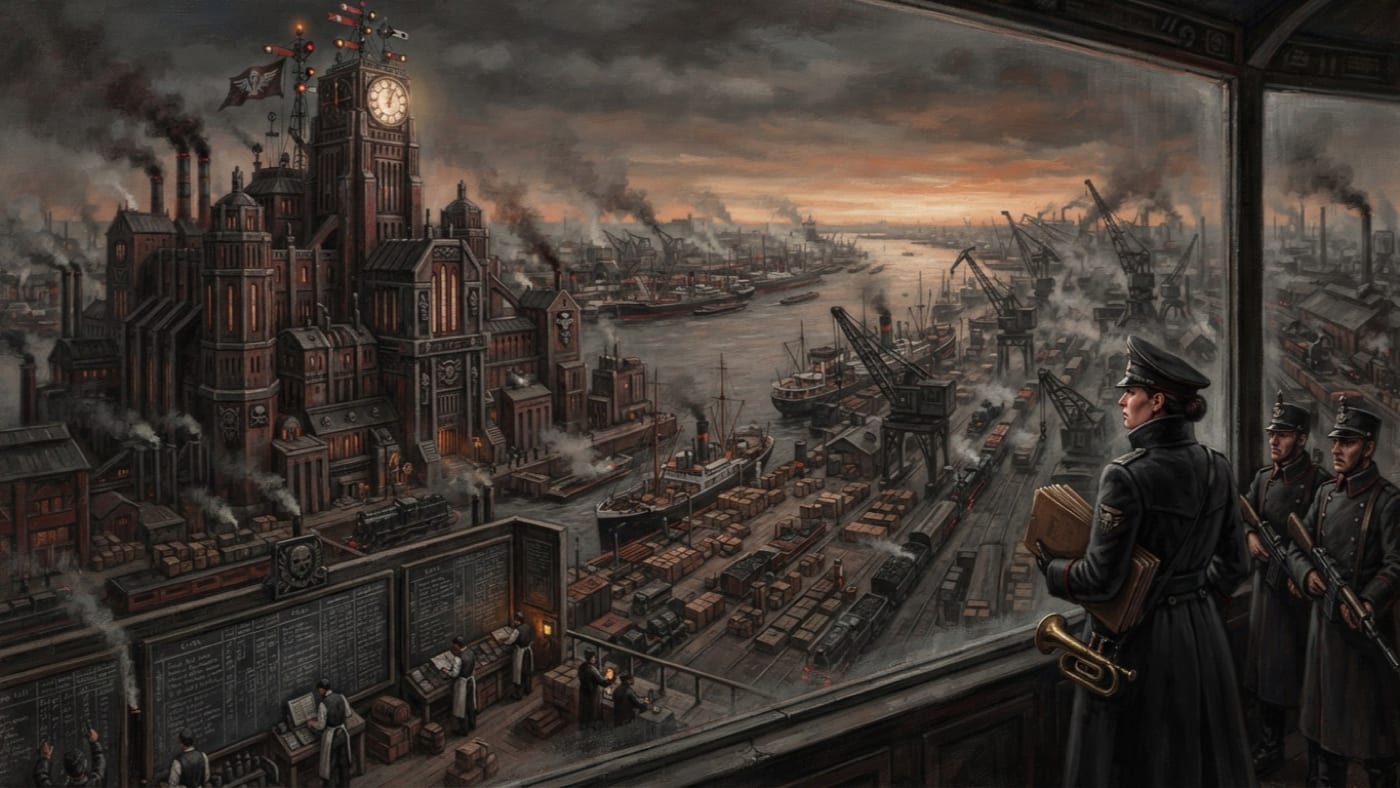
#On Its Station
The Northern Maritime Chapterhouse sits in the Synod Quarter of Hamburg on the north bank of the Elbe, and it spends the day looking across the water at the thing it exists to hurry. The working docks are on the south bank: the cranes, coal chutes, bonded sheds, quarantine pens, guild hiring-halls and the smell. The Chapterhouse owns none of that brick and timber. What it owns is the order in which ships may approach it.
Its purpose can be stated plainly enough for a novice of Rites. Cargo arrives from the North Sea and has to leave eastward by rail or upriver by barge. Between arrival and departure lie a river, a harbour of finite depth, a finite number of cranes, and a Synod that would happily inspect a herring until it fossilised if nobody stopped it. The Chapterhouse decides which hull berths, which hold is broken first, which wagon receives what, and which official's objection can wait until the tide has turned.
No founding charter for the house has reached my desk, and I asked in the voice I keep for archivists who mislay things. Its architect is unrecorded, and so is its first master. Its present importance is recorded on every manifest that leaves the river.
#On the Division of Authority
Admiral-Prefect Gerta Halske has headed the Chapterhouse since A.S. 194. Her remit covers harbour routing, naval import control and its schedules, war-cargo priority, dock emergency orders, and the scheduling of foreign factors. The "Admiral" refers to ships that obey harbour signals. No battle fleet answers to her, and visitors who arrive expecting one are shown to the window.
She has two masters. The Archon of Kanzleiburg holds her answerable for civil administration, and the Bureau of War holds her answerable for military logistics. By the harbour's own count, these superiors contradict each other about once a week. Each contradiction arrives as a properly sealed instruction, and each seal is genuine.
The Quarter is crowded with other offices. War keeps its import-routing office there, the Bureau of Tithes keeps its customs directorate, and the Bureau of Purity keeps a sub-office of eleven officers responsible for nine hundred thousand souls. These are the Chapterhouse's neighbours and not its departments. Every one of them will recite the distinction to you, at length, the moment a delay acquires a name.
Picture one grain steamer at the river mouth. War wants her discharged at once. Tithes wants her assessed before a sack moves. Purity wants her boarded before anyone touches her. Kanzleiburg wants her held until the eastbound line has a free slot. That makes four instructions for one hull on one tide, and the cargo has opinions of its own, mostly about weevils. When the instructions cannot all be obeyed, Halske does what the harbour requires and files her reasons afterward in blue pencil.
A Quarter memorandum described the Northern Maritime Chapterhouse as "answerable to no superior authority in harbour matters."
Corrected. The Chapterhouse answers in writing to Kanzleiburg for civil administration and to the Bureau of War for military logistics. No charter grants it independence. When the two superiors conflict, it exercises the practical discretion its office requires and accounts for that discretion afterward. The memorandum's author confused the habit of getting one's way with a right to it.
#On the Harbour Boards
The boards are updated before first bell. Each inbound vessel is a line of chalk and ink: draught, cargo class, spoilage risk, plague flag, any Dutch lien, the latest British weather report, the crane gangs available on the relevant quay, and the rail slot that will take the cargo inland. Each berth is a second line giving its depth at the coming tide. The clerks who keep the boards speak little. A clerk who speaks too much is soon keeping a different board somewhere colder.
A representative decision runs as follows. A deep-laden vessel's draught is set against the depth of every berth that will be free when she reaches it. If no berth is deep enough, nothing else on the line matters and she waits in the roads, burning coal and wages. If one is deep enough, perishability comes next, because grain that sits in a sweating hold during an argument comes out as a different and less nourishing substance. A plague flag sends her to the quarantine pens, and her place in the order passes to whoever is next. A Dutch lien means the cargo still belongs, on paper, to a house in Amsterdam until the paper clears, and the Chapterhouse does not unload property it cannot prove the Synod holds. Then come the cranes, because a berth without a crane gang is only a wall. Last comes the rail slot, because cargo landed with no wagon to receive it simply becomes the quay's problem instead of the ship's.
The priorities set against that column are perishability, military consequence, foreign consequence and scandal risk. Ordinary manifests are processed before any vessel moves. The documents that are themselves the cargo are a separate case: liens, payroll packets, sealed instructions. The standing order covers the difference. Paper follows cargo unless paper is the cargo. I have heard theologians try to improve on that sentence and fail.
#On Those Who Can Refuse
The Chapterhouse can assign a berth. It cannot fill one.
Grain and coal arrive in British bottoms under contracts the British Crown has no obligation to renew. Credit arrives from the Netherlands on the same terms, at an interest rate negotiated by men with very small smiles. Timber and iron come from Scandinavia, and seal-oil comes down from the fjord settlements of the Fractured North. None of these suppliers is governed by the Synod. All of them can be scheduled. Halske can tell a British master where and when to tie up. She cannot tell London to send him. The Chapterhouse decides the order of what the world chooses to sell, and the Bureau of Doctrine has never quite forgiven the world for keeping that choice.
The dock labour can refuse too. About forty thousand people work Hamburg's waterfront, organised in guilds, and any of those guilds can stop a quay faster than any Bureau can start one.
What gets unloaded has to keep moving. The rail line runs to Kanzleiburg, then to Warsaw, then out along the forward spurs to Bastion-Königsberg and Bastion-Brest. Brest consumes material at a rate that would embarrass a cathedral chapter. Elbe barges take further tonnage upriver to the transfer yards at Magdeburg and Dresden. In winter, when the outer harbour closes against the coastal convoys, the Salt-Vigil Causeways provide a spur through the Frisian approaches. Each of these routes has its own masters, ledgers and grievances. The Chapterhouse feeds them and does not command them. Seal-oil gets winter priority by temperature table, because a bastion that cannot heat its lamps cannot read its own orders.
#On the Fire Remembered
In A.S. 189 a warehouse of chrismole, sanctified fuel bound for Brest, exploded on the south bank and took four city blocks with it. Three hundred and twelve people died. The dock workers refused to unload ships for eleven days. They went back on the twelfth, after the Bureau of War offered a seven-percent hazard supplement. The Dock Fire has its own entry and its own long list of guilty walls.
Halske was appointed five years later. She did not negotiate the settlement and did not appoint the men who did. She inherited the consequences, which is the usual way an office receives its history.
The consequences show on the boards. Any hazardous cargo is a quay decision that the guilds will check against the memory of four blocks. A shipment of chrismole is now a question about which wall it will sit against, for how long, and how far it will be from the gangs who have to handle it. The supplement is still paid, and every crane foreman knows why. A Chapterhouse priority that asks the docks to hurry dangerous freight is asking men who remember the eleven days. They have shown once that they can stop.
#On the Present Condition
In A.S. 201 the Chapterhouse works. The harbour across the river moved 4.2 million metric tons in A.S. 200 across three hundred and forty deep-draught berths and twelve hundred coastal and riverine berths. Those are the harbour's figures. The Chapterhouse is a house of boards, clerks and pencils on the opposite bank, and it would be a vulgar mistake to credit it with the quays it schedules. It would be a worse mistake to imagine the quays running in order without it.
The house is contested. Its superiors still disagree, its neighbours still regard every waived inspection as a personal insult, and the guilds still keep their own count of the hazard supplement. The Bureau of Doctrine calls the arrangement Providentially Arranged, a phrase the Chapterhouse clerks have been forbidden to use in shortage reports.
It is also dependent. Foreign masters may decline to sail, foreign banks may decline to lend, and the docks may decline to work. The Chapterhouse can overrule none of them, and any one of them can unmake its schedule. It survives by being the one office in the Quarter that knows, every morning before first bell, exactly what is coming and when. The Creator made the tides. The Great Deceiver, I suspect, invented the customs form. The Chapterhouse decides between the two before breakfast, and on most mornings the tide wins.