
#On the Classification
Since A.S. 199 the Bureau of Doctrine has classified the Lantern Way, the Christian faith of the British Crown, as Non-Standard Observance, Diplomatically Accommodated. Mind the comma. The words before it describe the British. The words after it describe us.
It replaced an older designation, and nothing in Britain had changed. Canterbury's bells kept their hours. The Wardens still held sword and confession in one hand. The walls took the condemned at the usual rate, and the fasts ran as long as they always had. In ordinary Synod practice a classification follows the thing it classifies: the heretic recants, the file is amended, and the Ledger records that a soul has moved. In A.S. 199 the file moved and the soul stayed where it was, on an island in Zone 0 that never signed the Concordat, never asked our opinion, and has never once been bothered by it.
The designation applies to an observance and to nothing else. British territory remains an independent sovereignty. The Crown remains a co-belligerent outside the Concordat. The King-Warden is exactly as unconverted as on the day he was crowned. Doctrine reclassified a religion, and nobody consulted the religion.
The Lantern Way: Schismatic Heresy, Category Two.
Revised A.S. 199: Non-Standard Observance, Diplomatically Accommodated. Every theological objection recorded under the prior designation is retained and transferred to the new file unaltered. Only the heading has been corrected.
#On the Convoys
The cause was hulls.
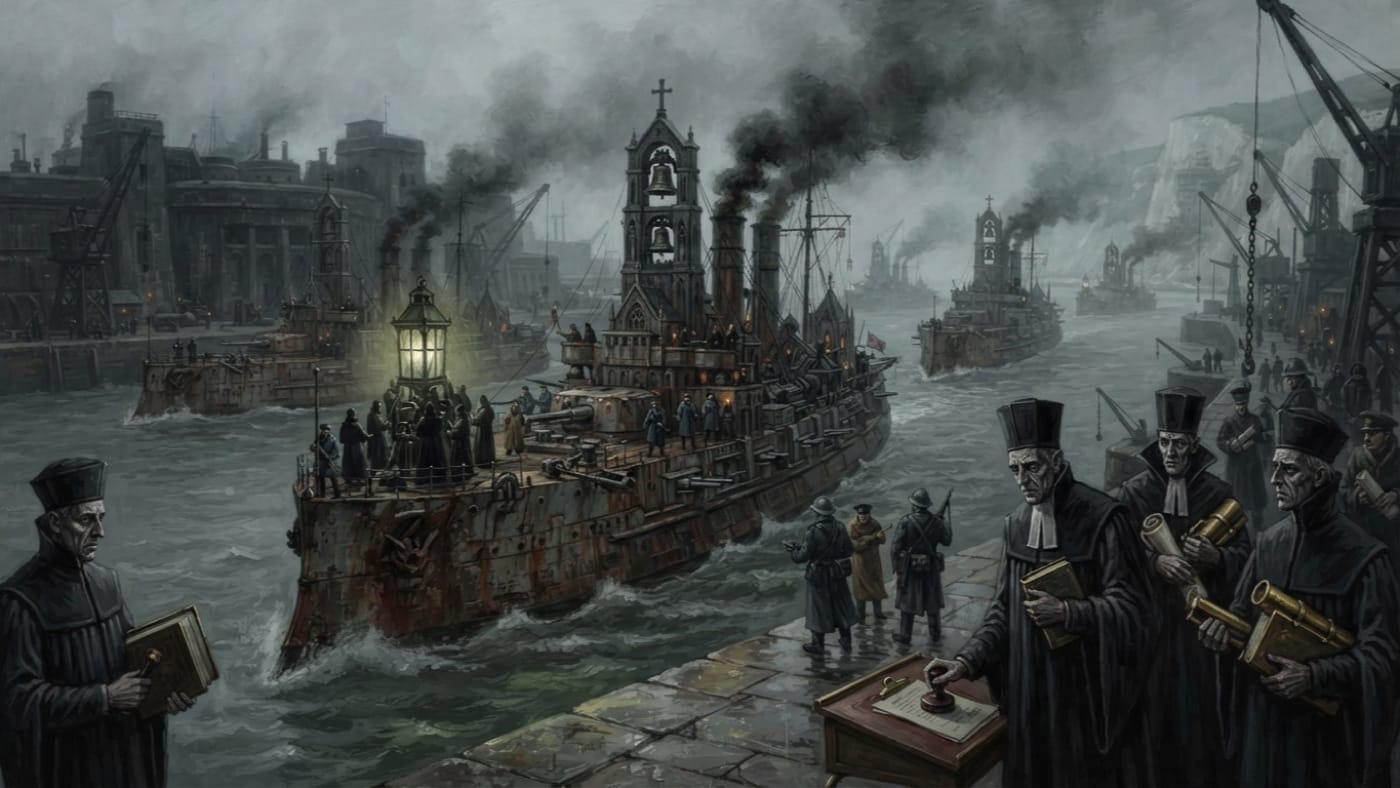
British Cathedral Ships escort the western convoys and the Channel crossings. They carry grain first. After the grain come coal, chain and net-cord from the Dover Chainworks, pilgrims, medical stores, and the diplomatic pouches that carry our complaints about British bells to and fro under British protection. Every hull has a chapel amidships, a bell-tower over the quarterdeck, guns along its batteries, and a reliquary sealed in its keel. Pirates dislike these ships. The things in the fog dislike them more. The Synod keeps installations at the Chalk Redoubt of Calais that watch the Channel with admirable thoroughness and change very little of what happens on it.
The Royal Fleet musters some three hundred warships, and the Cathedral Ships are among them. The Synod has two Vigil Arks and an opinion.
War had understood this for decades. In A.S. 199 the Bureau of War finally said it to Doctrine in writing. Its observation was that the Synod could not go on asking the British to guard its bread while its own registers called their religion a Category Two heresy, because sooner or later someone would read the second document aloud in Canterbury. The dependency was older than the file. War's contribution was to make it legible to men who eat bread without asking which ships brought it.
Doctrine answered by keeping the theology and changing the heading. The cause it recorded was diplomatic necessity. The cause it understood was the escort, which arrived on schedule either way.
#On the Accommodation
Accommodation is a diplomatic act and confers no doctrinal approval. Concord repeats that sentence wherever the designation is applied, partly because repeating it costs less than proving it and partly because Purity checks.
Three classifications touch Britain, and careless clerks mix them up. Zone 0 is geography: independent territory outside Synod rule. Category Zero is diplomacy. It is the accreditation the Bureau of Concord gives sovereignties we cannot do without and cannot prosecute, and it carries embassy inviolability, limited chapel practice, pouch privilege and protected coin. Non-Standard Observance is doctrine, and it grants nothing. The embassy's chapel privileges were Concord's work long before A.S. 199. In A.S. 198, under Category Zero, Lord-Warden Eccleston saw a Purity inspection out of the embassy, a full year before Doctrine found its new vocabulary. Concord had already given the British a door. Doctrine came afterward and painted a word over it.
The plainest evidence of the change is kept in the Concord Quarter. Its guest-chapel registers once entered British embassy worship as "schismatic observance, tolerated pending correction." In A.S. 199 the pages were re-ruled. A single red line was drawn through the old entry and the new designation was written beside it. The old entry can still be read through the line. The British in the chapel noticed no difference. They rang the same hours and said the same prayers to the Creator in the same severe cadence. The only thing corrected was the register by the door, and the correction was for our benefit alone.
Nothing else moved. Doctrine kept every objection. Bells still objects to British hours. Tithes still disputes the Iron Crown. Purity watches the embassy and keeps its grievances in a drawer marked pending. British requests for nothing at all continue to arrive, promptly, by return of silence. On the island the old severity carries on as well: months-long fasts, public penance, and dissenters walled up in monastery masonry under sentence. The revision was not a mercy to anyone in Britain. It was a courtesy to the Crown that does the walling, and the Crown did not ask for it.
#On Those Who Received the Notice
King-Warden Aldric III had not requested the revision. He sent no reply. Over the years Strasbourg has received many silences from the British Crown. It files them, gives them reference numbers, and shelves them together, and the shelf grows.
The record says Eccleston received the notice in Strasbourg with professional stillness. I know that stillness. It belongs to a man signing for a parcel he never ordered and does not intend to return.
From Canterbury, Legate-Prior Mertens reported that the court "appears unsurprised." That was accurate, and in A.S. 199 accuracy was hazardous. The same year, after the reclassification, the Bureau of Purity opened a review into whether eleven years among British rites had softened Mertens's doctrinal reflexes. It found no actionable contamination, and he remained at his post. Nothing in the file names him as author of the formula, and nothing in the file needed to. A retreat built on ships still needs a man to blame, and ships cannot be summoned for interview.
#On the Present Application
As of A.S. 201 the designation stands. The Lantern Way is Non-Standard Observance, Diplomatically Accommodated in every register that matters and in several that do not. Britain is still sovereign, still outside the Concordat, and still indifferent to how it is headed. The Cathedral Ships still escort the grain. The Lantern-Ringers still ring. The Bureau of Engineering still asks for keel specifications and tower dimensions and still gets back feast-day schedules and exquisite manners.
The formula does not travel. Doctrine has applied it to no other observance and has published no procedure under which another observance might apply. A foreign envoy who wanted his chapel accommodated would, by the logic of A.S. 199, first have to acquire a navy and then make himself necessary. So far no one has managed the second part.
Strasbourg has learned to live with the arrangement in the way it lives with most arrangements: on paper, through clerks, with a red line drawn through the inconvenient part and the old words kept legible underneath. Doctrine considers this rigour. The British have not commented, and the grain still comes in.