
#On the Tavern Beside the Pilgrimage
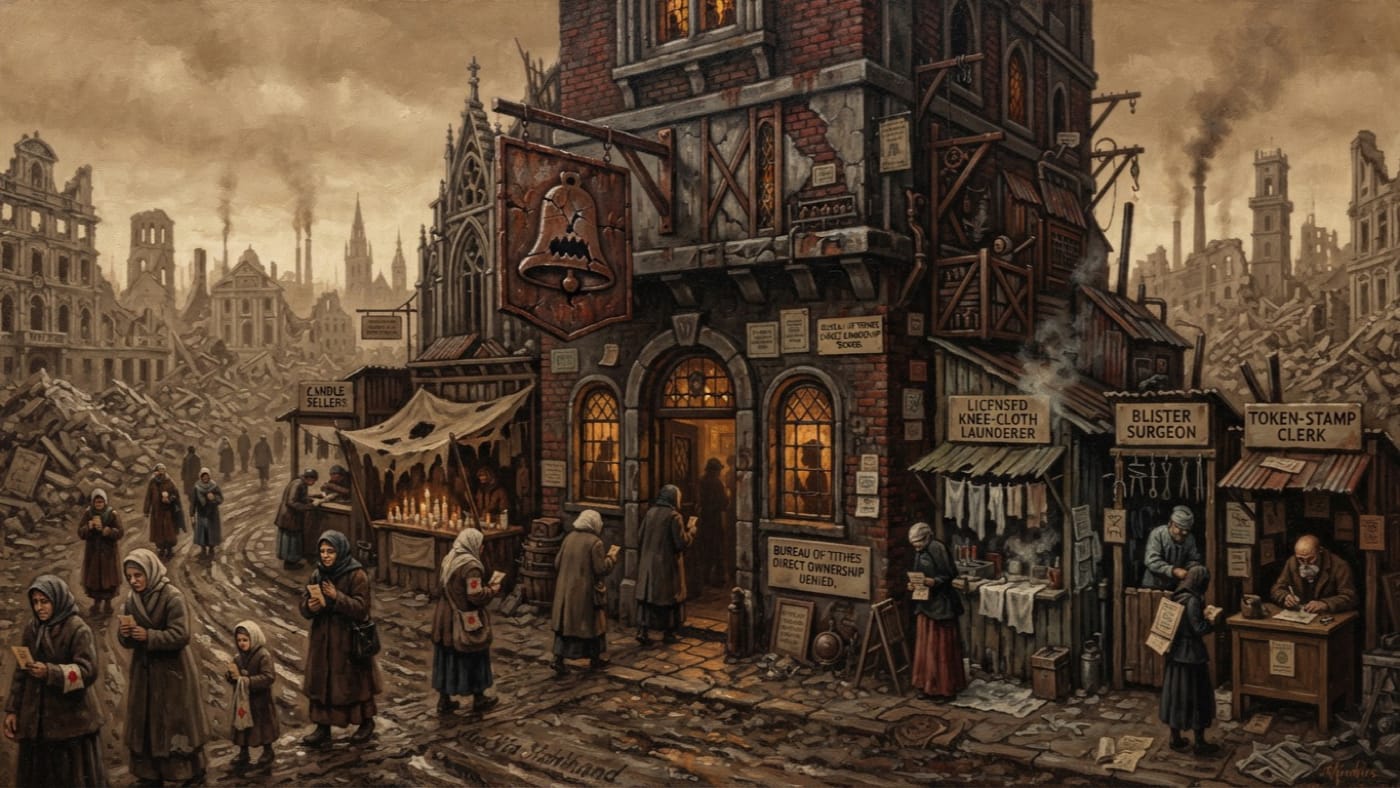
This entry is a current survey, made in A.S. 201 (1911 CE), of The Ninth Second, a tavern in the ruin-town of Vienna. It sets down what the published account of the Via Stahlhand establishes about the house, and it leaves out what that account omits. Three things are established. The Ninth Second lives on the commerce of that penitential road. By the account's own assessment it is the ruin-town's most profitable tavern. Its sign shows a bell with a cracked jaw.
A fourth matter rests on a single sentence: the Bureau of Tithes denies direct ownership. I will come to that sentence later, and slowly, because it is a sentence that rewards slow reading.
The record does not say who founded the house, who keeps it now, when its shutters first opened, how many beds it lets, or what it pours. Nothing in the Ledger answers those questions, and this survey does not supply answers of its own. A reader who wants the landlord's name must ask the landlord. The Ledger has no entry for him.
#On the Name and the Note
The name comes from a sound. During the Siege of Vienna in A.S. 95 (1805 CE), Clemens Stahlhand struck down Althazar of Pest at Saint Rupert's altar with the reliquary mace of Saint Aldebrand. Seventeen testimonies taken after the siege disagree about posture, weather and the words spoken. They agree about the note. It was low, felt in the sternum more than heard, and it lasted nine seconds. Every preacher in Vienna has counted to nine from the pulpit at least once since, and the faithful count along with him.
Anyone who can count will see the link between that count and a tavern called The Ninth Second. The record does not show that anyone intended it. I have found no christening deed, no founder's declaration and no blessing pronounced over the lintel. The association is plain to see and has no document behind it. The Codex keeps those two things apart, even where the town does not bother.
The sign is a painted bell. Nothing in the record makes it a siege bell, a relic, or an object that has ever rung. Bell-founders speak of the lip and the sound-bow. Whoever painted this sign gave the bell a jaw instead, and cracked it. A cracked rim cannot hold a true note for long. The emblem therefore shows the very thing that the seventeen witnesses swear the mace did not do. Whether the painter meant this as a joke, a piety or a warning, the record does not say.
The Via ends at the Impact Plate before Saint Rupert's altar. Pilgrims press their foreheads to its bronze rim and listen for the note.
Earlier guidebooks identified the Impact Plate as the original stone struck by Clemens's blow.
Corrected in the route's published account. The Plate is a contact substitute, installed in A.S. 112. The forehead has not been informed and does not appear to mind.
#On the Trade Around the Knees
A relic draws the crowd. After that, the route has to be serviced. The published account lists the occupations that the Via supports: candle sellers, licensed knee-cloth launderers, token-stamp clerks, blister surgeons, ash-gatherers, confession scribes and approved weeping witnesses. Each of them earns a living from one particular consequence of four hundred and eleven metres of stone.
The candle seller is paid for hope before the passage begins. The launderer is paid for the cloth afterwards. The surgeon is paid for the knee under the cloth, and the clerk for proof that the knee went the whole distance. The confession scribe writes down whatever the crawl shook loose. The weeping witness holds a licence and supplies grief to pilgrims whose own grief arrived late, or not at all. The arrangement is orderly enough for a diocese to envy, and it is still incomplete. Someone must also attend to the pilgrim who has finished.
The Bureau of Pilgrimage manages the route from its Central Corridor headquarters beside the breach. Each pilgrim is issued a knee-cloth, a wax token and a printed caution against theatrical bleeding, and is sent forward in a file of forty. The Bureau sets the posture, the order of march and the fees. It does nothing about thirst. The road takes a pilgrim off his feet for three-quarters of an hour and puts him back on them sore, cold or exalted, depending on the hour of his file. Something in the ruin-town has to receive him. Among the houses that do, the record ranks The Ninth Second first in profit.
The crowd changes with the hours. The poor crawl at dawn, when the stones are cold and the fee is lowest. The wealthy crawl at Vespers, when the lamps turn the rubble gold, the guides lower their voices, and a surcharge is added for the reverence. Veterans crawl badly on ruined knees and refuse help. Widows crawl best. They move as if they were collecting a debt.
The ruin-town feeds and comforts all of these people. The record names the crowd and it names the tavern. It does not say which pilgrims go through The Ninth Second's door, in what numbers, or what they ask for once inside. I will not draw that connection in pencil for the reader's convenience. A pilgrim economy has a body at the centre of it. This is the shameless part of the trade and also the honest part. Every service on the account's list answers to some part of the flesh: the knee, the blister, the tongue, the eye. A tavern answers to the part of the pilgrim that is still a traveller after his penance is finished.
#On Direct Ownership
The Bureau of Tithes counts what the faithful owe. Out of long habit it also counts what they spend. A shrine-town that lives on pilgrims is, from Tithes' point of view, one large instrument of collection with chapels attached. So the Bureau's interest in Vienna's most profitable tavern needs no explanation. Its denial is another matter.
Tithes denies direct ownership of The Ninth Second. The route's published account remarked that the denial is phrased so carefully that it confesses by punctuation. I wrote that sentence. I still admire it. It is commentary, and the Codex enters it as commentary, not as a finding.
The adjective is the whole point. A plain denial of ownership would deny every form of ownership. A denial of direct ownership rules out one form and says nothing about the rest. The record does not mention any lease, loan, share of takings, nominee, debt or favour, and it does not rule any of them out either. A clerk who is paid by the word does not usually spend one he could have kept.
Everything I have written above is suspicion. Suspicion is a proper clerical faculty, and I use it freely. It is still not evidence. The Codex records the denial as it was issued, with its adjective intact. The Codex names no owner, cites no instrument, and records no share of takings. I have not seen the denial's full wording, its signatory or its file number, so I do not reproduce them, and I have not invented them. Anyone who wants an accusation can take the adjective and make one. This entry contains none.
#On the Present Account
The survey can certify a sign that shows a bell with a cracked jaw. It can certify a tavern that the route's account ranks first in profit among the ruin-town's houses. It can certify one denial from the Bureau of Tithes, carefully worded. Beyond those three entries the Ledger holds nothing about The Ninth Second. It has certified holier places on less evidence.
On the other side of the breach, the pilgrims go on crawling toward a substitute stone to listen for a note that seventeen witnesses timed. When they get up again, the town is waiting with candles, cloths, surgeons, scribes, and a sign with a broken bell on it.