
#On the Working Waterfront
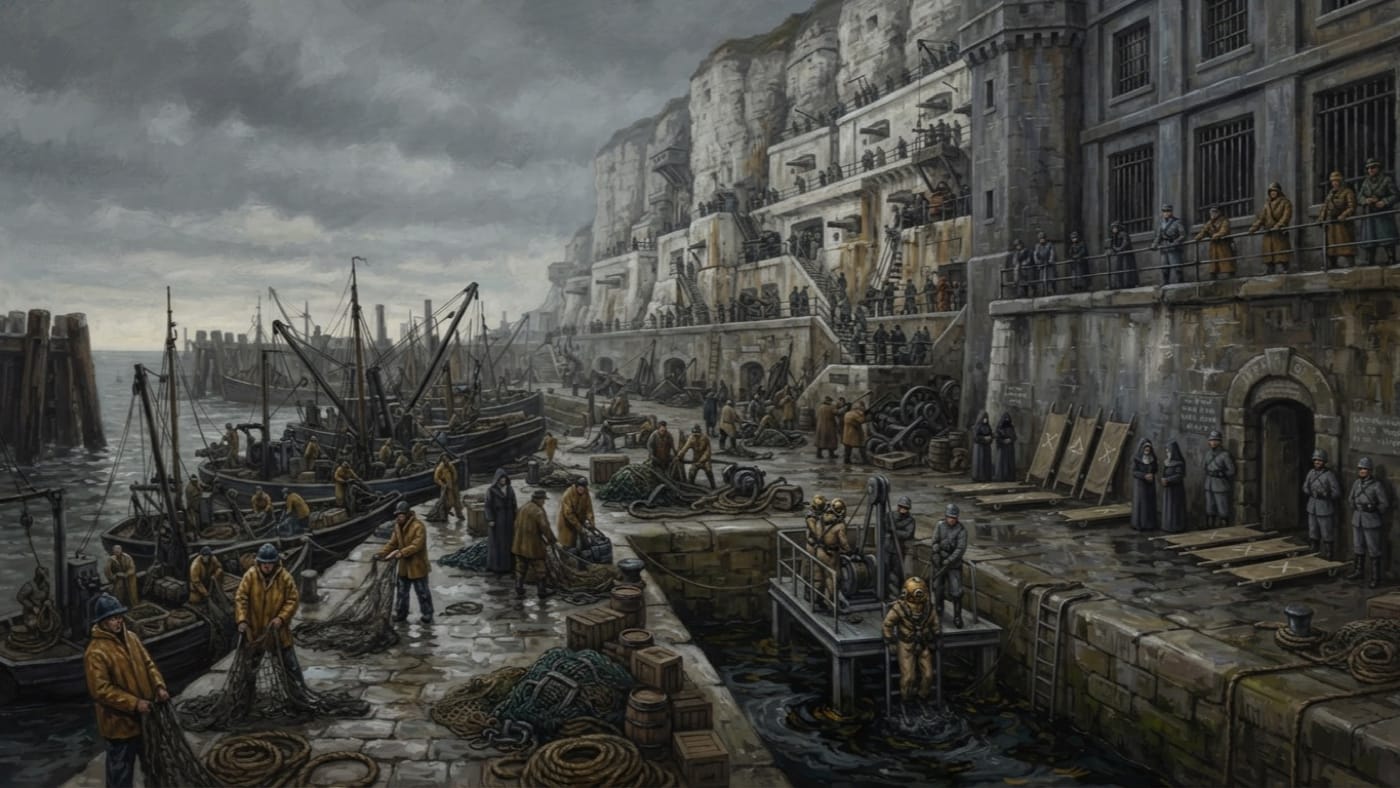
Net Quay is the wet floor of Calais. Above it the Chalk Redoubt climbs in white galleries, gun mouths, hoists, and stairs slick with spray. At its foot the cliff gives up its pretensions and puts people to gutting fish. Tribunal ledgers write the place in the plural, the Net Quays, because a clerk counts landings the way he counts sins: one at a time and each for a fee. The people who work there say Net Quay, the way a man names his parish. Both names cover the same ground and the same three trades: fishing, salvage, and the launching of divers.
It smells of fish oil and seaweed rot. Visitors notice this first and complain about it longest. Quay folk stopped noticing long ago, since they have already paid for the smell with their lungs.
The quay is bounded by authority on three sides and water on the fourth. Salt Tribunal Row faces it across a strip of wet stone, all grilles and seal windows. Beneath both, in what were once net-drying cellars, lie the Undertide Pens. Out past the moorings the Teeth stand across the harbour mouth, knocking in their iron collars. Between these sit the quay's own furniture: nets slung over rails, tarred hulls hauled up for patching, coils of diver rope, rope bells, recovery hooks, lime barrels, and stretchers stacked against the wall. The stretchers see more use than the visitors' guidebooks admit.
#On Nets and Salvage
The quay wakes at dawn with the guns. While the Crownline inspects its barrels, the boats go out, and each net is salt-blessed at the rail before it goes over. The rite is brief and fiercely observed. A crew that skips it gets the blame for every bad catch in the harbour for a season. Fish, cured provisions, and salvage iron leave the quay for the galleries, the Chalk Warrens, and the garrison kitchens. The Redoubt's guns are famous, but it is fed by men in oilskins whose names appear only in debt ledgers.
Midday belongs to the salvage auctions, held in sight of the Tribunal queues so that anyone who loses a lot can go straight to the window and lose an appeal as well. Bids come in coin, salt chits, ration chits, stamped paper, lantern tokens, and oath-notes. They are made in a shouting dialect that a Strasbourg clerk would mistake for a riot. Iron fittings, ship timber, cable, and broken things from wrecks change hands. So, now and then, does something recovered from deeper water that a sensible auctioneer refuses to touch with bare hands.
The Net & Hook Guild works the quay as if the quay were its property. Its public face is feeding the city, and in fairness it does. It holds the nets, boats, and crews, and it keeps them in line with contracts, threats, and price control, in rising order of candour. Netmaster Rena carries her rope scars like a seal of office. Hookman Jory is always wet, in every weather, at every hour, and has never offered an explanation. What the Guild wants is salvage rights: all of them, including whatever demon remains the tide gives up. Wanting is not owning. I have found no ledger that grants the Guild exclusive title to the quay or its salvage. Lots are still fought over one at a time, and the Tribunal goes on stamping each dispute as though it were the first.
#On Permission and Return
Every movement on the quay runs in one of two directions, and both are taxed.
Going out takes permission. A boat needs a sea pass from the Salt Tribunal, a cargo seal for anything worth carrying, an inspection at the rail, and compliance with the bell chart. A pass that was valid at dawn can lapse by noon when the tide-hour runs out on the paper. That is the quarrel at the bottom of all the others. The Tribunal wants fewer passes. The quay wants to fish and salvage, because the alternative is going hungry with good papers. Fines that cannot be paid become labour, and labour on the Row becomes reading duty. A man denied his fishing clearance at midday may be kneeling at the Script Wall by midnight, paying in voice what he could not pay in salt.
Coming back takes quarantine. When a crew hauls up a body, or a diver surfaces wrong, or a net brings up an object the inspectors do not like, the cordon goes up before anyone asks questions. A service route runs from the Row to the quays for stretchers, seized cargo, and things that ought not to pass through a crowd. Behind the quays is the Pens' working door, wide enough for a stretcher and low enough to make an officer bow. The family goes round to the public arch on Salt Row, where a clerk tells them there is no visitation.
The procedure has earned its severity. In A.S. 103, wash-water from the Pens went into a quay gutter. Gulls drank from it and began speaking the names of condemned smugglers. The gulls were shot, the gutter was relaid, and the Pens drains have been sealed ever since.
#On the First Alarm
The redoubt was founded in A.S. 69. Two years later the sea came for it. In A.S. 71, during a west-hush so complete that the harbour chains stopped clinking, children on Net Quay saw lamps moving under the water with no divers attached. Theirs was the first alarm. A chalk miner's flooding tunnel was the second. The third was three drowned watchmen walking upright out of the boat-tunnel locks.
The Great Breach lasted eleven hours. Hundreds drowned across the redoubt. It ended when a makeshift bell-choir, striking whatever metal would ring, drove the things back into the caves. The Gunline Choir would not be certified for another two decades.
Then the quay became a sorting floor. The coastal officers of that year had no procedure for what the Undertide had left behind, and the formal Synodal apparatus that later took over their files did not yet exist. They had lime, salt, canvas, rope, and lanterns. On the quay stones they separated the clearly dead from the clearly living. Everything that fit neither category went into chalk-marked barrels. By dawn that sorting had failed, and the barrels were carried down into the old net-drying cellars. Someone wrote temporary holding on the lintel. It has been repainted every decade since.
The quay also gave the bestiary one of its names. Net & Hook fishermen called the large pale swells that rise under hulls bellies. They named them from the deck, while the hull opened beneath them.
The Bureau file on the Undertide describes the Undertide Divers as "the only living witnesses of the things below."
Narrowed. The Black Lungs are the only living witnesses with repeated underwater experience and the only ones who carry out reconnaissance. The first sighting on record came from Net Quay children standing on the stones. The first common name came from fishermen in boats. Surface testimony is admissible, though nobody enjoys admitting it.
#On the Routes Beneath
Divers go down from the quay during the working day, with rope crews paying out line and riggers watching the lamp flames for any sideways flattening. At night they stay ashore. The launches belong to Diver-Captain Sain and her crews. The quay supplies the hands, rope, and stretchers, and as a rule it does not ask what the divers saw.
Under the cliff the boat tunnels run through the chalk below the Warrens. Divers use them for emergency descents. The Grey Keel Syndicate uses the same cuts for skiffs, forged passes, and bribes carried in waxed cloth. Shared water does not mean shared loyalty. A Guild crew, a Black Lung, and a Grey Keel boatman may all tie up at the same ring on the same morning, and each would swear on the Creator that the other two have no business there.
Ila "Kelp", Sain's second, has been seen near Net Quay talking with a woman who smelled of tar and orange perfume. The woman has not been identified. No admissible proceeding has tied Ila to the Syndicate. The sighting is in her file, where it stays unresolved, which is how Calais prefers its useful people.
#On the Present Quay
It is A.S. 201, and Calais stands at Amber. Since A.S. 199, chalkscript has been appearing on doorframes inland, well away from the Wall. Fear has gone up the stairs with it, and so have the quarantine holds. Lamp oil is short. Readings run slowly in poor light, and slow readings bring the west-hush back into the harbour.
The quay pays for this in hours. Men who read names at night in the surf haul nets at dawn on no sleep. Passes are harder to get and expire sooner. Auction lots sit under seal waiting for an inspector who is needed somewhere else. The Pens are overfull, so stretchers wait at the working door longer than any stretcher should, while the Brine Sisters' gloves split and the wardens send no word. Rena's crews still go out. Jory is still wet. The children still watch the water, because everyone on the quay knows what the water did the last time they stopped watching.
The Great Deceiver keeps a patient ledger. The quay keeps a quicker one, in chalk on the boat-sheds, and settles it every dawn.