
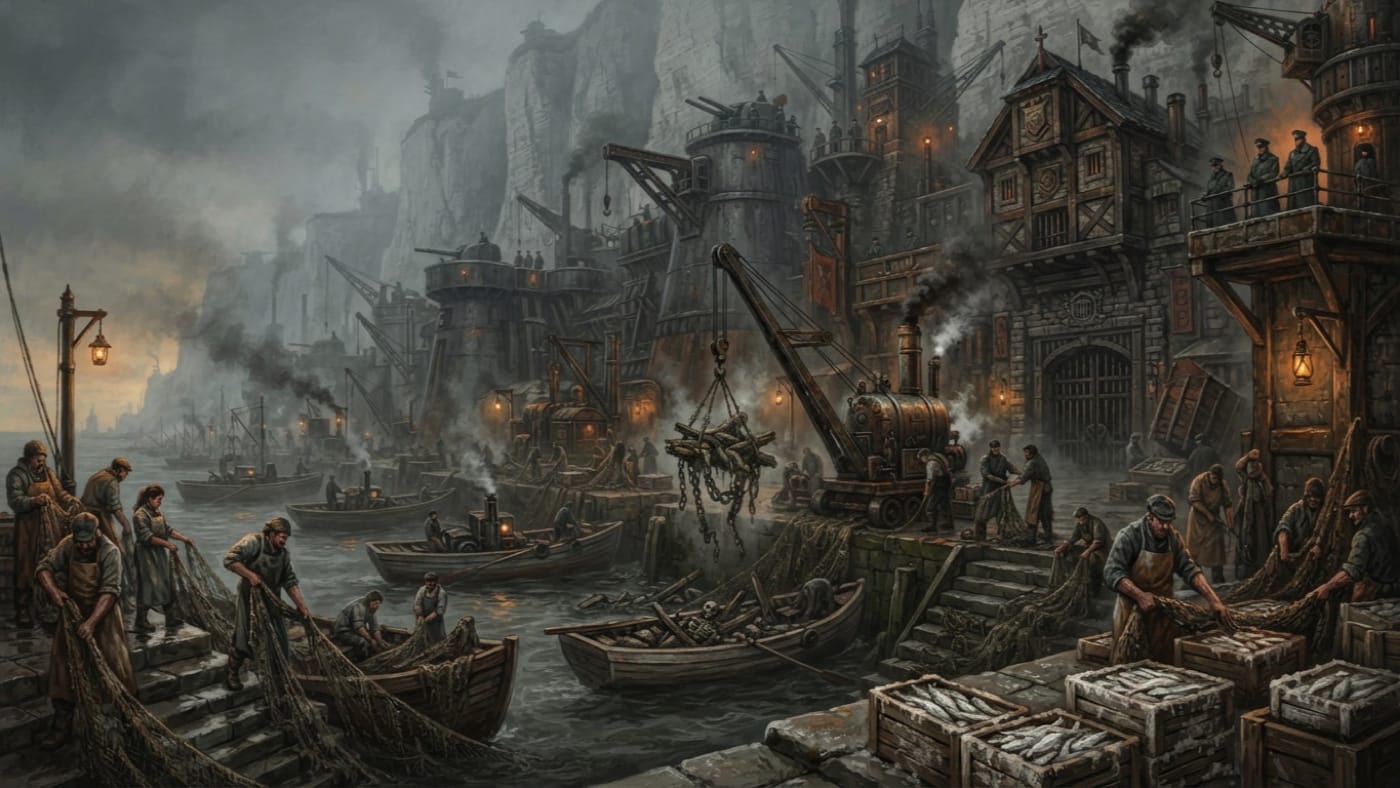
#On the Quays
The Net & Hook Guild feeds the Chalk Redoubt of Calais. It will tell you so before you ask, and again once you have paid.
The guild holds the Net Quays, the low shelf of wet stone below the cliff where fishing boats, salvage crews and diver launches use the same stairs and breathe the same air: fish oil, seaweed rot and tar going soft in the damp. At dawn, while the gun crews above inspect their pieces, the boats go out. The nets come off the drying racks stiff with salt and receive the salt-blessing again before launch, because Calais blesses everything that might come back wrong. By midday the catch is on the stones, gutted, counted and priced.
Between grain convoys, the Chalk Warrens live on brine porridge, fish-scrap stew and cured fish. The guild knows this, and so does the garrison. The Commander-Prior knows it best of all, since no Commander-Prior has yet found a way to load fish into a cannon.
On the quays the guild hands are called rope-saints. The name brings no feast day and no relic privilege, and nobody has petitioned for either. It describes their hands. Haul wet nets against the Channel tide for twenty years and your palms will look like a martyr's on the third day of the instruments.
#On Nets, Boats and Contracts
The guild owns three things: nets, boats and crews. None of them is remarkable alone. Together they give the guild its bargaining power. A city that eats from the sea depends on whoever owns the means of reaching it, and the owners worked out long ago that keeping a fleet ashore for one morning is an argument the Chapterhouse understands.
The Calais survey lists the guild's methods with admirable economy: contracts, threats and price control. Contracts bind crews to boats and boats to buyers. Threats make sure the contracts get read. Price control sets what a hungry district pays for its stew and what a salvage lot fetches at the midday auction.
Two guild officers appear in the coastal register. Netmaster Rena has rope scars, the marks a running line leaves on any hand that grips it. Hookman Jory is always wet. Neither the register nor the street will say which title ranks higher, or whether either holder commands the guild as a whole. The Bureau has not asked. I will not guess in print.
What the guild wants is simpler to state than what it holds. It wants to own salvage rights in the harbour, all of them, including rights over demon remains. Wanting them does not make them the guild's. No Tribunal judgment I have read gives the guild exclusive claim to anything the sea returns. Every Salvage Claim is still a separate paper, stamped on its own and open to challenge on its own. The guild wins each one the way everyone else does: by reaching the water first, shouting loudest at the table, and costing the most to refuse.
#On What the Harbour Returns
The harbour gives back three kinds of goods. The guild would rather you did not tell them apart too carefully.
The first is fish, which feeds the city and pays the salt tithe. The second is salvage proper: timbers, chain, harbour iron, and the remains of boats that did not come home in one piece. Calais breaks ships and exports their iron, and guild crews are usually the hands nearest the wreck. The third is what salvagers call the bone-pile. These are the remains of the things beneath the harbour. They are pale and calcified, and somebody always wants them badly.
Demon remains already hold part of the city up. The Teeth stand on demon-bone pilings, placed on the advice of the Bureau of Alchemical Standards. Matter that drives back the Undertide is matter the Church wants. That makes it valuable, and anything valuable that comes out of the water is something a fishing guild would like to own. The Salvage Yard of Saints auctions such remains in smoke and salt. This survey cannot say whether the guild owns the yard, rents it, or simply dominates the bidding. Its interest in the outcome is beyond doubt.
At the Net Quays auctions the guild's weapon is salt. On the quays, fish is reckoned in salt chits as often as in coin, and salvage is bid in the same chits. A guild that controls the morning catch can shift what a chit buys by midday. Bidders who arrive with coin find the room already priced in a currency the guild has been salting since dawn.
The guild's fishermen gave the name bellies to the large Undertide forms that rise under boats. They are pale swells, pocked with barnacles, and look soft until a hull touches one. The name tells you where it was coined: on deck, looking down.
The Coastal Annex entry on the Undertide calls the Undertide Divers the only living witnesses of the things below.
Corrected for scope. The Divers are the only living witnesses under the water. The Net & Hook Guild sees the same things from above, from open boats, with a hull's thickness between, and the Coastal Annex now uses its word. Testimony from the surface carries less theological weight and more fish.
#On Passes and Closed Water
Every boat that leaves the Net Quays leaves with permission. The Salt Tribunal controls sea passes, cargo legality and inspections from its offices on Salt Tribunal Row. Nothing passes the sea-gate without a seal, and nothing comes back without a manifest. At present the Tribunal wants fewer passes issued, while the people of the quays want to fish and salvage. The guild sides with the quays because that is where its boats are moored.
The Gunline Choir keeps the harbour usable with its bell-sequences and coastal guns. The guild relies on that service every time a crew rows past the Teeth in fog. The same Choir enforces signal compliance and the curfew routes. At curfew the sea-gate shuts and the quays are locked. Any boat still outside is no longer the guild's problem, at least until morning.
The Divers launch from the same quays, but they are a separate body. They have their own suits, lamps, writs and silences, and they work from the boat tunnels and harbour approaches. Sharing a launch stair makes them neighbours, not employees. When the Divers recover something, the guild would like to bid on it. That is as much of a relationship as I am prepared to certify.
Then there is quarantine. Quarantine authority belongs to the Coastal Chapterhouse, and the Quarantine Wardens enforce it with cordons, health passes and detention in the Undertide Pens. A sick ship arrives, or a taint report is filed, or a Harbour Hygiene Action is called, and the harbour closes. When it closes, the guild loses both its trades on the same day. The public service stops: no catch, no stew, no cured fish on the ration line. The private ambition stops too: no salvage, no claims, no auction. The survey names harbour closure as the event that sets the guild moving. Nothing in the record gives the guild power to reopen the harbour.
The Grey Keel Syndicate also works the waterfront, with skiffs, forged passes and cave routes. The two organisations share the fog, the tide and the Tribunal. I have found no contract, alliance or merger between them, and I have searched where such things are usually hidden.
#On the Present Account
As of A.S. 201, Calais stands at Amber, and lamp oil is short. The nightly reading at the Script Wall needs light. The reading roster needs households, fishing households among them, to give up their voices and their sleep to it. A crew that read names until the small hours rows worse at dawn. The guild's boats now go out on borrowed sleep.
The Commander-Prior has asked for oil and powder, and for authority to seal boat tunnels. Every request that is granted tightens control of the harbour, and the guild feels it. Every request that is refused leaves the water more dangerous for the guild's crews. The survey finds no third outcome for the rope-saints.
The survey makes no forecast of where the shortage leads. Each morning the nets still go out, and each midday the salt chits still change hands at the auction. Above the quays, three offices still hold the keys to the water.