
#On the Seven That Were Counted
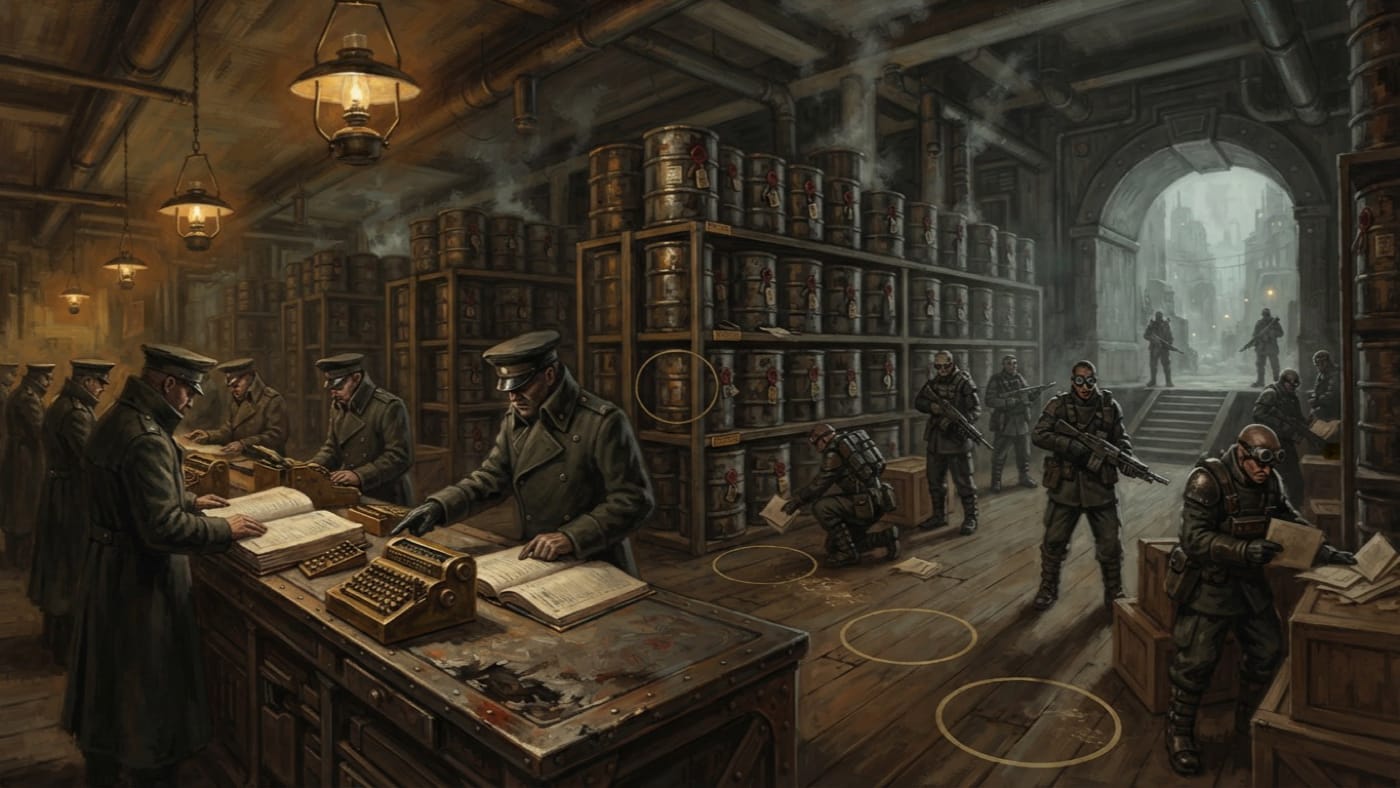
Seven sealed drums of Chrismole vanished from the inventory of the Manifest Court in the spring of A.S. 201. The Court stands in the Rail-Manifest Quarter of Brast, beside the eastern gates through which lawful fuel leaves for the Line, and its inventory is the most closely watched collection of objects in the Warm City. These seven had been sealed, entered and double-witnessed. Then the ledger held them and the floor did not.
No day appears in any account I am authorised to cite. There is no bell of discovery, no hour, and no clerk named as the first to notice the gap. The season and the count survive. The count is the trouble. A missing gallon can be argued down into residue, evaporation, fatigue or a widow's bladder. Seven whole drums cannot be argued down into anything smaller than seven whole drums.
Commander-Auditor Sorn Vale made fourteen arrests. The fourteen produced three confessions. The three confessions produced no drums. As of A.S. 201 nothing has been recovered, and Brast has repeated the arithmetic so often that it now has the cadence of a catechism response.
#On Why a Drum Cannot Simply Leave
Apart from a saint's bones, sanctified fuel is the most thoroughly described matter in the Church, and the bones complain less. A Brast drum has three kinds of identity, and the Court keeps each one through a separate office in case the other two lie.
The first is the body. The published account of the Warmth Thieves lists the characteristics by which a drum may be known: scent trace, pressure memory, fibre inclusion, prayer pattern and serial impression. The scent clerk reads the trace by cracking a bead beneath a treated strip. The serial impression gives the drum its number. I leave pressure memory undefined, because Engineering has never defined it to my satisfaction and Doctrine has defined it too often.
The second is the paper. Each drum travels with a destination docket, a filter-lot reference and a certification from the Calibration Choir. The filter lot traces the drum back through the Distillers' Compact to the feedstock receipts from the Still-Canals. The certificate ties it to a licensed throat. A drum without its papers is contraband. A drum carrying someone else's papers is a hearing.
The third is the permission. Movement inside the Court follows a ritual sequence: hot weighing, cooled weighing, wax depth tested with a warmed needle, seal witnessed, dispatch bell struck. Each stage leaves a mark and a man who made it.
The sources I may cite describe the identifiers the seven carried in the ordinary course of custody. They report no completed examination of the seven themselves. Nobody has produced a surviving seal fragment, a matching residue or a trail. The drums were legible to the last. Legibility did not detain them.
#On the Difficulty of Carrying Seven
A sealed drum is no spoonful of residue to be warmed under a coat. According to the published account of the Warmth Thieves, moving one whole drum requires passage through rail access, the manifest, the weighing, the sealing and the systems the Compact controls, with silence and bribery as the likely grease at each joint. Each of those systems belongs to someone. Each someone keeps a ledger, a grudge, or both.
Multiply by seven and the interests multiply with it. The same account offers two explanations for the scale: a conspiracy wide enough to buy every relevant blindness at once, or a process so lawful that nobody recognised the theft until the paperwork had saluted it. Neither is a finding. The second is the greater insult, because it implies that the Court's own machinery may have carried the drums out in procession, with every bell struck correctly.
Suspicion settled on the Warmth Thieves early, the way soot settles on Brast. They are dispersed heat-diversion networks: siphon crews, warm-chit counterfeiters, seal specialists, rail bribers and runners. They deny involvement. Their denial proves nothing, and neither does their skill at illicit movement, though in Brast skill has always been the shorter road to the rope. One published conjecture holds that they may have supplied pieces of a larger operation, perhaps a route or a seal, without ever lifting a drum. It remains conjecture.
An Ordnance field bulletin named Warmth Thief networks "the probable central actors" in the seven-drum disappearance.
Corrected in the published account of the Warmth Thieves. They are suspected, they deny it, and no source establishes them as central actors. Ordnance prefers culprits who sleep under pipes, because such culprits rarely file appeals.
Vale, Pex Ruln of the Compact and Ilyra Kest of the Choir each hold part of the chain a drum must cross. That makes them jurisdictions. It does not make them a suspect list, and I decline to draw one for men who have not paid for it.
#On the Sweeps and Their Price
Vale's investigation went where investigations in Brast always go, which is downward. His sweeps reached the Boiler Commons and the Slag Market. The Court changed its custody as well. Double-witness checks at the eastern gate became triple. Convoys already certified clean were reweighed at random. Dispatch cages received bell-hour locks. The canteen sweep in the Boiler Commons came at mid-meal and recovered false chits, an under-table press, unregistered heat bladders and a scrap of quiet hymn. It recovered no drums.
The three confessions need a sentence of their own. They record what the investigation obtained. They do not record what became of the fuel. In Brast a confession is a document like any other, signed, witnessed and filed, and it may be about as accurate as a heat allotment table. The fuel it describes has not appeared.
The investigation's second effect reached the market without passing through any court. The published account of the Warmth Thieves records it, and the Slag Market's own entry repeats much of it. Informants multiplied. Knife prices rose. Warm-chit brokers stopped counting in public. Three stall families vanished from Little Amber. Nobody has reported them dead, and nobody has reported them found. Mother Brann, a counterfeit seal-maker, had her thumbs broken by persons unknown and was then arrested by persons official. The record does not say whether either party thought she knew anything about the drums, and no finding says she did.
Criminal partners now refuse any introduction not vouched for by blood, debt or a shared arrest. Runners keep to higher routes. The lower city has become harder to read for the very officers who most needed to read it. That is the usual reward for reading with a boot.
#On the Furnace and the Outstanding Account
One further observation belongs on the record, though nowhere near the evidence table. The article on Saint-Combust reports that the low note from Kiln Three's warped mouth during night ash-scrape has shifted twice since the missing-drums incident. That is the order of events, and that is the count. The report establishes no cause, no communication between furnace and fuel, no hiding place and no complicity. The Furnace Chapterhouse may pray over the interval. The Court may not hang it.
I file it here because it was reported after the loss and someone will ask. Doctrine has not ruled on what the note means. Engineering has not ruled on what the note is. My only ruling is that it belongs in a separate entry.
Lux Thane Mire has been dispatched from Strasbourg with a warrant covering responsive machinery and substrate handling, and his dossier lists the seven missing drums among the matters awaiting him. Brast is waiting for him in turn, with clean receipt caskets and cleaner ledgers. His inquiry has produced nothing I may cite. Until it does, the seven remain an open line in a court that despises open lines.
The Court reweighs, triple-witnesses and locks its cages at the bell. Every drum now leaving by the eastern gate is counted more thoroughly than any drum before it. The seven are carried forward each cycle in red ink under their serials, owed by no one willing to admit the debt.