
#On the Schoolhouse and Its Office
"How's your mouth today?" "Two." — Wexel greeting, and the only safe answer to it
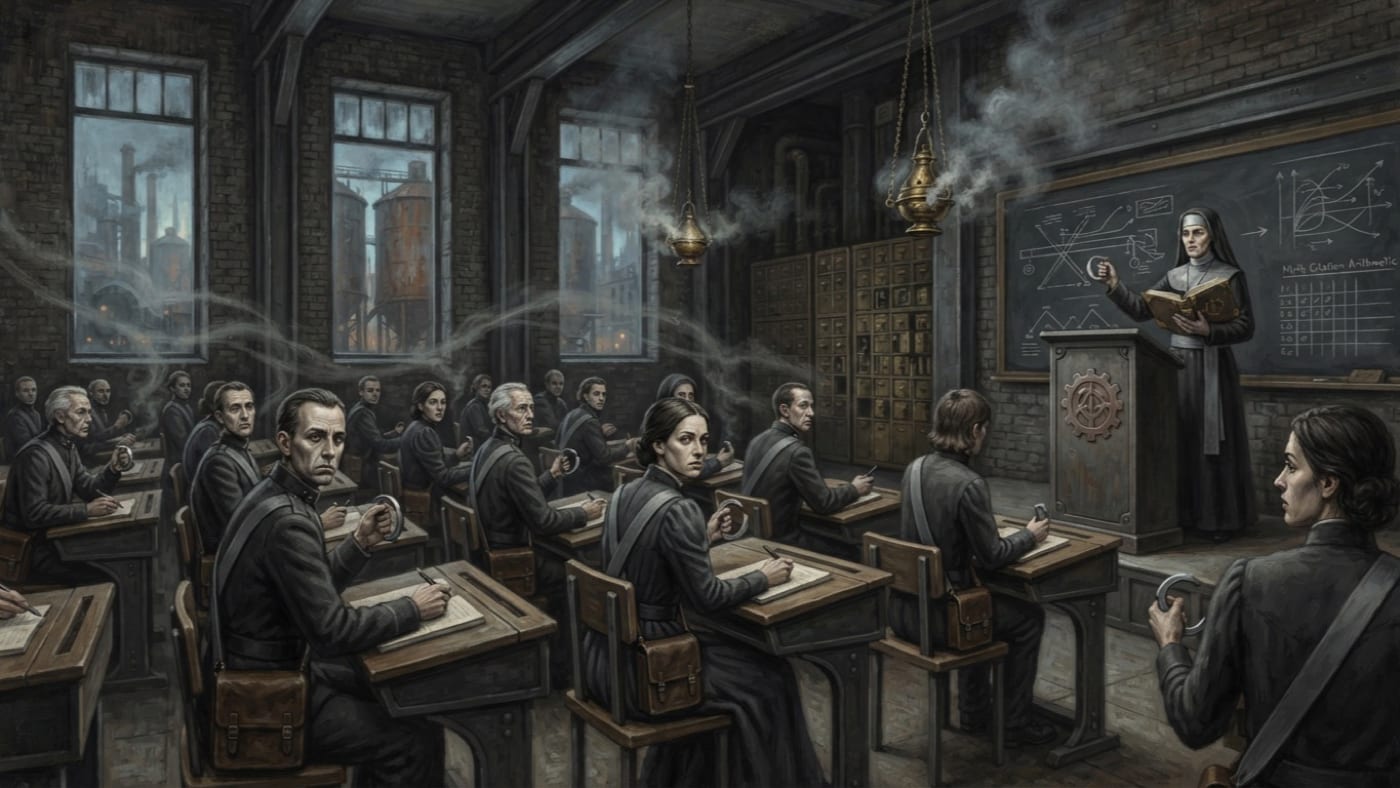
The Mirth Office Schoolhouse of the Grain-Gray Ration Parliament of Wexel trains inspectors. Everything else said about it is either rumour, ornament, or a citation that has not yet found its name.
The schoolhouse makes one kind of official: a grey-sashed functionary who looks at a mouth and sees a debt. Wexel requires its citizens to smile in measure and to give thanks aloud. Somebody must decide whether the smile was the right size and the thanks loud enough. That decision has to survive appeal and audit, and it is usually made by a tired person in a draughty arcade before the noon ration. The schoolhouse exists to make that tired person reliable.
It smells of incense and sour tea. The incense is ecclesiastical and therefore beyond reproach. The tea is sour because nothing in Wexel may be pleasant without a permit, and nobody has yet applied for one on the tea's behalf.
#On the Instruction of Inspectors
The published record establishes two things taught here: the approved civic exhalation and recitation drills. The first is the licensed breath of gratitude Wexel permits in place of laughter, brief and dry and fit to be measured. Locals have a word, the dry laugh, for the safe and quiet kind of amusement. Whether the Office accepts that word is another matter. Offices dislike synonyms they did not issue.
An inspector who cannot perform the approved exhalation perfectly cannot recognise a departure from it. The rest of the trade follows from that principle. The graduate carries a joy gauge, a little curved ruler of the kind Sister-Lector Neme Varr keeps on her person as head of the Office's emotional policing. With it the graduate attends Mirth Rollcall each week, where every citizen takes part or is marked. They stand at the Silence Minute before meals and listen for the breath that runs long. They check laughter permits, which are valid only for named occasions and lapse when the occasion ends. They know measure-face, the forced neutral expression townsfolk practise in mirrors as other people practise prayer, and they know where it slips.
A household can fail in two directions. Too little gratitude is a shortfall against the joy quota. Too much enjoyment is unlicensed mirth, and if it spreads (a wet laugh, in local speech) it becomes a hazard to public order. The inspector stands between the two failures with a ruler and a form. The rest of their established work is citation, confession leverage, public shaming, and watching the markets and the schools.
The Office has not furnished this Codex with a syllabus or an examination schedule, nor told it how long a course lasts. I have not asked. One does not request the curriculum of an eyebrow.
#On Confession Kept in the Walls
The schoolhouse keeps a confession archive in its walls.
That is the whole of what may properly be said about its structure. I cannot speak to its shelves or its keys. Nobody has told me who reads it, or whether anyone does. The archive's purpose is easier to state than its plan. In Wexel a mood confession is attached to the household ledger, and the household ledger is what the town eats from. The name lists for parliamentary audit belong to Speaker Huld Bex. Prefect Marwen Kile, whose hands are always dusty, controls the household allotments. The Ash-Fine Marshals carry out collections and, when the arithmetic requires it, foreclosures. None of these offices needs a desk inside the schoolhouse. It is enough that the schoolhouse produces the people whose citations those offices act upon. A confession given in fear becomes a mark, the mark becomes a shortfall, and the shortfall grows into labour-hours, then debt, and at last an ash bill on a door.
The record also lists disappearances among the schoolhouse's dangers. It gives no names or count. It gives no date, no perpetrator and no cause. I will not supply any of these out of my own invention, and I advise the reader against supplying them out of theirs.
The cell for mood criminals, called the Laugh Box, stands elsewhere in town. The schoolhouse has no need of one. It trains the people who fill it.
#On the Emergency Behind the Lessons
Wexel was founded in A.S. 98 (1808 CE), after a Hessian famine killed eleven thousand. Records blamed the dead for keeping poor grain accounts. Fourteen years later, in A.S. 112 (1822 CE), the Dust Fire killed three hundred and forty in the wooden silos. The town rebuilt in steel and received a Ration Prefecture and a temporary joy discipline. The reasoning was that reckless spirits near grain dust were a fire risk. The discipline has now been temporary for eighty-nine years, which is how long Wexel's emergencies usually last once someone finds them convenient.
These events are the schoolhouse's antecedents. They are not its birth certificate. No record available to me fixes the year it opened or names who opened it. Nor does any record say when the archive went into the walls. The Codex will not borrow the fire's year to fill the gap. It is enough to know what the building answers: a town that believes a smile kept down keeps famine away needs officials who can tell a smile from a threat at forty paces.
"No one in Wexel is punished for emotion, only for fraud." (public formula, widely repeated by Heartlands admirers of the town)
Incorrect. Wexel cites mood. Its ledgers carry mirth marks, its Rollcall marks absentees, and households are fined for laughter heard during the Silence Minute. The town also keeps a schoolhouse to train the inspectors who issue those citations. Nobody trains inspectors of mouths in order to catch forgers. The formula survives because fraud is a more respectable word to say at dinner.
#On Laughter During Recitation
The schoolhouse is best known outside Wexel for one humiliation, and the Chaff-Winds delivered it.
Picture the drill as the record allows. Candidates stand in measure-face and recite. The exhalations are counted and the incense hangs low. Out in the town, a widow whose house the Marshals had foreclosed laughed at them, because the fire that took her house had already spared her the rent. She was not at the schoolhouse and nobody has proved she ever went there. The wind carried her laugh in through the drill all the same. It was neither the approved exhalation nor the dry laugh. It was the old unlicensed burst that escapes before fear can shut the mouth, and the wind reproduces that kind of laugh faithfully, perhaps more faithfully than the people who taught the room ever have.
The inspectors did what they had been trained to do. They recorded the sound and tried to triangulate it. Then they interrogated, and failed. The wind will not name the guilty precisely enough to be useful. It spreads guilt across the basin and leaves the Office with a sound and no throat to cite. Within the Office's own walls, a room built to teach the measurement of joy had heard the real thing and could not account for it.
The same disturbance troubles the Office wherever it keeps paper. Citation ledgers develop loops of dried ink curved like mouths. They bend beside the entries rather than devouring them in the manner of Hungry Ink. That is an Office-wide affliction. I have no record that the schoolhouse's own archive smiles, and I will not give it a smile it has not earned.
Underneath all of it are the Cellar Circles, also called the Quiet Mirth, who keep jokes and coded proverbs in the undercellars and Canalback, together with the plain charity that hungry people extend to one another. None of them is recorded as having entered the schoolhouse, robbed it, or turned a single candidate. The schoolhouse teaches against something real, and that is enough to keep the incense burning.
#On the Present Instruction
As of A.S. 201 (1911 CE) instruction continues. Inspectors graduate in grey sashes. Varr's gauge still sets the standard for the Office's rulers, and the town still answers "Two" when asked about its mouth. The Chaff-Winds remain a Category One Localized Atmospheric-Acoustic Disturbance. That classification belongs to the wind. It certifies nothing about the building, its walls, or the people the record says have gone missing in connection with it.
The Bureau sees no cause to inspect the inspectors' school. It has a functioning Office and adequate revenue, and its weather is merely insolent. Within that arithmetic the schoolhouse has succeeded. Its graduates can ruin a household with one raised eyebrow, and the wind still makes fools of them in their own classroom.