
#On the Regional Seat
The Mediterranean Revenue Office is the Bureau of Tithes at the edge of salt water. The Bureau's central headquarters is the Palatine Counting House in Strasbourg. The great ledgers are reconciled there, and Salome Veyrault has directed the Bureau from there since A.S. 189. Strasbourg sums. Marseille weighs. The Office is a regional seat that answers to the Counting House. It has never been a Bureau in its own right, whatever its clerks claim after the second bottle.
The house is limestone and stands among the harbour premises of a port of some six hundred and fifty thousand souls. Its architecture is identical to the southern headquarters of the Bureau of Pilgrimage. Its armament is superior and its wine cellar inferior, and both Bureaus hold these differences to be theologically significant. I have yet to hear either one explain the theology. The archive does not say who drew the plans, who paid for the stone, or in what year the first assessor took a stool behind the counter.
This entry is surveyed at A.S. 201 / 1911 CE. That year indexes the survey and nothing more. The Office's foundation, construction, opening and dedication are unrecorded. I will not borrow a founding year from the levy it collects, nor from the year Pilgrimage was authorized to raise its own house.
#On the Assessment of Cargo
Cargo arrives in Marseille as a claim. A merchant writes on a manifest that the hold carries so many barrels of Iberian salt, or cured fish, or grain packed against the damp. The Office's work is to turn that claim into a sum the Bureau can collect.
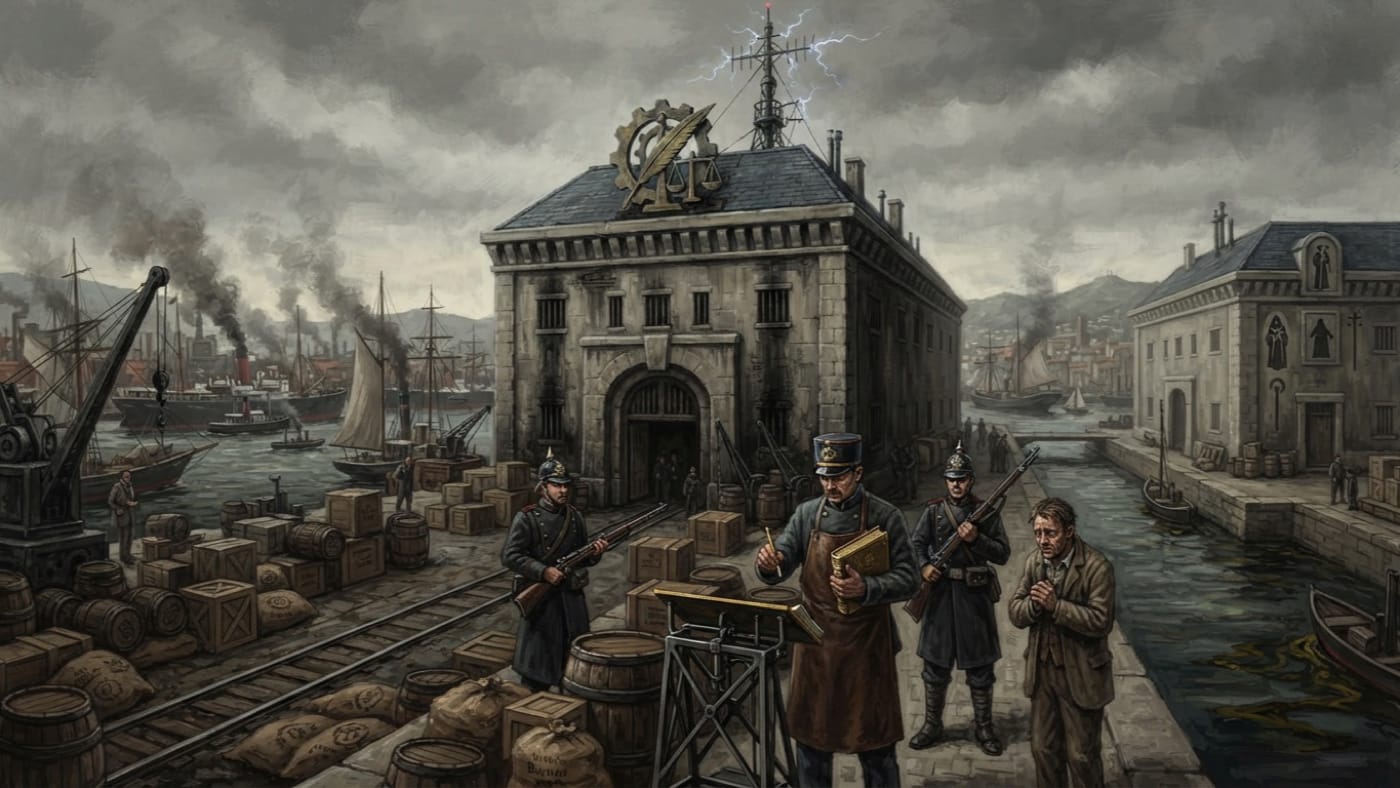
The assessor begins with the manifest and then goes down to the quay with an armed escort, folding scales, measure rods, a gilded ledger, seal cords, receipt blanks and the brine-testing stone. The escort is there for the ledger, because merchants have been known to admire gilding.
The barrels go on the scales and their weight is compared with the declared weight. The measure rod goes into the stack. The stone comes out of its case last. It is a slab of fired clay that changes colour on contact with adulterated salt. Bureau doctrine holds the stone to be infallible, and I have no quarrel with doctrine. I also have no sample of the clay.
Then the charges accumulate, each under its own heading in the same patient hand. First come the Salt Dues and the Harbour Maintenance Tithe. The Pilgrim Infrastructure Levy follows if any passenger aboard holds a Pilgrimage token. The War Surcharge is owed, by the Office's reckoning, on cargo bound within three hundred miles of the Sagittal Line. The Office draws that radius generously for a port that sits so far behind the front. After these come handling and dock sanctification, and finally the Meta-Levy, which charges for the business of charging. The record I hold gives no rate for any of them. The merchant does not need rates to learn that the total exceeds the margin on the voyage.
The merchant waits through all of it with brine-chapped hands folded over the manifest. The quay charges by the day, and the ship's master wants the hold emptied. No buyer on the Canebière will pay for a single barrel without a sealed receipt, because nobody in Marseille wants to inherit another man's arrears. When the receipt finally comes, it is a blank filled in, tied with cord and pressed in ochre wax. It is the only page in the whole transaction the merchant keeps, and the merchant pays for the privilege. Salt grit gets into the wax. No one has ever complained of it in writing.
At evening the receipts are reconciled against the ledger, and the escorts' boots leave white tidemarks on the stair.
#On the Temporary Revenue
The Salt Dues of Marseille were first imposed in A.S. 92 to secure supply for the Iberian campaigns. They were declared temporary at the time and remain temporary today. One hundred and nine years have passed, and every one of them has been collected under the same provisional description.
The Dues yield about 1.4 million Crowns of Grace a year. That figure belongs to the levy. It is not the Office's total revenue, its operating budget or its profit, and a clerk who writes it at the head of an Office balance sheet will have it struck through in red. The record does not state what the Office takes in under all its other headings, or what it costs to keep the escorts armed and the cellar mediocre.
On paper the Dues are older than any record of the Office I hold. The instrument of A.S. 92 tells us when Marseille began to pay. It does not tell us when the limestone house began to receive. The Bureau dislikes that distinction, because it prefers its institutions to have always existed. The fuller history of the levy, including its ancestry and its arithmetic, belongs to the levy's own entry.
The published account of the Dues records objections attributed to Pilgrimage in every year since A.S. 94. Tithes has noted each one, and noting counts as a complete administrative response.
#On the Competing Bureaus
"Bureau of Pilgrimage personnel shall not borrow, lend, or accept as gift any writing implement or fluid from Bureau of Tithes personnel, nor shall Bureau of Tithes personnel extend such courtesies, this prohibition extending to chalk, wax, and the margins of shared documents." — inter-Bureau memorandum, A.S. 167
The harbour is divided by portfolio. Pilgrimage handles the passenger manifests, souls bound for Thessaloniki and the shrine-roads. Tithes assesses cargo. The Bureau of War controls military shipments. The Harbour-Master works in the middle of all three. One hull may carry pilgrims, salt and military freight together, which means it arrives under three jurisdictions and departs under whichever of them files first.
An assessment gives the Office a claim on a cargo's value. The berth, the crane and the order to sail belong to other hands. The Office's correspondence allows collection to continue while the question of whose hands remains open, and in Marseille it has stayed open for as long as anyone has kept files.
Pilgrimage complains that the Dues raise the cost of putting a pilgrim aboard. Tithes answers that revenue is sacred. The memorandum of A.S. 167 is what that exchange looks like once it has dried. The two Bureaus keep separate inkwells, separate wax and separate chalk, and no margin is shared.
In A.S. 199 the Inter-Bureau Arbitration Panel convened over a number. Pilgrimage corrected its count of the fleet's annual departures. Tithes then demanded that harbour dues collected on the return voyages be refunded. Pilgrimage declined to refund, and Tithes declined to accept the declination. The record does not identify which coffer received those dues, what sum is in question, or who would pay it. As of A.S. 201 the ruling is pending.
The pilgrim fleet of Marseille records two hundred and six departures each year.
CORRECTED — Bureau of Pilgrimage revision: "approximately one hundred and forty," the earlier method having counted return voyages as separate departures. Both figures count departures. Neither counts hulls. The difference between them is neither a number of refundable voyages nor a sum of Crowns, and the Revenue Office is asked to stop writing it on slates.
#On the Salt Stores Audit
A separate matter from the same year survives in the papers of the Eastern Basin Salt Stores, and it names the Mediterranean Revenue Office as the assessing office. This is the excerpt, with its omissions as they stand.
AUDIT EXCERPT — EASTERN BASIN SALT STORES, A.S. 199 Assessing office: Mediterranean Revenue Office Discrepancy: █████ barrels Declared cargo: cured fish, devotional grade Actual contents: salt, coin, bone fragments, two sleeping children, one crate emitting violet light Jurisdiction claimed by: Tithes, War, Pilgrimage, Relics, Shadows Jurisdiction exercised by: █████████ Outcome: filed as spoilage
The form did what it was built to do. One line holds the declaration and the next holds the contents, and the whole office exists in the gap between them. The children are entered in the contents column between the bone and the crate, in the same ink and at the same weight. The form has no field for a name because it was drafted for fish.
The record does not say whose children they were, where they were bound or what became of them. It does not say whether the bones were holy or the cause of the violet light. Five Bureaus entered claims, and one of them acted. Whose name stood on that line was struck out, as was the barrel count.
Filed as spoilage is how the account was closed. Spoiled cargo is subtracted from the assessable weight, so the phrase moves a consignment from the column where it owes into the column where it is forgiven. It records a disposition of the account and nothing about the fate of any person.
#On the Present Operation
At A.S. 201 the Office collects. The escorts walk the quay. The stone changes colour or does not, and the Bureau calls it right either way. Receipts are corded, waxed and paid for. The Salt Dues are temporary. The arbitration is pending. Jurisdiction over the harbour is still contested, as it has been in every year that has left paperwork. None of this has interrupted the collection.