
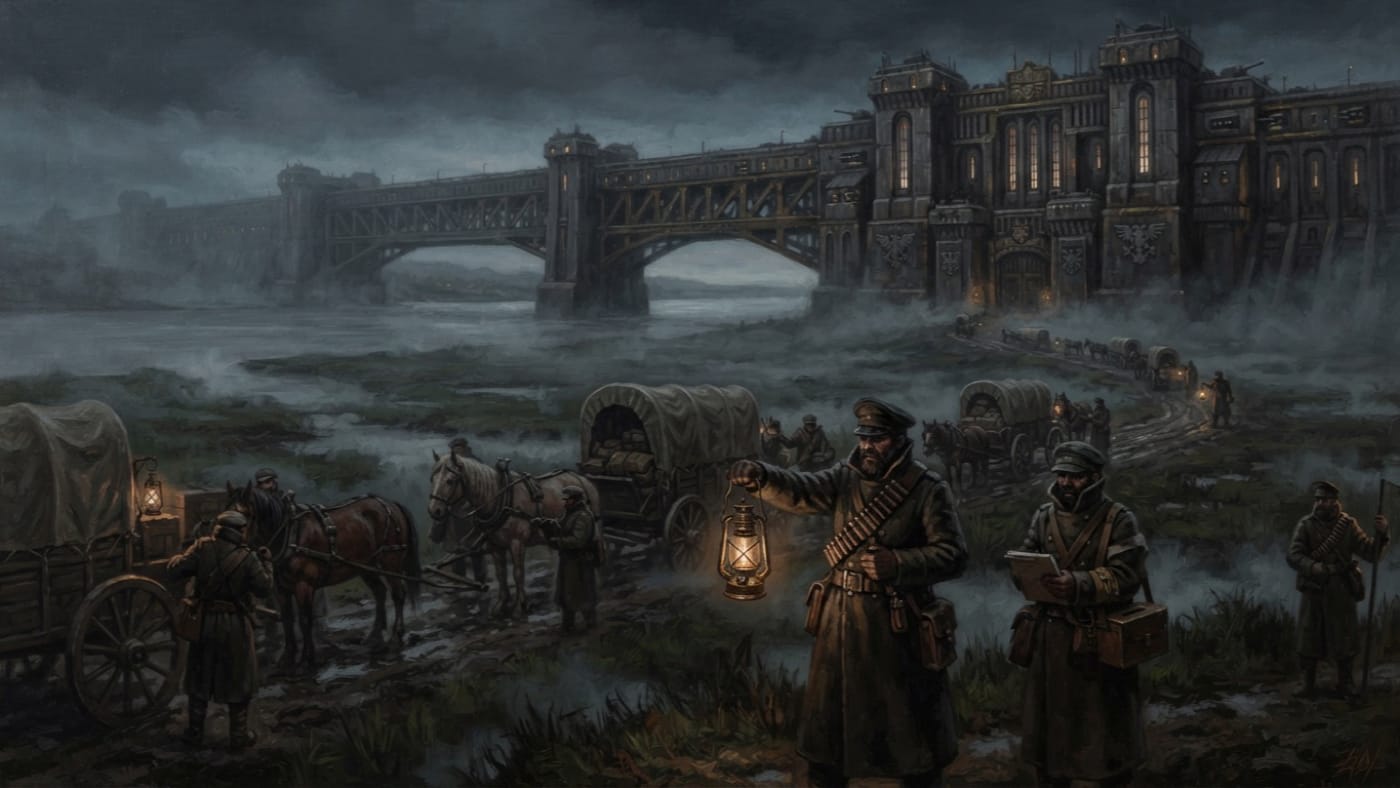
#On Their Station
This survey concerns the Marsh Lanterns as they stand in A.S. 201, working the approaches to Bastion-Brest. It covers the present and nothing earlier. The Ledger has not been shown when they lit their first lamp, who first swore them, how many they muster or what paper they claim to stand under. I will not give a militia a genealogy just because the page looks bare without one.
What can be entered is this. The Marsh Lanterns are a militia. Their ground is the floodplain on the approaches to the Bug River crossing: the outer peat lanes, where convoys bound for the Brass Ribs leave the made road and start trusting turf. They say their purpose is to protect those approaches from bandits. They pursue a second purpose more steadily, which is to take payment from those same travellers before the travellers reach the gate.
In my survey of the Covenant Military I listed the Lanterns among the local bodies the Covenant tolerates because central uniformity would require central money. I also remarked that they tax the outer peat lanes with habits that make the Bureau of Tithes jealous. The remark stands. Tithes has not written to contest it.
#On the Approaches and Their Signals
The Bug is the natural moat of the northern Sagittal Line, and Brest is its lock. The bridge-fortress is thrown across the only stable bedrock pinch for miles. Its brass-ribbed trusses hide gun casemates, and its gatehouses demand papers, receipts and seals from everyone who wants the other bank. Every road that means to cross has to come to that pinch, and between the road and the pinch lies the marsh.
The marsh has no interest in convoys. It stinks of peat. River mist soaks the manifests until the ink lifts, and it lies so thick on the lanes that a wagon-master hears the recoil from the span before seeing its ribs. Under the mist, firm ground and drowning ground look the same. A traveller who leaves the lane without knowing the way can lose a wheel, a horse, a cargo or a life, and the river keeps no receipts.
The Lanterns bring two possessions into this: their knowledge of the marsh routes and their lantern signals. The record lists a guide named Fenn among them as one who knows the routes. It connects Captain Varn with the lantern code. Those two lines are everything this office holds on either of them.
I have no copy of the code. No document submitted to me describes its lamps, stations or meanings, and a sensible surveyor does not draw a cipher he has never read. Its use is plain without one. A light lifted on one hummock is seen from another while a convoy is still feeling its way along the lane, and by then men are already waiting at the narrow place ahead of the wagons. In fog a lamp travels faster than an axle. Whoever holds both the lamp and the dry route also decides when a traveller first finds out they need help.
#On Escort and Collection
Two methods are on record: the toll ambush and the escort fee. The Lanterns may call either one a service. I name both by what they do.
The toll ambush is simple. A convoy rounds a stand of reed on a lane that takes one wagon at a time and finds armed men with lamps in the way. The men explain that the approaches are dangerous and that their protection has a price. The escort fee is the same instrument with better manners. A guide is offered at the edge of the peat, and the convoy accepts because the alternative is the peat. Men who know the dry route lead the wagons along it, and the convoy pays.
Then the convoy reaches the gate, and the Lantern who escorted it asks to be paid again.
An earlier draft of this survey entered the Marsh Lanterns under the heading "Toll Offices, Outer."
Corrected. A toll office keeps its accounts at the gate under the Crossing Bureau's seal. The Lanterns keep theirs in the marsh and have shown this office no seal at all. The heading has been struck, and its clerk has been told that resemblance is not a filing category.
I record the second demand with care. It does not make the Lanterns masters of the gate, and nothing in their file suggests they hold the bridge's books, writs or keys. The formal crossing belongs to others. The Bridge Tribunal holds the confession receipts, the Gun-Cantor Command holds the casemates, and the Crossing Bureau holds the tolls, the stamps and the shell levy. The Lantern's second charge comes at the edge of all that machinery, at the moment a convoy master can see the gatehouse and is working out what still waits inside it.
Convoy masters in that spot are wretched. Behind them lies the marsh they have just paid to cross. Ahead lies an administration that will want its own coin, its own receipt and its own confession. Refusing earns them a trip back across the peat with no escort and a quarrel with armed men who know where the deep water is. So they pay. They were protected from bandits the whole way, and the bill says so.
#On Useful Tolerance
The Lanterns are tolerated by the Commandant when useful. The sentence is short, and it should be read like a contract.
Tolerated does not mean commissioned. No charter, warrant or grant of collection has reached this office, and I enter none. By the Commandant names whose patience they enjoy but not what that patience costs the office that grants it. I know of no share passing upward and will not invent one to balance the page. When useful is the clause everything else depends on, and it is a condition by design. A tolerance with a condition can be withdrawn by the same hand on the same afternoon.
It is easy to see how they might be useful at a contested crossing. Armed men on the approaches are armed men who are not at the gate. Lamps in the marsh see things before the bridge does. A militia that claims to drive off bandits is one the Commandant does not have to raise, feed or pay. Those reasons explain the tolerance. They do not make it law.
The Covenant knows this posture from long practice. As I wrote of local bodies in general, it absorbs them when they are useful and disowns them when it must. A militia that puts down a riot becomes auxiliary personnel. The same militia caught extorting pilgrims becomes an irregular formation whose documents hostile readers have misunderstood. I give the principle only as context. No record before me shows the Lanterns formally taken in or formally cast out. For now they live between the two stamps, which is where the Church keeps most of its useful men.
I have already entered all I hold on their people. Varn carries the title of captain and is connected with the lantern code. Fenn guides. The file gives neither of them any further rank, history or face, and a militia's officers do not become more real for being described.
#On the Present Survey
What wakes the Lanterns is a convoy backlog. When the gate slows, whether for audit, for shortage or for any of the reasons a bridge-fortress has for making men wait, the queue does not disappear. It backs up onto the approaches. Wagons that should have passed through the peat stand in it instead, and every hour a convoy stands in sight of the lamps is another hour in which protection can be offered and priced.
The same sums come out the same way every time. Delay puts travellers on the Lanterns' ground. That ground holds the dry routes, and the dry routes are for sale. When the gate finally opens it has its own price, and sometimes a Lantern arrives with a second bill.
Their formal status is as uncertain at the end of this survey as it was at the start. Their founding is not on record, and neither are their numbers. They have no warrant. Their lamps are lit, and the Commandant has not put them out.