
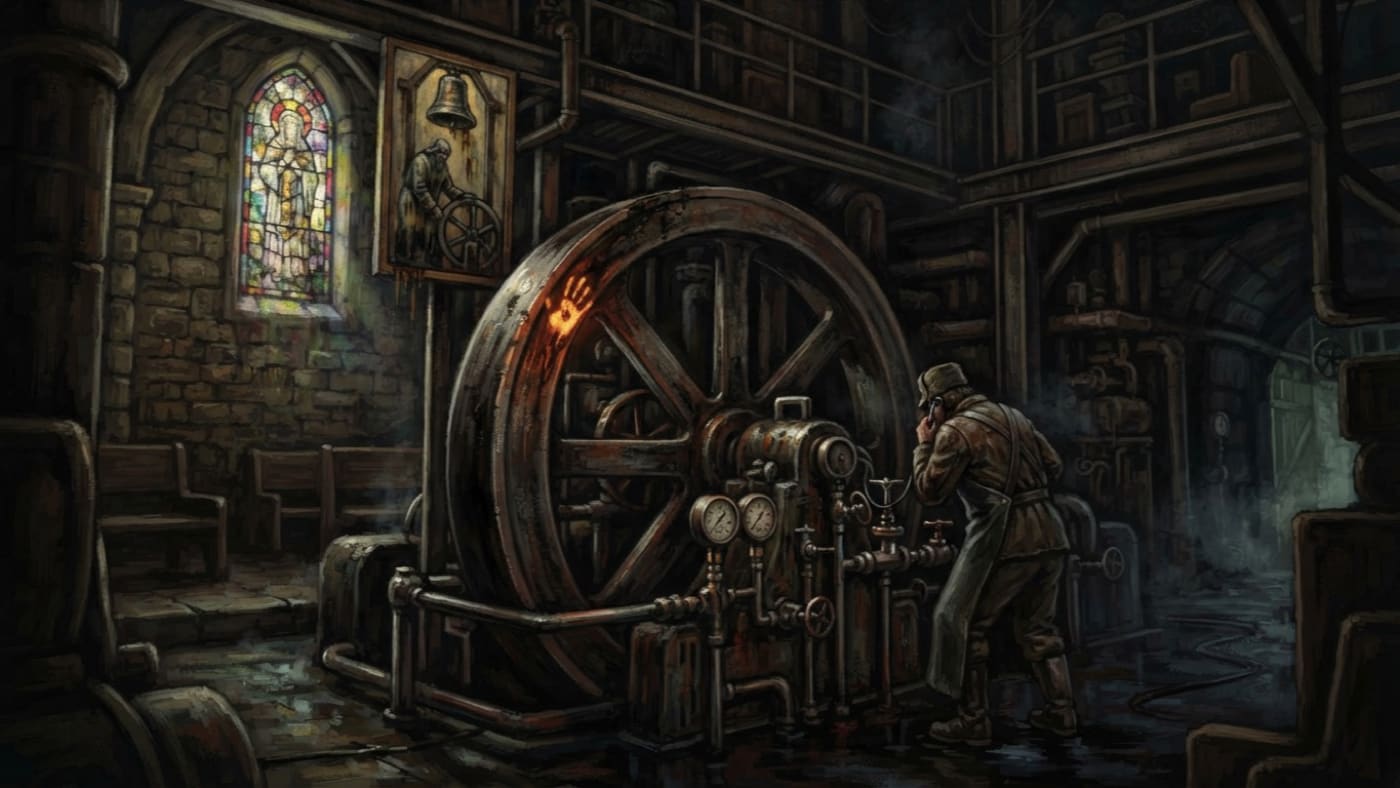
#On the Chapel and What Lies Beneath It
Manifold Chapel C stands in District Seven of Bastion-Przemyśl, the Wire Orchard, which holds the western Carpathian passes for Zone 4 of the Sagittal Line (Unregistered). Beneath it lies the auxiliary restoration wheel of the district's thumper manifold. Beside it hangs an icon that two Bureaus would rather had been hung somewhere else.
That is the whole of the survey, and I set it down without apology. The Codex holds no plan of the chapel's floor, no measure of its nave, no count of its benches or its congregation, and no record of the day a cleric first blessed its threshold. A clerk who wants a founding date may go and dig for one. I will not cut a dedication out of the general age of the bastion and paste it here as though the wax were original.
The letter tells us just as little. C is the chapel's designation, and the archive does not explain it. It does not prove a Chapel A or a Chapel B. It does not make this the third foundation of anything, and it abbreviates nothing that anyone has been able to document.
#On the Pulse It Keeps
A bastion's walls are made of stone, and its obedience is held up by pressure. Under District Seven run the diesel vibration lines that the Resonance Line Technicians keep fed. These are pressurised arteries of fuel and fluid that drive the thumper manifold. The manifold's low hammer-pulse holds the ward-plates in harmonic and keeps the alarm ribs honest. It gives the gate listeners a steady note to listen against, and it carries devotional communication to the chapel-mouth relays. When that pulse is steady nobody notices it. The Plumbers count this their highest commendation. They are rarely given another.
Their work is a liturgy with a wrench in it. They listen for drift and isolate the failing section without killing the district. They bleed the air the trade calls doubt and seal the line with hymn-gasket, clamp and wax. Then they tune the manifold back into its safe band, test the bell echo against the ward response, and lie on the compliance sheet. The equipment is ordinary issue: pressure gauges, valve keys, line clamps, spark-safe lanterns, and the stethoscope-horn pressed to iron as a physician presses an ear to a consumptive chest.
Such work is done among hot metal and wet stone. Everything is slick with diesel film, sweet with wax and black with soot. The pulse comes up through the boots before it reaches the ears, and any Plumber past forty has already spent half his hearing on it. In such a bastion a chapel set over a restoration wheel is no curiosity. The Church has always raised its sanctuaries on whatever keeps them standing, and it has generally had the decency to lay a floor between the hymn and the hydraulics.
#On the Word "Inoperable"
From A.S. 168, three years before anyone had reason to care, the auxiliary wheel beneath Chapel C was marked inoperable. That date is secure. The designation was entered, filed and never revisited, which is how a maintenance designation normally lives and dies.
By the emergency of A.S. 171 the wheel's surroundings had joined it in disgrace. The access corridor was listed as sealed. The chapel key was missing. Pressure in the line exceeded the wheel's rating by nine measures. The record does not say when each of these conditions began, and I decline to backdate them to 168 for the sake of a tidy paragraph. Some defects are entered on a single day. Others accrue, like interest, like guilt, like the dust on a requisition nobody intends to read.
The record does include the Bureau of Engineering's account of what happened at that wheel. It is a document of remarkable serenity.
Bureau of Engineering abstract: District Seven's ward-plates were restored by "standard auxiliary wheel operation performed within emergency tolerance."
Corrected. The wheel had been designated inoperable since A.S. 168. When it was used, its access corridor was listed as sealed, the chapel key was missing, and line pressure stood nine measures above the wheel's rating. No tolerance in Engineering's published schedules covers any of these conditions. Engineering has not produced the unpublished schedule that would.
#On the Restoration of A.S. 171
The Thumper Blackout of A.S. 171 has its own entry, and I will not reprint it here. A brief account will serve the reader who arrived by the wrong stair. During the second half of Matins load, District Seven's manifold cascaded. Ward-plates across six underlevels fell mute, and alarm ribs, gate listeners and chapel-mouth relays went with them. Three of twelve rostered technicians had reported for duty. No qualified Harmonic Listener had been posted for seventeen days. The manifold had been knocking in metre for a week. The warnings had been filed and the gaskets requisitioned, but the lawful stock had gone to Bastion-Shipka after the Unhymn Infiltration. Senior technician Edric Sann fitted counterfeit stock. It held for six hours.
Four hundred died across the district before containment. They did not all die at this chapel, and the enemy did not kill them all. Ward-doors that sealed late and sealed wrong took their share, and so did a relief company that fired on its own. The Bureau of War classes the entire four hundred as enemy casualties, which settles the arithmetic and nothing else.
Containment took several kinds of labour. A manual bell relay was run from Upper Works and the manifold was retuned live under hostile contact. A rifle cordon held, the chapel-mouths were purged and the wards were rekindled. The wheel under Chapel C was one stage in that sequence, and its operator did not contain the district alone. How long containment lasted is classified, and I leave it classified.
The official records leave the operator unnamed. Plumber testimony names Sann. According to that testimony, he crossed two sealed corridors, a flooded sump and a service throat hot enough to blister breath, and reached the wheel by the ninth hour. He turned it against pressure. The metal took his glove and the skin beneath it. He kept turning.
The depositions do not explain how a man passes through a corridor listed as sealed, and they do not say whether the missing key was ever found. I record the route as it was given. Embroidering it is work for hagiographers, and they are paid by the miracle.
The plates came back in order: Underlevel Six, then Underlevel Four, then the chapel line, then the gate echo. Within three minutes of the plates' return, the hostile bodies inside the district lost coherence. Those three minutes measure only that interval. They are not the length of the emergency.
#On the Icon, the Patron and the Hand
Three accounts contend for this chapel, and none has been allowed to prevail.
The first concerns the icon beside Chapel C. After the Blackout, the icon was found, by report, with diesel burned black across its painted wheel and its wax melted uphill. It is the trade's familiar type: a figure turning a wheel beneath the shadow of a bell. No Bureau has authenticated the condition of the icon. No Bureau has explained it either. Wax that runs toward the vault of a ceiling has embarrassed better theologians than the ones assigned to District Seven.
The second is Saint Vellum of the Valve, whom Przemyśl binds to the restoration. Vellum is the trade's patron. He is honoured in sump chambers and chapel subfloors, but I have not found his name on any roll of canonisation shown to me. In the bastion's telling, his local legend begins at this wheel. That telling does not make Sann into Vellum, and it gives no proof that the saint turned the wheel through a technician's hand. Nor does it prove that Sann died there. I have no evidence that Sann believed in the saint at all. The Plumbers who tell the story have never asked for such evidence.
The third is the mark itself. The account sealed in A.S. 201 records a handprint on the wheel. The Bureau of Engineering calls it heat distortion. The Bureau of Purity calls it unauthorised devotional marking. Both descriptions stand in the file side by side, and neither has been withdrawn.
#On the Site as Last Recorded
By the account sealed with the event's entry in A.S. 201, District Seven functions. The plates ring, the gates answer, and the chapel line carries what it is told to carry.
Apprentices are brought down to the manifold scar and told to listen. In cold weather the pipe knocks twice. Nobody answers the third knock. This practice belongs to the trade and to the wider manifold. It has no feast-day and no sacristan, and the Codex records no public road down to it. Anyone who describes it as a pilgrimage has never been asked to show a line-access sigil at the stair.
After the four hundred, the Resonance Line Technicians were reclassified as "auxiliary personnel, conditionally essential." The Plumbers petitioned to strike conditionally. The petition failed.
The chapel has no surveyed floor and no founding date. The letter in its name has no explanation, the saint at its side has no canonisation, and the wheel beneath it carries one handprint filed under two offences.