
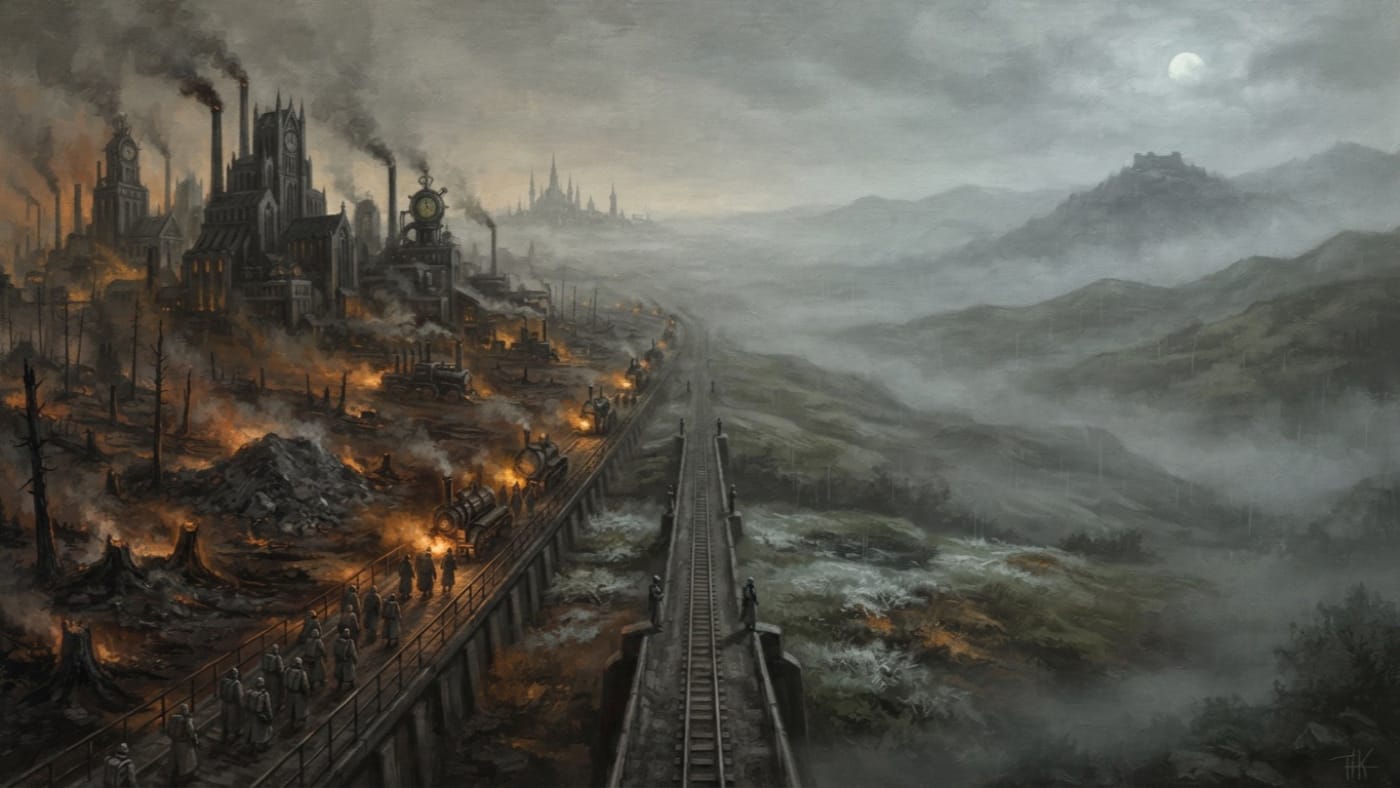
#On the Present Contest
What follows is a survey, taken in A.S. 201, of the hatred between Maldrake the Wrathforged and Syrion the Languid Dreamer, and of what the Synod currently makes of it. It is no chronicle. The Ledger records no first blow, no opening campaign, and no morning on which fire first looked across a valley and found the fog insolent. Readers who want a beginning may apply to the Great Deceiver, who keeps no public registry.
The contest matters for a plain reason. Maldrake presses out of Thrace toward Constantinople. Syrion holds the Bulgarian highlands and the Balkan Mountains against Shipka. Between them lies the southern hinge of the Sagittal Line, and every season the two spend on each other is a season neither spends on the hinge.
The Codex holds two entries on this matter, and I wrote both. The first records that the feud has devastated entire sectors of the front. The second records a strip of Balkan foothill where the two dominions keep a stable hostile interface, a condition the Bureau of Inter-Infernal Analysis calls mutual accommodation. Both entries stand. The Ledger does not say which sectors burned or when, nor whether the quiet strip is an exception to the burning or a sequel to it. I decline to forge the hinge between them for the comfort of tidy readers.
#On What Each Enemy Undoes
The Bureau of Doctrine calls the hatred "ontologically inevitable." Wrath cannot abide stillness, and Sloth cannot abide interruption. That is Doctrine's reading, sealed in Doctrine's wax, and it may be correct. I enter it as a reading. The infernal heart does not send its motives to Strasbourg for countersignature.
The operational record is plainer. Syrion conquers slowly. His fog takes a field's width in a season and a ridge in a decade. A province he takes is lost to exhaustion: sentries sit down, villages stop answering letters, and garrisons file the morning report and then file nothing at all. It is patient work. Inter-Infernal Analysis records that Maldrake has burned territories Syrion spent decades lulling into surrender. Decades of drowse were ended by an afternoon of slag, the stillness struck flat the way a smith strikes iron that has begun to cool.
The injury runs the other way with less noise. Maldrake commands a true army of forge-warriors, corrupted men, the Hellbow Legion and walking furnaces, and an army must be kept moving. The lore records that his forces, left undirected, would turn on one another, on the landscape and on stillness itself. Under his direction they are relentless and tactically intelligent. Neither condition keeps well in fog. The Contact Zone ledgers record Ember-Soldiers who entered the grey and came back seated, their fires banked down to a red pulse beneath the skin. The Bureau measures Maldrake's advance in miles per campaign season, and such a creature fares poorly in a country where nobody can reliably measure a season.
The Ledger lists ruin on both sides of the account and strikes no balance.
#On the Uses Made of Hatred
"Two Sin-Generals fighting each other are two Sin-Generals not fighting us." — the Bureau of War's reasoning, as entered in this Codex
The Bureau of War has quietly encouraged the feud. Say so in the nave if you like, since the choir already knows. The instrument is Inter-Infernal Analysis: fourteen analysts in three rooms of War's Strasbourg headquarters, drawn from Shadows, Records and Doctrine, and charged to observe, catalogue and, where it is operationally advantageous, exploit the antagonisms among the Seven. The section began under the Synod's military command in A.S. 94 and passed into War's directorate at War's charter in A.S. 105. Neither year dates this feud, and neither dates the first time anyone thought to feed it.
The methods are classified. What the Codex may print is thin but sufficient. Bells are timed. Reconnaissance is delayed. Rumours are allowed to reach one hostile camp before the other. A forge column turned toward fog cannot hammer Constantinople, and a sleep-bank harried by heat cannot roll over Shipka. No confirmed record shows the Bureau speaking to anything beyond the Line. It arranges the weather of information and leaves two furies to read the sky.
War calls this "operational realism." Doctrine calls it "dangerous proximity to sin-adjacent reasoning." The Bureau of Purity once asked whether sustained contemplation of demonic factional dynamics amounted to theological contamination, and it concluded "insufficient evidence," which the analysts took as a compliment. War and Doctrine have each entered the view that the policy works. That agreement is a stated position rather than an audit. Nobody has counted the sectors spared against the sectors burned, and I would distrust any clerk who claimed to have done so.
#On the Accommodation in the Foothills
The Contact Zone has its own entry, with its surveys, its observation posts and its three ledgers, and I send the reader there rather than drag them twice across the same burnt reeds. It concerns this survey for one reason: it is the evidence that complicates the simplest account of the feud.
In the Balkan foothills, between the Shipka approaches and the Thracian pressure on Constantinople, Maldrake's heat-shimmer meets Syrion's time-fog. Rain falls upward and burns. The air swings from frost to forge-heat between watches, and seasons last hours. The Bureau of Engineering recommends against being present. All of this is weather. The scandal lies in conduct. Neither host crosses in force. Probes go out and fail, Grey Heralds drift too near the heat and kindle while still urging rest, and after each incident the line mends itself.
Inter-Infernal Analysis calls this mutual accommodation. Its director, Assessor-Tertiary Yrsa Haugen, wrote on the A.S. 201 quarterly circular: "Mutual accommodation is not peace. It is violence with manners." I know of no better gloss and have not attempted one.
The evidence has limits. The Contact Zone is a strip and not the whole quarrel. Its stability is local, and its classification belongs to it alone. The sector devastation recorded under Syrion's entry has not been withdrawn. Nothing in the foothill ledgers proves that the burning has stopped elsewhere, and nothing proves that it continues. A man may keep a civil pew beside his enemy at the Dawn Office and still fire his barn on Tuesday. The sources do not say whether the Sin-Generals keep such Sundays.
#On the Assumption Still in Service
The Bureau's founding assumption is that the Seven hate one another more than they hate us. Its circulars test that assumption every quarter, and over six years the wording has moved.
A.S. 195 position: "No significant deviations from the baseline assumption of inter-Sin-General hostility."
A.S. 201 position: "The baseline assumption remains operationally valid while acknowledging localised variations of uncertain significance." The foothills supply the localised variation. Everything else supplies the uncertain significance.
Then there is the memorandum. In the margin of Dossier Vermillion, folio 1,442, someone wrote: They are not feuding. They are rehearsing. The hand matches no current or former analyst, and the note bears no date. Haugen asked for a fourteenth lock on the cabinet and was refused on budgetary grounds.
At dinners I should not attend, I am asked what it means. It means that somebody wrote it, in a hand the Bureau cannot place, in the margin of a dossier kept on a different Sin-General entirely. A hidden alliance would fit the sentence. So would a forger's joke, a visitor's bad night, or a truth that no folio yet supports. The Bureau has filed all four readings in the same drawer, which is what drawers are for. Whether anything above the Seven has laid a ruler across that map is a question the Bureau has filed and has not answered. I have no answer to add, and I will not invent one for the sake of a stronger paragraph.
The present position, then, as it stands this year. War feeds the feud. Inter-Infernal Analysis reviews it every quarter and distrusts its quiet patch. Shipka keeps its wake-bells against fog-backwash, and Constantinople watches the Thracian glow with grim gratitude whenever some of Maldrake's fury finds another insult to answer. Syrion waits, as he always does. The Line spends the interval it is given and does not ask who gave it.