
#On the Review and Its Date
The Codex knows the Lyon Road incident by its correction. That is the proper way for a Warden matter to be known. Blood dries. Banners are restitched or burned. Mules are dealt with by whoever owns the mule. The manual endures, and the manual was amended.
The amendment came out of a review in A.S. 188, which is 1898 in the common reckoning. This dossier carries that year because the review carries it. The incident under review has no year in the record of the Peregrine Wardens, and I will not give it one. A date is a seal, and one does not press a seal on air.
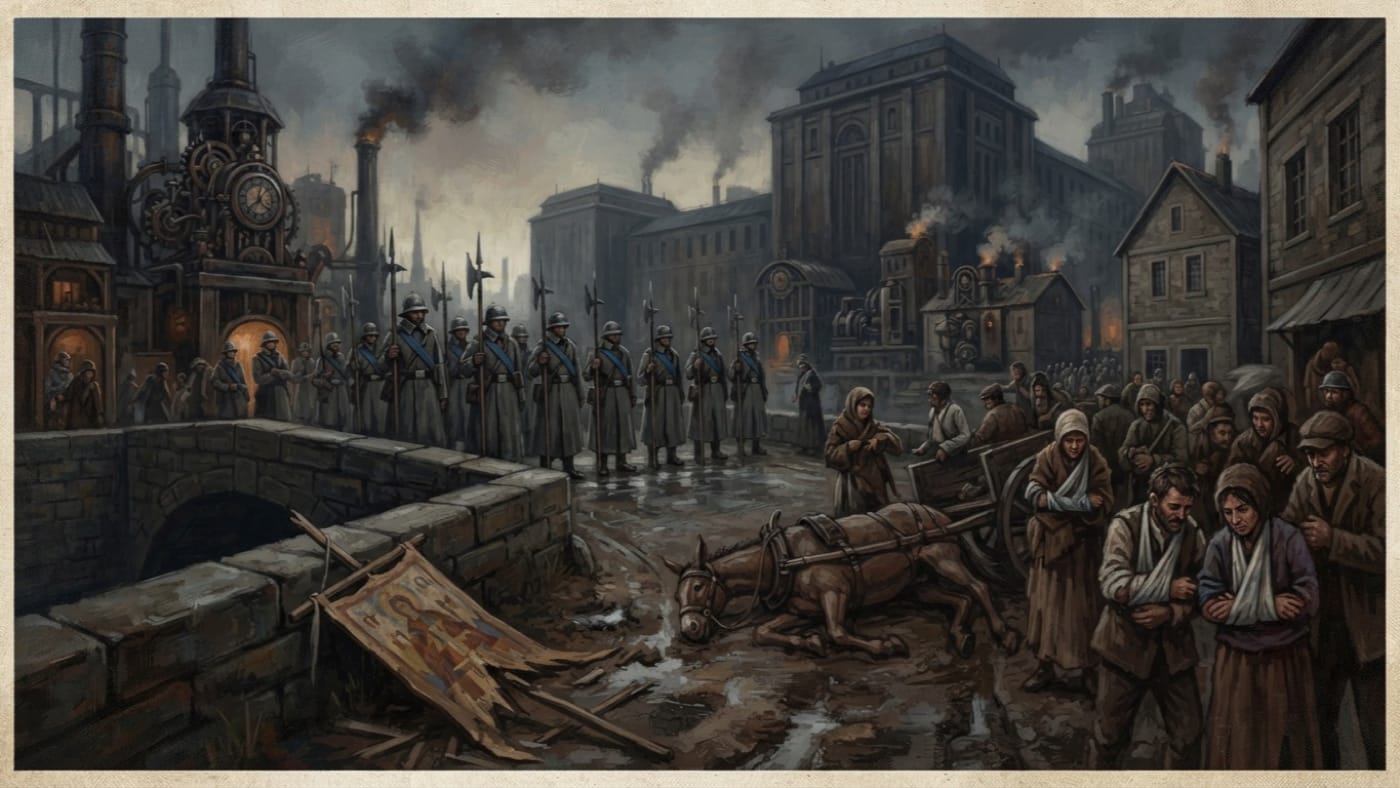
What survives is the Wardens' own account, entered as an erratum to their discipline. The older manuals spoke of "pastoral firmness." The review found that pastoral firmness had broken seven arms, one shrine banner and a mule, and the manuals now say "licensed compulsion." The mule's owner was fined. The mule was not compensated. The account names no officer and no owner. It gives no milestone, no hour and no cause. A reader who wants those things may go and question the Lyon Road in person. It has kept its counsel this long.
#On the Authority of the Road
The Wardens are the armed road-arm of the Bureau of Pilgrimage. They were founded under the Harmonized Routes Edict of A.S. 123, and ever since they have been charged with escort, inspection, licence enforcement, the dissolution of guilds and the pacification of routes. They wear road-grey wool and a pilgrim-blue sash. Each patrol carries a route folio and three classes of seal: warning, suspension and voidance. Their faction entry, which I submitted and which is correct, records that a Warden protects a route before he protects a body. The route is holier and dearer than anyone walking on it, and far more taxable.
That is the general power, and it is broad. A Warden may halt a column, inspect a token and void a licence. By touching wax to parchment he can turn a merchant into a loiterer with cargo. He also keeps bandits off the road, which irritates the romantic critic. Convoys under Warden escort reach their waystations alive more often than convoys that trust to cousins and devotion. The Bureau does not apologise for this efficiency, and neither do I.
None of this tells us what happened at Lyon Road. The record does not say whether a seal was pressed or a polearm lifted. It does not say how many Wardens walked that file, or why they were walking it. I could fill every gap from the road-school syllabus, and a lesser archivist would. The Bureau of Doctrine does not fill gaps. It certifies, and here it certifies only what the Wardens themselves wrote into their manual afterwards.
#On What Was Broken
Seven arms. One shrine banner. One mule.
The arms are arms. The record does not say they belonged to seven people, and I will not do the sum for it. Most of the faithful come with arms in pairs, and an honest clerk counts limbs as limbs. The record also does not say whose arms they were, whether pilgrims', townsfolk's or merely the bystanders'. They were broken. The review accepted that much and was content.
The shrine banner sits in the same column of the ledger as the arms, and I commend the clerk who put it there. A banner carried toward a shrine is devotional property. Someone blessed it or paid for it, usually both, and someone walked a long way holding it up. The record names neither its saint nor its bearer. It does not say how it came to be broken. The verb is the review's, and I keep it.
The mule comes last, as mules generally do, and it is listed as broken, which is all a ledger ever needs to say about a mule. The record does not say whether it walked again, was sold or went to the knacker. I am content to share its silence.
Read the line in order and it falls into a liturgy of three: the body, the sacred object, the beast of burden. Anyone who wants to know what pastoral firmness looked like on a pilgrim road need only read it aloud. The review read it and changed a word.
#On the Corrected Manual
Older manuals described Warden discipline as "pastoral firmness."
Corrected after the A.S. 188 review of the Lyon Road incident, in which pastoral firmness broke seven arms, one shrine banner, and a mule. Current manuals use "licensed compulsion."
"Pastoral firmness" was a shepherd's phrase. It called up the crook and the staff and the patient nudge that steers a lamb toward pasture. It promised that whatever the Warden did, he did for the pilgrim's good, and gently enough to be called care. Seven arms is a great deal of care.
"Licensed compulsion" promises less and holds more. Compulsion admits the force. Licensed puts that force under seal and charter, inside the Bureau's lawful reach. The new phrase does not apologise. It files. Of the two terms it is the more accurate, and the Wardens adopted it into their own manuals. In my experience, that is how one recognises a correct choice.
The scope of the correction must be stated exactly. The review changed a phrase. The record does not say it changed a doctrine of force, a drill or a scale of blows. It does not say anyone was disciplined, acquitted, thanked or transferred. It changed the name the manuals give to the thing the Wardens do. Anyone who thinks that a small result has never been on the wrong end of a definition.
#On Compensation and Obstruction
The mule received no compensation. Its owner was fined for obstructing a holy route.
Those two sentences are the only administrative consequence the record keeps. Together they are the purest specimen of Bureau reasoning I have ever had the pleasure of setting down in a Codex. Ordinary jurisprudence asks who harmed whom. Pilgrimage law asks who was in the road.
A licensed route is a consecrated thing. The traffic on it is counted and taxed, and its continuity is the whole reason the Wardens exist. Whatever stands on it without leave stands against it. The record does not say whether it was the owner, the mule or the two together that occupied the ground the route required. The fine fell on the owner all the same. The mule could not be fined, so the obstruction was charged to the person responsible for it. The mule's breaking was charged to nobody.
The record gives no amount for the fine. It names no hearing, no magistrate and no appeal, and I supply none. It says nothing in this column about the seven arms or the banner. I note that silence and leave it unfilled. A clerk who invents a payment is as guilty as a clerk who steals one, and the Bureau of Tithes would hang them from the same beam.
Some readers will call the arrangement cruel. They have misunderstood what a route is for. A broken mule is a loss to one household. An obstructed route is an offence against every pilgrim behind it, against the Bureau that licensed it, and against the Creator to whose shrines it leads. The Bureau prices these accordingly.