
#On the Proposal
"The Bureau of War does not wish to discover what happens when a choir sings to the starving dead, and respectfully suggests that the Bureau of Doctrine volunteer its own personnel for the experiment." — Bureau of War, response to the third proposal, filed A.S. 199
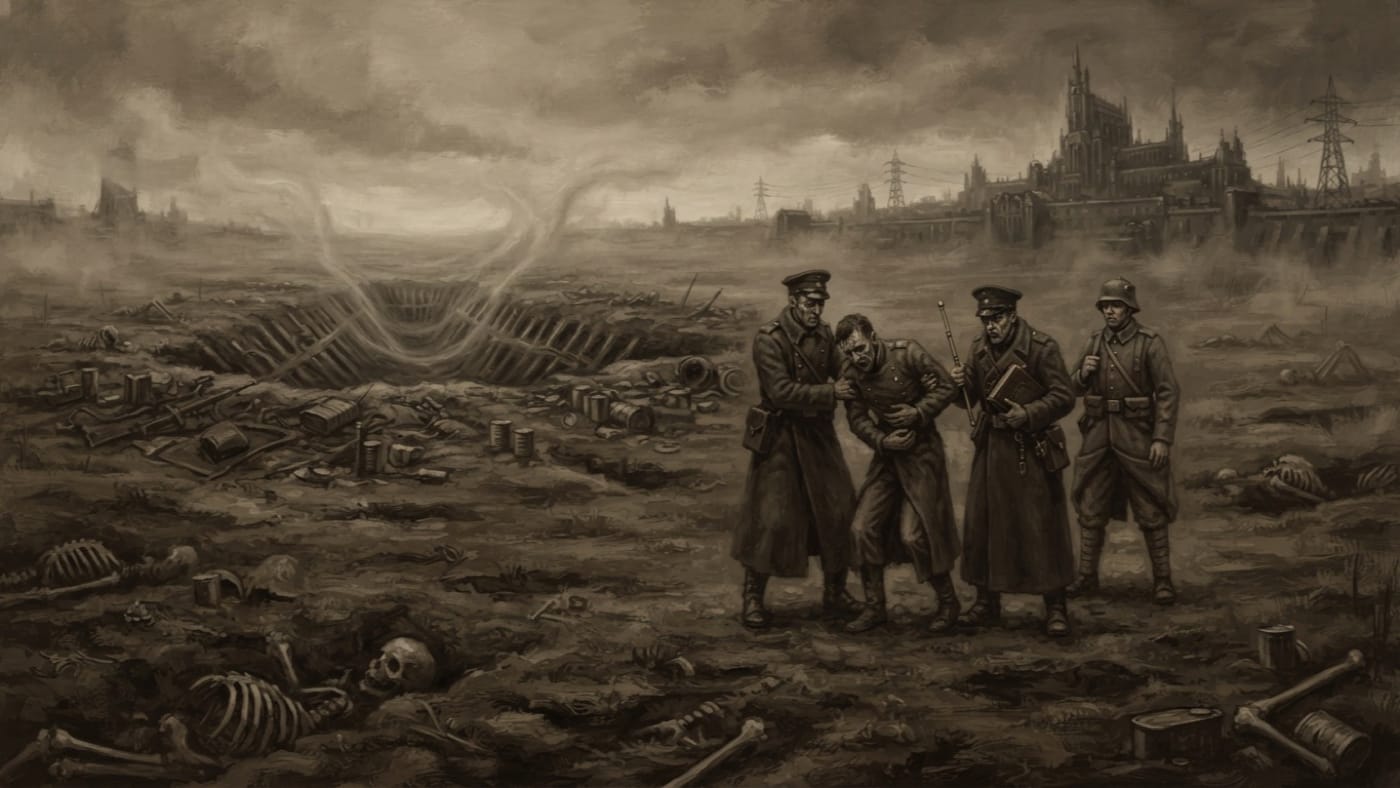
The Liturgy of Satiation is a rite intended for the emanation fields of the Famine Pits. These are the burial grounds of the former Hungarian plain, inside the Blightmarsh. Their dead have kept their hunger, and they lend it, unasked, to anyone who comes near. The Bureau of Doctrine has proposed that such a liturgy be composed and tested three times since A.S. 180 / 1890 CE. The Bureau of Rites endorsed the proposal. The Bureau of Orison and Song drafted the liturgy. The draft was submitted for field testing.
It has never been sung at a Pit.
Left alone, the title would do the Bureau's work for it. A liturgy named for satiation has fed no one. The name records an intention, in the way a requisition for boots records a hope of boots. Composing a response to the dead is one thing and demonstrating one is another, and the distance between them is an exclusion zone that nobody in the Synod has yet been ordered to cross.
#On the Hunger to Be Addressed
The liturgy is meant to answer a field of want. Near a Pit the abdomen tightens. Closer, it cramps. Closer still, a man who ate an hour ago begins to starve in earnest, and his body burns its own reserves as though he had gone without food for days. The Bureau of Medicine calls the advanced stage a pseudo-starvation cascade. The prefix describes the cause. The starvation is real.
The history of this knowledge is short and does the Synod no credit. In A.S. 120 / 1830 CE a patrol from Bastion-Constantinople's eastern garrison, under Lieutenant Voss, approached a burial south-east of Pécs. It reported the effect, and the report was shelved. In A.S. 134 / 1844 CE the Bureau of Medicine matched a cluster of unexplained gastric failures to the old burial lists and confirmed the phenomenon. The Bureau of War has since confirmed fourteen sites, the latest in A.S. 197 / 1907 CE.
Medicine's confirmation included a controlled exposure at Pit Seven, south of Mohács. I name it here so that no reader mistakes it for the subject of this entry. That exposure was carried out for measurement, on subjects whose identities Doctrine has classified. It had nothing to do with the Liturgy of Satiation, which appears in no file I have seen until decades later. It matters only as precedent. The Synod has already learned what close approach costs, and it learned the lesson on bodies it did not ask.
#On the Offices Responsible
The division of labour is exact. In a Synod of overlapping seals, exactness is rare enough to deserve study.
Doctrine defines orthodoxy and drafts the Synod's proclamations. It classifies the Pits as a passive residual sin-manifestation, with Kargath named as agent. In Doctrine's arithmetic a demonic manifestation is something holy things oppose, and a liturgy follows from that classification as a sermon follows its text. Doctrine's part is to propose. Proposing requires a desk.
Rites standardizes liturgies, fasts and penances, and audits how they are performed. Its endorsement certifies that a rite of this kind would be proper, and Rites can rule on propriety without leaving Strasbourg. Rites has contested jurisdiction over the Pits since A.S. 134, when Medicine recommended that the matter be transferred to it and the recommendation was denied. I read the endorsement as one more claim lodged against that denial. The file states no motive. The reading is mine.
Orison and Song licenses hymnals and choirs, and it turns sound into a weapon on the front. Of the four Bureaus, it is the only one whose ordinary work involves sending voices into hostile ground and recording what comes back. It drafted the liturgy. The file names no composer and preserves no text. It gives no mode, pitch, length, choir strength or instrumentation, and I will supply none. These particulars are absent from the file. That does not make them secret, and I will not dress them up as secret.
The Bureau of War holds the ground. A field test would need War's permission, War's escort and War's medical withdrawal. In A.S. 199 / 1909 CE War answered the third proposal in the single sentence quoted at the head of this entry.
Three Bureaus have spent ink. The fourth was asked to spend men.
#On the Objection
War's sentence is the soundest document in the file. I say so as an official who has good reason to dislike most of War's sentences.
A field test needs a choir singing close enough that the dead might plausibly hear it. The ranges at which the Pits begin to feed are well charted. No chart shows the range at which the dead would attend to a hymn. A test therefore means putting singers, an escort and a recording clerk inside the field for as long as the rite lasts. The clerk would have to measure whether the hunger eases while the singers' own bodies are being emptied. Standing Order 77-K already requires that personnel showing unusual appetite near a Pit be withdrawn and quarantined, and it treats a refusal to eat the same way. The test would produce those symptoms in the people running it. A baritone doubled over at the second strophe is a datum. He is also a casualty, and War is the Bureau that buries casualties.
The objection also raises the question the proposal never answers: whom would the choir be singing to?
Doctrine's answer is Kargath, or what he left behind. If the Pits are his work, a liturgy against Gluttony is aimed at the correct enemy. The Synod's acoustic warfare offers ample precedent for aiming hymns at demonic fields. I do not accept Doctrine's answer. The Bureau of Alchemical Standards reported in A.S. 190 that the Pits' signature matches no known demonic profile. A footnote the Bureau wished to suppress compared it to the relic signature of human grief. I argued from that footnote in the parent entry and was answered with silence. I still hold the reading. I do not claim it is proved.
Either way, the choir would be singing to the dead. Doctrine sees them as a contaminated site. I see the refugees of the Great Retreat, and at Pit Fourteen our own soldiers, who died wanting and have gone on wanting. If I am right, a rite composed for an infestation would be sung to a congregation. No Bureau knows whether a congregation of starving dead would take a hymn as alms, as insult or as nothing at all. That hymns work against demons along the Line tells us nothing about the hungry in the ground.
War's suggestion that Doctrine supply its own personnel is the only administrative remedy anyone has offered. It assigns the danger to the office that proposes it. I commend it to the Bureau as a principle of very wide application.
#On the Present Application
As of the assessment sealed in the parent entry in A.S. 201 / 1911 CE, the liturgy stands as follows. It has been proposed three times, endorsed, drafted and submitted for field testing. It has not been tested. No benefit has been shown, and no harm has been recorded, because nothing has been attempted. No Bureau may cite the Liturgy of Satiation as a countermeasure. None of the fourteen confirmed sites has a countermeasure confirmed effective.
Personnel near the Pits remain under Standing Order 77-K and the authority of their garrison commanders. No patrol may approach closely without the commander's written authorisation, and the parent entry records that none has been granted since A.S. 190. The liturgy has changed none of this. A chaplain on eastern patrol carries the ordinary rites, double rations and an order to withdraw.
The folio sits with Orison and Song, or Doctrine, or Rites, whichever Bureau last signed for it. War's sentence is filed beside it. The dead remain where they were buried.