
#On the Litany's Office
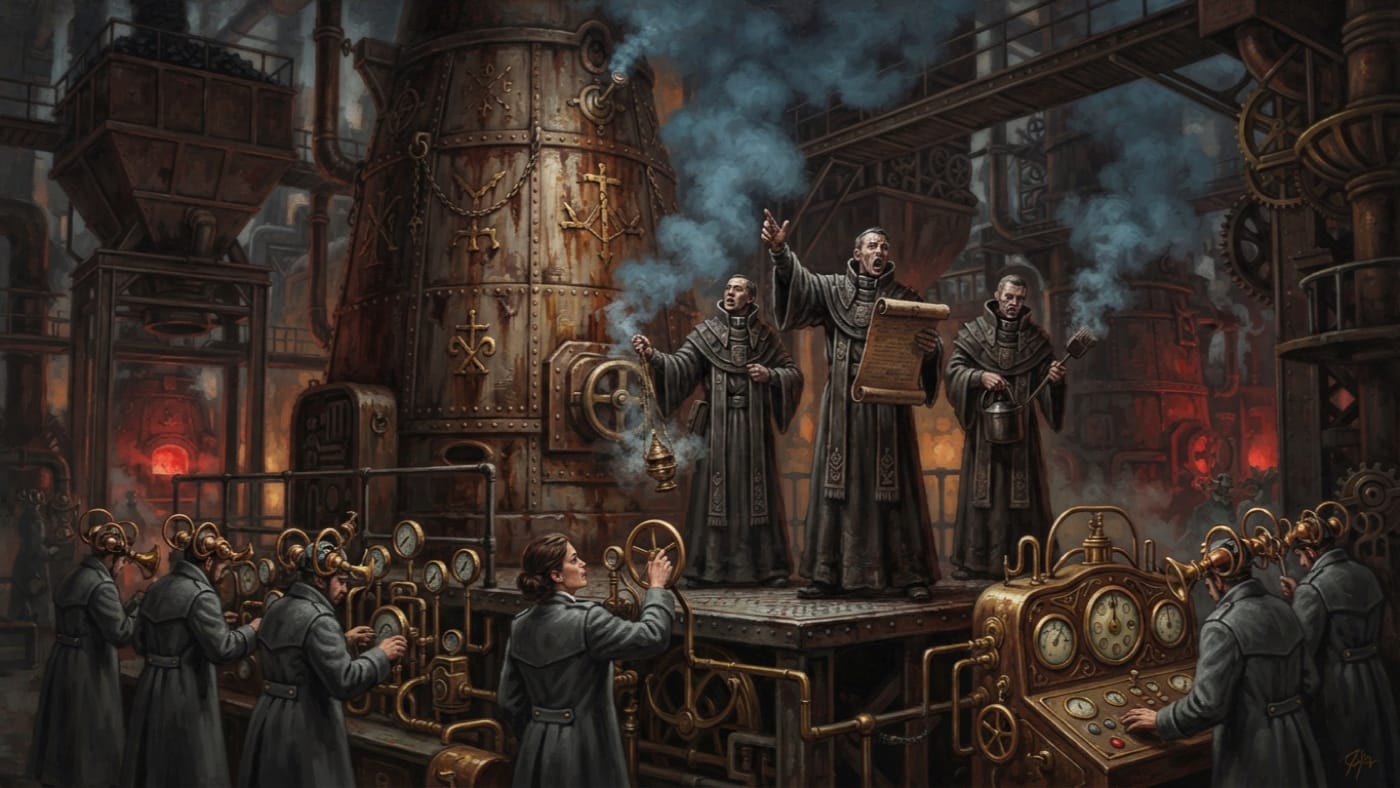
The Litany of Combustive Submission is a thing priests say to furnaces. I state it plainly because the record states nothing grander. It appears once in sealed Chapterhouse description, inside a working sentence: a priest of the Furnace Chapterhouse of Saint-Combust may anoint a valve, bless a drum, and recite the Litany of Combustive Submission in a voice fit to stun pigeons from rafters. The same sentence then hands the furnace to someone else. If Ilyra Kest raises one finger, the work stops.
That sentence holds everything the litany does and everything that troubles it. The litany belongs to the maintenance devotions of the Chrismole Crown at Brast. It sits beside the oil-pot and the smoke-cross, and it is recited by men whose public charge is to sanctify the burn. The record gives it no composer and no year of adoption. It assigns no fixed bell. No rubric binds it to the anointing or the blessing that come before it in that sentence. This survey quotes none of its words. Archivists of the Bureau of Doctrine will call that prudence, and critics will call it absence. Both may file their objections in triplicate.
The title alone is enough to begin with. Submission is a relation, and every relation has a lower party. The name of the litany does not say which party it means.
#On the Furnace in Vestments
The furnace has a name because it killed people. On the nineteenth day of Ashmonth, A.S. 74, Kiln Three suffered a pressure reversal during second-bell feed. The front plate blew inward and nine men died. The engineering office of the day recorded an Acoustic-Mechanical Disturbance. The doctrinal office certified the catastrophe as consistent with martyrdom and declared the furnace a vessel of instructive Providence. I give that office the later Bureau's title for convenience, because the formal Synod was still sixteen years from its constitution.
Look at the grammar of that settlement. Saint-Combust is the furnace. The nine men are its evidence, and evidence does not receive a feast.
By A.S. 76, boilerside priests were taking vows under Kiln Three's warped mouth. The Concordat settlement of A.S. 90 ratified Brast and left the Chapterhouse custodian of the Crown. At some point in those years, the iron cladding of the seventeen kilns became vestments. Engineering still calls it thermal armour. The quarrel is really about fastenings. Whoever names the plate decides who may unbolt it, and whether the unbolting requires a prayer.
A vested furnace can be addressed. It can be anointed, scolded, consoled and recited at. The Church has admitted it to the clergy at the lowest grade it could devise for an object, and a cleric of any grade owes obedience upward. The Litany of Combustive Submission is spoken into that arrangement. The name is ambiguous, but the vestments are not. I hold that whatever its clauses ask of the fire, they ask it from above.
#On the Prayer and the Measure
Brast keeps two registers of sung authority, and the Chapterhouse owns only one.
The Calibration Choir holds the fourth bell. Kest commands three hundred and twelve licensed choir-technicians, and in the Crown her correction travels faster than a priest's petition. When she murmurs, the furnace obeys her before it flatters him. The Choir's songs are measures. They are checked against gauges, held to tolerance and corrected by people whose ears the city cannot spare. I find no record that the Litany of Combustive Submission has ever been asked to do that work. I would not stand on the catwalk of any kiln that tried.
Elsewhere in the Church, the Litany-Engineers treat a hymn as a specification and an omitted verse as a fault report waiting to be written. The Brast Chapterhouse keeps a gentler arithmetic. Its litany petitions. It may soothe a valve the Choir has already set. It may console a furnace the priests believe capable of consolation. On the Sulking Engines, Engineering blames harmonic interference, pressure irregularity and responsive material fatigue. The Chapterhouse blames a rudimentary spiritual awareness grown in sanctified fuel under long and correct rite. Neither party has yet persuaded a kiln.
Fuel is also outside the priest's hand. The Distillers' Compact supplies the feedstock and the filters. Pex Ruln sends grey drums, and the Chapterhouse blesses them without naming what is inside. A blessing over a drum that the Compact can withhold is a courtesy paid to inventory.
What the priests keep is speech and whatever speech collects. Every confession heard before a pressure rise goes into the eastern furnace archive. So does every accident prayer and every heat anomaly whispered at the screen, each indexed by kiln, bell and stain. Sorn Vale wants those cabinets for audit. The litany cannot set a valve. The men who recite it know which valves have frightened whom, and since when.
#On the Forbidden Address
The approved rites of the Crown command, soothe, petition and flatter. They call the furnace vessel, martyr or instructive Providence. Each title sets it on a rung of a ladder, and the priest holds the rung above. Whatever submission means in the litany's own clauses, it belongs to that ladder.
In late A.S. 201, a furnace-feeder on night ash-scrape confessed that he had heard a hymn from behind Kiln Three, sung in a voice like wet iron cooling. By his account, it put the distillation measure at the wrong stress, reversed the mercy syllable and named Saint-Combust Brother Furnace. He reported warmth in his teeth. The priest who received the confession reported that the slip grew hot in his hand.
More reports came within three nights. Two rag-boys of the Still-Canals hummed the altered phrase over a filter housing, and the mesh is said to have softened without heat. A child of the Boiler Commons repeated it in play, and a kettle is recorded as whistling for forty-seven minutes after it was taken off the flame. The Chapterhouse declared a containment fast, doubled the censer smoke and burned seven hymn slips reconstructed from memory.
Nothing in the record makes the heretical hymn a corrupted copy of the Litany of Combustive Submission. Its reported faults belong to a distillation measure. Its singer, its source and the way it reached the Still-Canals are all unestablished. The comparison is mine, and it concerns grammar only. A litany of submission keeps the furnace in its grade. A brother has no grade below yours. He has a seat at the table and a claim on the estate.
Public Chapterhouse notices classify the incident as "a misremembered work-song of no doctrinal consequence."
Struck pending the Mire inquiry. A work-song of no consequence does not ordinarily cost the Chapterhouse a fast, a doubled censer allowance and seven slips to the brazier.
#On the Present Application
As of A.S. 201, the litany is still in use. Valves are anointed, drums are blessed and the priests recite. The fourth bell remains the Choir's. The Kiln Three shrine stays warm through maintenance cuts. Workers touch the railing at shift change, unofficially, and the Chapterhouse records it only when it needs a hook.
Lux Thane Mire has not yet opened his examination. When he does, he will want the burnt slips, the confession ledger and the furnace's own testimony. He may also ask a smaller question, one more dangerous to the Chapterhouse than any of those. In the Litany of Combustive Submission, who submits? The priests will have an answer. Kiln Three may have another.