
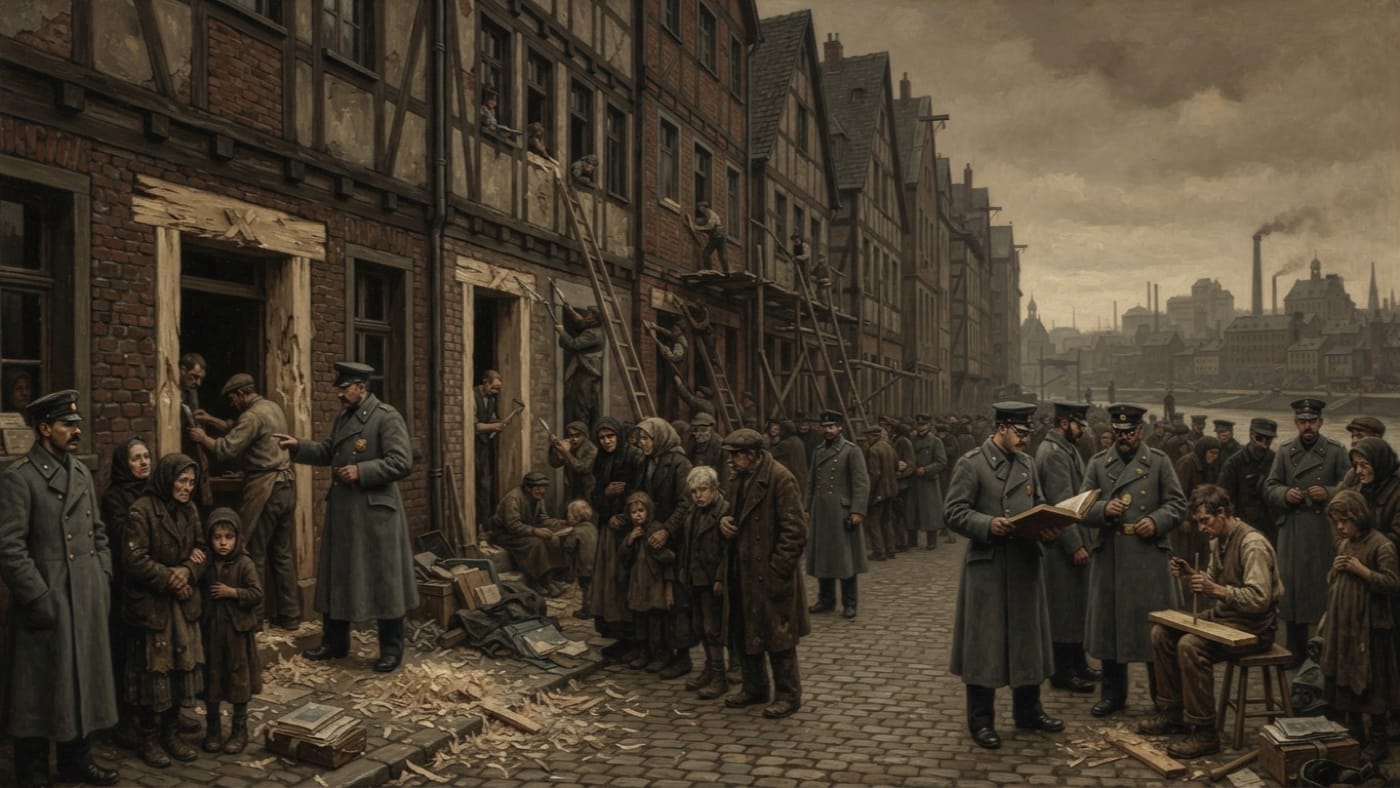
#On the Threshold and Its Proof
In A.S. 112, in the river quarter of Cologne, the Church learned that a Knot may be perfect and still be a lie. The lesson cost fourteen houses their lintels, a district its doors, and three carvers their air. It also produced the Knotwright Registry, which Heraldry regards as a fair exchange and which I am required to regard the same way.
The reader must first understand what a threshold mark is for. A Gate-Carver works with a short and holy kit: the tri-cord of three knotted lengths for spacing, a serialised stencil-frame for the loops, consecration chalk to test the angle, a registry punch to sign the cut, and wax to tag it. The finished Triune Knot tells the inspector that the house is claimed, the living within are named, and the dead beneath the parish slabs are bound. A house without one is unmoored. It cannot claim rations. It cannot call for mercy. It cannot prove that its occupants occupy it.
Geometry alone proves nothing. Any apprentice with a steady wrist and a stolen frame can lay three loops at a lawful angle. The Knot is lawful because a licensed hand cut it with an issued tool and struck the issued punch beside it. Before A.S. 112 the trade knew this as doctrine. Cologne made it a statute.
#On the Fourteen Houses
Purity operatives walking the river quarter that year found fourteen houses whose marks passed every visible test. The loops were clean. The depth met table. The chalk, rubbed across the cut, lay where chalk ought to lie. An inspector of ordinary diligence would have initialled each lintel and gone home to supper.
The houses sheltered unregistered persons. I record the category exactly as Purity recorded it, because the category was the offence. These were people absent from the roll, an administrative condition, and the file makes no finding of heresy against any one of them. On who they were the file says nothing with authority, and I decline to improve it.
The marks over their heads had been made by unlicensed hands using stolen stencils and counterfeit punches. A forged punch is a small thing, a slug of iron no longer than a finger joint. Struck beside a correct Knot, it converts a stranger into a householder. Fourteen such strikes had done exactly that.
#On the Correction of the Streets
Fourteen houses were the discovery. The streets were the remedy.
Purity reasoned, with the economy that sets it apart from the merely zealous, that if fourteen correct marks were false, no correct mark in the vicinity could be presumed true. Every door on the affected streets was stripped to bare wood. Lawful Knots came off with the unlawful ones, under the same scrapers, into the same heaps of shavings. Any widow whose lintel had been cut by a sworn master in front of a scribe was, for the duration, exactly as unmoored as the forger's client next door.
Residents were re-documented. Neighbours were questioned. The record gives no count of doors, streets, residents or detentions, and I will not supply one, though Heraldry clerks have since offered me several, each larger than the last and none of them signed.
Every household that watched the wood come up pale knew what a stripped door meant. Until a lawful hand re-cut the mark and a lawful punch was struck beside it, the house stood outside the ration roll, outside the reach of the mercy wards, outside recognised occupancy. The papers in their hands were the only proof the occupants had of being where they stood. Purity read the papers and kept some of them.
#On the Freehand Examination
Hands had cut the forgeries, so hands were examined. Every Knotwright in the district was brought before a Sigil Inspector, grey coat buttoned, brass eye-badge polished, seal-book open, and ordered to reproduce the assigned geometry freehand while Purity watched.
The reader who knows the trade will see the joke. Carving without a stencil-frame is a professional taboo. Apprentices are slapped for it and masters are fined for it. The frame exists so that no carver's wrist ever becomes the measure of the law. In Cologne the Church ordered every carver in the district to break the taboo in front of witnesses. The theory was that a hand unable to cut a true Knot unaided could not be trusted with the frame, while a hand that could cut one might have been making forgeries for years.
The candidate's fingers could not satisfy both suspicions at once. The Purity observers watched for tremor, for hesitation at the lower return, and for the small fluency of a hand that has practised where it should not. The inspector measured. The cord was held, then taken away. The plank received whatever the candidate's nerves allowed.
Three carvers failed.
Two of the three had sold stencil access to a Black Ledger cell. On this point, unlike much else in the file, the record is firm. The frames that lawful hands were bonded to guard had been rented out, and the cell had used them above the fourteen thresholds. The third carver is recorded as trembling. The surviving extract records no admission.
FREEHAND EXAMINATION EXTRACT — COLOGNE POST-LINTEL REVIEW Candidate: █████████████ Observed condition: hand tremor Confession result: no admission Disposition: immurement executed under Purity supervision
All three were immured. Immurement for pattern treason was already among the trade's written punishments. Purity needed no new law to use it, only three candidates. The file separates the two sellers from the third in its description and nowhere else. The niches are not identified. The names are not given. The dates are not entered. I am told this reflects the sensitivity of the matter. It reflects how cheap the matter was.
#On the Charter
The Bureau of Heraldry chartered the Registry in the same year, in the immediate aftermath, with a speed it has never since shown toward any petition from a carver.
The charter changed what could be traced. Knots, carvers and licences all existed before Cologne. So did registry punches, which is why they could be counterfeited. What did not yet exist was a central roll that could connect one cut on one lintel to the licensed hand that made it, the stencil issued to that hand, and the punch in that hand's custody. The charter supplied four instruments: a roll of licensed carvers, a record of every stencil issued, serial custody of every punch, and quarterly audit by Masks and Seals, who count the tools themselves because they do not trust Heraldry to count them.
From A.S. 112 forward, a correct Knot without a traceable chain is a forgery by definition. A carver who cannot produce their assigned punch has lost more than a tool. The Registry's rooms and present procedures are set down in its own entry, and I will not tour them twice.
For some years Heraldry's own abstracts called the whole affair a review.
Early Heraldry abstracts entered the Lintel Pogroms of Cologne as the "Registry Chartering Review."
Struck by Doctrine. The streets were stripped before anyone had set out a chair for reviewing. The Registry's charter followed the correction and did not conduct it. Its name is not to be lent to the scrapers after the fact.
#On What the Trade Kept
The profession left Cologne suspicious of itself. True Knot masters took the examinations as vindication: only a hand that holds the line in memory deserves a licence, and full ceremony costs less than a niche. The Fast Hands took the stripped streets as a work order, since bare wood does not re-knot itself and families outside the ration roll cannot wait on ceremony. Each faction has been fined for the other's virtues ever since.
The same year gave the Rhineland the Quiet Purges, a separate operation against teachers, choirmasters and Street-Vicars, carried out without public trial. Careless archivists sometimes bind the two in one folio. The Quiet Purges corrected what people said. Cologne corrected what doors were permitted to say about the people behind them.
Saint Edrin of the Three Nails, whom the Registry later adopted as its vocational patron, took no part in any of it. His nails were Measure, Witness and Refusal. Cologne supplied the first two and kept the third for the Bureau.