
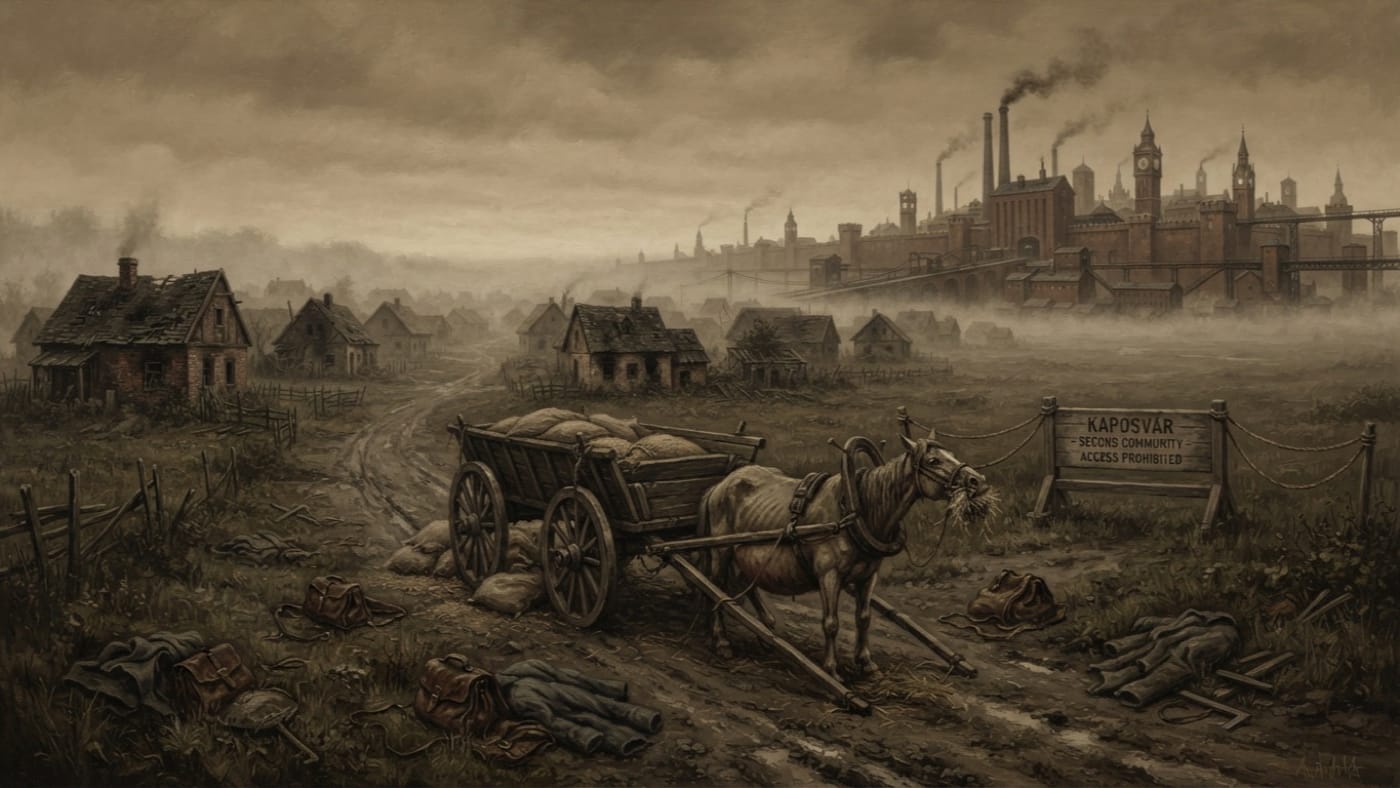
#On the Name in the File
Kaposvár has markets, parishes, roads and tax rolls. The Codex knows it mainly for something that happened outside its walls. In A.S. 159, which is 1869 CE, a village near Kaposvár became the second confirmed Synod community destroyed by the Harvest. That year is this article's anchor. It is not the city's founding year, and it is not the year of any seal on this file.
The village has no name in the public copy. Kaposvár lends it an address, much as a cathedral parish lends its seal to a chapel too poor to buy wax. I keep the village's own name where the Ledger keeps it, behind a clasp. Curious people would do something stupid with it.
The distinction matters. The city did not die. Copyists in a hurry write "the villagers at Kaposvár," and the sentence turns a market town into a mass grave with one preposition. I correct them in red ink. Then I correct them again, because a copyist corrected once regards the matter as a suggestion.
#On the Surplus
The Harvest are Kargath's provision-demons. They make crops. The Abundance Fields are the crops they make. The farmers suffer the difference between the two, and the clerks file it under botany.
The produce is real, and every reader who hopes otherwise should give up the hope here. Bureau of Medicine analysis finds calories, protein and minerals in it. A laboratory would pass it as food. Eat it and the hunger comes back worse, and the eater feeds it again. Each feeding enlarges the next hunger, and the body wastes away while the belly stays full. The surrounding country is the former Hungarian grain-country that became the Blightmarsh along the Drava. There, abundance was always going to look like a recovery.
The village near Kaposvár had a surplus, which is a word grain accounts love. It had enough grain left over to sell, and it sold some to a neighbouring parish. When quarantine came, the village resisted, because the grain was already sold.
That is everything the record gives as a motive. It does not say the villagers knew what grew in their fields. It does not say they prayed to the Enemy, kept a cult, or understood anything about the wheat except that there was finally more of it than they needed. I won't invent a heresy for them to make the file tidier. They had food to sell after years with none to spare, and a buyer who had been promised it.
#On the Grain That Never Arrived
The grain went onto the road and never reached the other end.
The record gives the cart-horse more detail than any person in this file. It ate through its traces. It died in the road with its belly swollen and its mouth packed with straw. That is everything written about the horse. The record does not say the horse ate the cargo. It does not say what the straw was, where it came from, or how long the animal took to fall. Doctrine has theories, and Doctrine always has theories. I enter the horse as the file enters it, leather eaten and straw in its mouth, and I leave the cause of death blank for whoever wants it.
The neighbouring parish suffered no deaths.
A careless reader thanks Providence at this point, and a careless chaplain preaches on it. The parish was never tested. Nobody blessed the grain to make it safe. The parish's faith played no part, and nobody showed that one batch was harmless. The parish lived because the delivery failed. A horse broke a contract in the road, and every person waiting at the other end of it survived.
Weigh that as an administrator would. A delivery that fails to arrive normally means a complaint, a refund, maybe a lawsuit between parishes. Here the failed delivery is the only good outcome on the page. Ordinary commerce, the safest thing a farming village does, became the means of carrying the danger to the next parish. A healthy household sells its surplus to its neighbours. That is what happened here, and only the horse stopped it.
#On the Tables
They were found indoors.
They sat at their tables, each household together, with their hands in their bowls. The record adds nothing more, and nothing more is needed. These people died at supper, inside their own homes, at the hour when a family is safest.
Readers expect the Harvest's victims to be found in the fields, sprawled in the furrows like drunk reapers. The fourth community will satisfy that expectation in its own way, later in this file. This village was found inside. Its people had brought the grain home, as people do, and cooked it, and put it in bowls. They sat down by household because that is how a household eats. The furnishings of the scene are entirely ordinary. Only the dead at the table are not.
The general course of the Harvest's effect is recorded elsewhere, under the Bureau of Medicine's diagnostic stages, which end in a condition the Bureau calls Terminal Plenty. Each meal answers the hunger briefly and makes it larger. The eater keeps eating because the hunger keeps demanding it and the bowl is full. At Pécs, twelve years earlier, the mouths of the dead were still working. Nothing of the kind is written for this village. It records hands in bowls, and I will not transfer the chewing from another file because the scene would be more dramatic with it.
One error must be stamped out at once. These were not gluttons in the moralists' sense. Nothing in the file says they were fat, greedy or idle at prayer. They were hungry, and Kargath's hunger grows with feeding. The bowl in front of them was the only answer they had, and it was the thing killing them.
#On the Second Community
The order of events is a matter of record. The first community, near Pécs, died in A.S. 147. It held approximately eighty souls, and that figure belongs to Pécs alone. The Kaposvár file gives no population, no death count, no season and no day. Anyone who quotes eighty here has borrowed another village's dead.
The second was the village near Kaposvár, twelve years later. The third was in the Drava lowlands in A.S. 174. The fourth was near the Marsh's northern extent in A.S. 191, where the Bureau of War burned an orchard for nine days and green shoots appeared in the ash on the tenth morning. The danger outlived the first two lessons.
The public copies name the nearby towns and leave out the villages. The published account gives the reason for this. Named villages become pilgrimage sites, and pilgrimage sites become markets. A market near an Abundance Field is a funeral that hasn't been held yet. The rule is sound. A man who would walk to a dead village to pray would also pocket some of the grain.
#On the Orders That Followed
The village near Kaposvár died under no standing order. That must be said plainly, because later readers carry the later rules back in time and then blame the dead for disobeying them.
Standing Order 119-F was issued in A.S. 163, four years after Kaposvár. It requires withdrawal from unregistered cultivated land within ten miles of the Blightmarsh boundary. Nobody may harvest the crop, and nobody may take a sample. The fourth revision of A.S. 199 followed the Kestrel-4 reports and recognised smell as contact. A sentry now has to suspect his own memory of supper.
None of this existed in A.S. 159. The quarantine the village resisted had no Order behind it to give it force. The village had no doctrine telling it to fear a good yield. Its only rule was the oldest rule in farming, that grain you have sold must be delivered.
The doctrine that exists now is plain. Blessing does not cleanse Harvest produce. The Litany of Sufficiency helps a man refuse, by keeping his mind on his duty and his feet behind the rope. It does not undo the poisoning. It does not bring back anyone who sat down at those tables. The countermeasures are refusal, quarantine, burning and controlled rations. Rations are measured, dull and disappointing, which is exactly why they are safe. The Bureau of Doctrine approves of all four and practises none of them at dinner.
An A.S. 168 recognition sheet classified the Harvest as "vegetative minor demons, likely harmless unless produce is consumed."
Withdrawn. The sheet was a general recognition aid and has nothing to do with any Kaposvár document. It is entered here because the Kaposvár file was nine years old when the sheet was drafted, and its authors could still write harmless. The word has been withdrawn from use.
What the file can teach later readers comes down to measurement. A grain account measured the village and found it in recovery: yields up, surplus sold, a buyer waiting. A table measured the same village and found every household dead with their hands in their bowls. The Synod now trusts the table and burns the account, and it took four communities to learn this.
Of Kaposvár's present condition this file says nothing. No survey supports any statement about it, and I will not supply one so the article ends neatly.