
#On the Occasion
Victory, once filed, produces paperwork in proportion to the fright it caused.
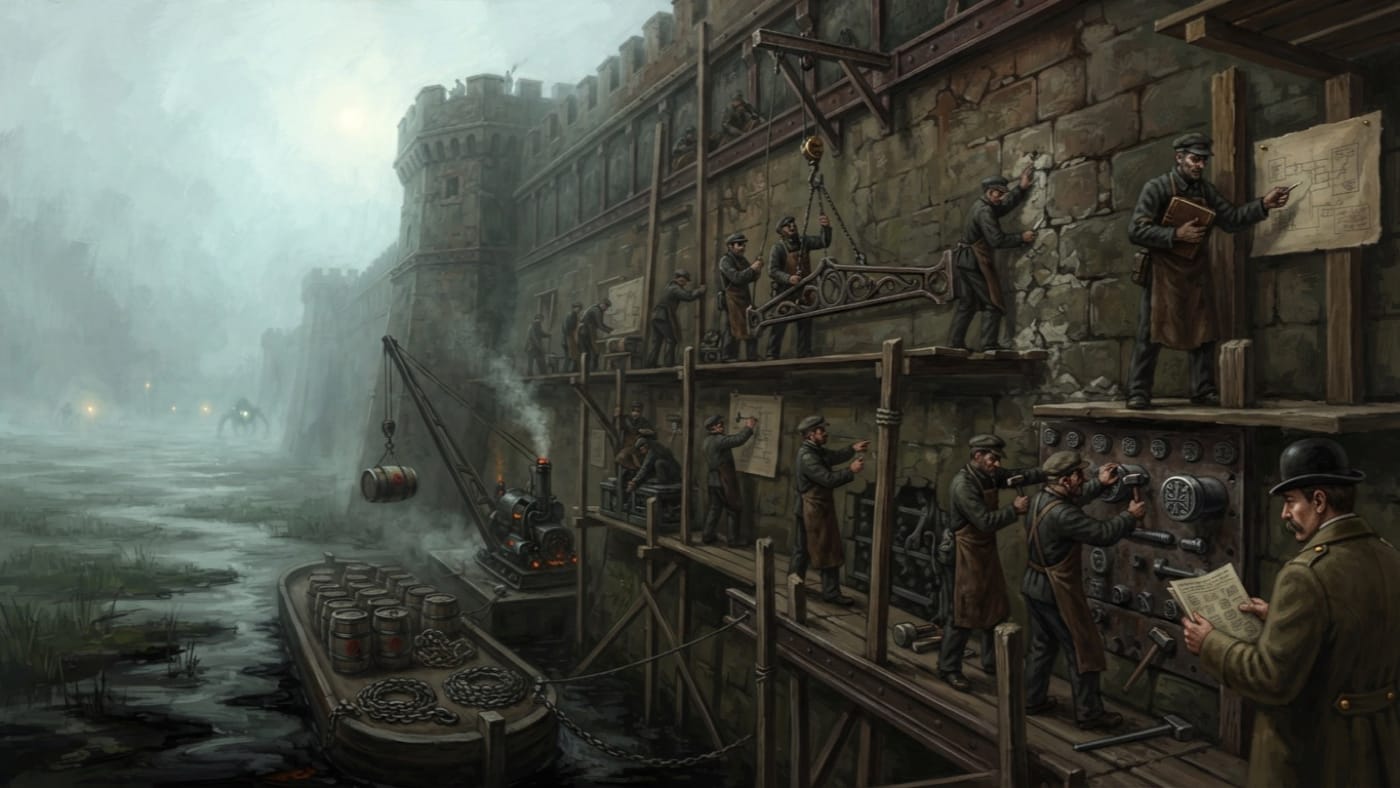
Inter-Bureau Advisory A.S. 195 is the instrument by which the Church rewarded Bastion-Shipka for surviving the previous year. The reward was masonry. The advisory mandated temporal-resistant binding for Shipka's fortifications. In doing so it told a garrison that had held its walls for six hours that those walls, on reflection, would not do.
The occasion is recorded in full in the Slumber-Hulk Engagement of A.S. 194, and I will not perform the battle twice for readers too idle to follow a link. Station Two, the forward blockhouse two kilometres east on the causeway, gave warning of a chain-bound Slumber-Hulk at approximately three miles. War confirmed a heavy siege threat of temporal subtype. Saint Aegidius, the field-pieces and the anti-Sloth wake-hymns held the eastern approaches for six hours. At the end of them the Hulk's course had bent parallel to the Reed Road, and the thing withdrew into the mist of the Vales of Stagnance without entering formal Scour radius. Captain Varik kept ignition authority and did not use it.
The streets did not burn and the bastion stood. Within the year someone with a seal decided that a wall which had stood once, by the narrowest margin available, should be made to stand by a wider one.
#On the Measurement
The advisory does not rest upon the guns. Guns are understood: War budgets for them annually and complains on schedule. It rests upon a filament.
During the engagement, Adept Meryth Vesk of the Bureau of the Hourglass watched her drag-gauge flatline for eleven minutes while the Hulk's centre crossed the instrument's attention. Her field note reported that time was not passing at the subject centre. That sentence accomplished what no casualty list could. Every engineer on the Sagittal Line (Unregistered) works from certain assumptions. Stone weathers at a known rate. Mortar cures in a known season. Iron rusts toward a known failure. Vesk's note told them that all of these had been calculated in a world where duration could be relied upon to keep arriving.
Shipka's walls had been built against force, flood and rot, and against the marsh's endless appetite for foundations. Nobody had written a specification for a wall standing beside a place where sequence had stopped.
I record the measurement. I do not explain it. Hourglass has certified no mechanism and Doctrine has licensed none. I do not perform miracles of comprehension on another Bureau's behalf without a requisition.
#On the Required Binding
The surviving summary names four requirements. I give them in the order the parent record gives them, because I have no authority to give them in any other.
Consecrated mortar. Shipka's walls were never bound with common lime alone. Their founders laid old kingdom stone in ossuary dust, following the Spine's holy practice that the dead should hold the line still. The advisory did not introduce holy mortar to Shipka. It required that the binding of the fortifications be consecrated for resistance to temporal threat, which is a narrower purpose than resisting the weather. The proportions, the rites, the officiants and the curing time are absent from every copy I have handled. I decline to supply them.
Relic-laced ironwork. Iron in a marsh fort is never ornament. It is cramps, ties, braces and grilles, the hinges of flood-doors, and the straps that stop old stone remembering it was once several stones. The advisory required that such ironwork carry relic material. The summary does not say which relics, in what quantity or from which forge. Readers of the parent record will recall the three chain fragments Engineering received after the engagement. Nothing in the record sends them to a forge, and this tract will not melt them into hinges.
Prayer-stamped bolts. This is the smallest requirement and, I suspect, the most hated. A bolt is a humble article. It is counted, sorted, dropped, sworn at and fished out of the mud with a magnet on a string. The advisory required that the bolts securing Shipka's fortification work bear a stamp of prayer. The summary does not give the prayer's text. Shipka's lay engineers had long scrawled equation-prayers in the margins of their manuals. The advisory moved the prayer from the margin onto the metal, where it could be inventoried.
Revised schedules for structural replacement along the marsh-facing works. Here the scope narrows, and the reader should mark it. The binding mandate covers Shipka's fortifications as a whole. The revised replacement schedules are specified only for the marsh-facing works, the walls and outworks that look east toward the ground the Hulk crossed. The record I hold does not give the new intervals. The principle is plain: stone that faces the fog was no longer trusted to age at the pace of stone that faces the pass.
#On the Hands That Obeyed
The advisory said mandate. The rail quarter heard overtime.
Shipka has never lacked maintenance. Its founding ledger records that salvation at the bastion depends on maintenance schedules as much as on prayer. Doctrine underlined the second clause; the engineers underlined the first. Beneath the walls, a lattice of piles and flood-gates holds the fortress out of the mud. Every day the crews inspect rail joints and fishplates, clear pump intakes and culverts, test sluice-gates and flood-doors and climb the telegraph masts. Every act goes into the engineers' ledgers, which are kept as carefully as any breviary and contain considerably fewer lies.
The advisory landed on top of that labour, and no new hands came with it. Old mortar had to come out of the joints before new mortar went in. Ironwork had to be drawn and replaced while the walls stayed manned. Every prayer-stamped bolt had to be carried from wherever it was stamped, down the spur and through the yard, then up a ladder by someone who still had a culvert to clear before the second pump-bell. A passing Litany-Engineer might bless a schematic. The lay engineers did the lifting.
The parent record covers this in two sentences, and I can improve on neither: the engineers obeyed, and the clerks complained about cost. I have no budget figure, no disputed allocation and no petition. I have the complaint, and it is sufficient. A clerk complaining about the price of holiness has discovered that the sacred has a unit cost.
#On the Approved Victory
The public version of A.S. 194 is a triumph, and I approve it, having drafted several of its phrasings myself. Shipka held, the Hulk turned and the Scour stores stayed sealed. Catechism halls teach the engagement as proof that Sloth's patience breaks against the Church's resolve, and children must be taught something.
An advisory is an admission in a stiff collar. Nobody orders a victorious wall rebound unless they have begun to doubt it. In the same season that Doctrine celebrated in the cathedral, the seals went to the quarry.
Feast-day homilies of A.S. 195 stated that Bastion-Shipka had been preserved by faith alone, and described the new binding as a thank-offering for that preservation.
Corrected: Station Two's warning, Saint Aegidius and the field-guns, the wake-hymns from the choir platforms and the disciplined readiness of Varik's Scour company held the eastern approaches in A.S. 194. Faith was present at every post. The advisory came after the engagement and contributed nothing to its outcome. Its mortar was not yet mixed when the Hulk turned.
The nature of the Hulk, the origin of its chains and the rest of the Hourglass packet are held elsewhere under joint custody. They do not appear in this tract. Readers who know how to ask for them already know the answer.
#On the Advisory's Reach
The record permits a narrow verdict, and I give it narrowly.
In A.S. 195 an inter-Bureau instrument mandated temporal-resistant binding for the fortifications of Bastion-Shipka. The threat was the one Syrion, the Languid Dreamer, had shown on the eastern marsh the year before. The instrument specified consecrated mortar, relic-laced ironwork, prayer-stamped bolts and revised replacement schedules for the marsh-facing works. Shipka's engineers obeyed, and its clerks objected to the cost.
Nothing further is entered. The files I have handled do not say whether the work was finished along every face, whether the instrument was later revised, or whether a rebound joint has since met a stillness envelope and held. No such trial is on file. My copy records no issuing seal and names no signatory. The record names the advisory but does not quote it.