
#On the Chamber at Station Two
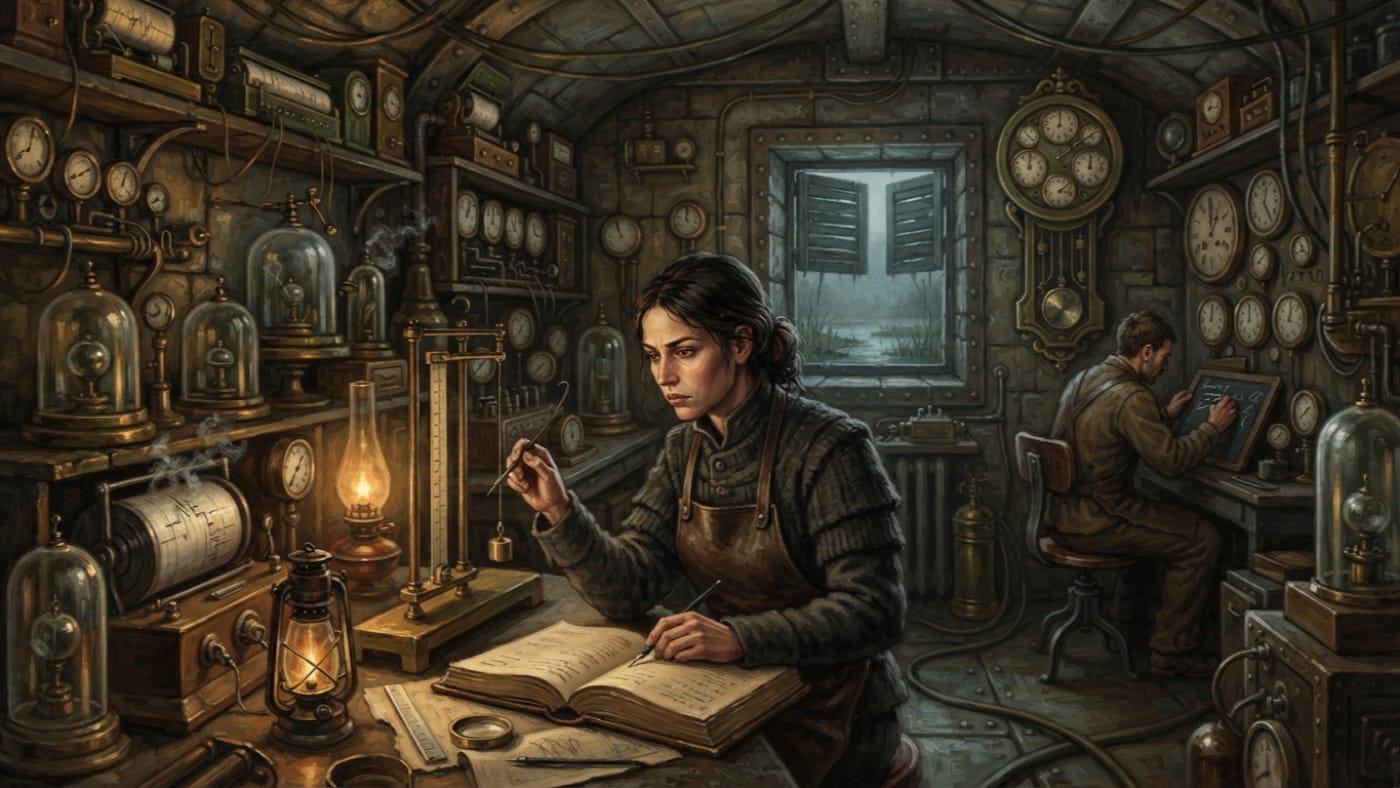
The word vault misleads visiting clergy. They arrive expecting a strongroom, a reliquary niche, or at least a door worth guarding. What they find is a low-ceilinged chamber inside the stone blockhouse of Station Two, filled from wall to wall with apparatus that ticks, whirs and chimes on no shared schedule. The ceiling makes tall men bow. I approve of this. A room ought to extract reverence from those who brought none.
Station Two stands two kilometres east of Bastion-Shipka, that hinge of the Sagittal Line, on a reinforced causeway thrust into the marsh corridor beside the Reed Road. Instrument-sheds crowd the blockhouse like debtors at a bishop's gate. Telegraph masts lean over the fog, and wooden platforms hold sentries who have been ordered to report, not to approach, and above all not to stare. Every part of the post serves the Vault. The sentries guard the causeway the observers walk, the masts carry the observers' findings west, and the platforms watch the fog the observers measure.
The air smells of oil, ozone and old parchment. The observers add damp wool. The clocks add something the Bureau has no column for, which is the particular unease a human creature feels in a room where every timepiece disagrees with its neighbour. I felt it within the quarter-hour and blamed the tea.
#On Instruments and Their Comparisons
The apparatus of record are drag-gauges, resonance-bells and seismographs. Everything else in the room is commentary.
The drag-gauge is the simplest of the three and the most offensive to theologians. A hair-thin brass filament with a weight on it is released against calibrated resistance, and the observer watches it fall. Under ordinary duration it falls at a known rate. Where local duration thickens, it falls more slowly, and where duration quickens, it falls faster. The gauge reports that time has misbehaved. It does not report who is responsible, and adepts who forget the difference are reassigned to rooms with fewer instruments and more confessors.
The resonance-bells of the Vault are tuned to detect distortions in local causality. Their larger cousins hang in roofed frames outside the blockhouse and are struck to schedule. Visitors who confuse the two are corrected with a contempt the Hourglass normally reserves for heresy and the Bureau of Engineering. The seismographs record tremor. During one six-hour stretch they recorded none.
Around these three instruments the station keeps a wider liturgy of comparison: a master clock, telegraph tickers, candle-burn registers, a water-clock set against a spring chronometer, and breath counters. The inventory of the station and the inventory of this single room are separate documents, and I have been shown only one of them. Every reading still comes back here to be set against the others. Senior Adept Meryth Vesk compares the master clock with the bastion clock, then with Lyon's last transmitted standard, then with the instruments around her, then with Sergeant Creed's pulse and the junior keeper's clicking tongue. She consults the frogs unofficially. The frogs are not on the requisition list.
Adepts work the Vault in shifts, recording, calibrating and annotating. The logbooks hold the station's entire theology in two kinds of entry. One reads Fog density: moderate. Several pages on, in the same hand, another reads Subaudible hum detected, duration: six hours, no correlating seismic event. The ink and the pen are the same. Only the reader goes pale.
#On the Keepers of the Readings
Vesk of Lyon is the Vault's senior observer and its chief asset. She is precise, and she refuses to let a finding die of neglect, which is a vice in Strasbourg and a virtue on a causeway. Her instruments are credited with three near-breaches that would otherwise have been logged as weather. The particulars rest in files I am not cleared to quote. The count is public, and the count is enough.
The junior technician and instrument-keeper is called Tick. He is a young conscript whose real name no one knows, because he stopped answering to it. He clicks his tongue in rhythm with the chronometers, constantly and without meaning to, and he catches a faltering rhythm before the dials show it. He has lately reported a counter-rhythm beneath the instruments, faint and irregular. No instrument records it. In public Vesk calls it auditory pareidolia. The log enters it as testimony, and in a properly kept Vault testimony and measurement are bound in separate quires.
Sergeant Hallin Creed commands the station's security detail. He has served three tours, each by requested extension. He guards the causeway, and he does not touch the dials, because nobody has asked him to. Beyond the blockhouse stand the Causeway Watch-Post and the Red Shed. The shed is locked, painted the colour the Synod uses for purgation, and stocked with emergency rations, Scour caches and sealed orders for the day the station falls. None of this is kept in the Vault. The Vault records what the fog does, and the Red Shed holds what is to be done about it, under different keys and in different hands.
Soldiers rotate out of Station Two every three months. Longer tours produce station-sickness: insomnia, auditory hallucinations and an obsessive counting of one's own heartbeat. The adepts appear to escape it. I stress appear. The medical officers have certified no immunity. They have merely observed that the adepts behaved this way on arrival.
#On the Eleven-Minute Reading
In A.S. 194 (1904 CE) a Slumber-Hulk came through the marsh fog towards Bastion-Shipka. Station Two raised the alarm, and the bastion prepared to burn its own sector rather than let the thing cross the Scour radius.
Vesk's drag-gauge flatlined for eleven minutes. The filament neither descended nor trembled, and it did not even break with the comforting violence of a failed instrument. It hung as if sequence had been revoked. Vesk read this as duration that was absent rather than merely slowed, and the tactical reading of the engagement was built on her interpretation. A slowed enemy can be outwaited. An enemy wrapped in absent time is a different arithmetic, and the officers on the walls needed that sum before they spent their shot.
The bastion's saturation fire and hymnal counter-rhythm shifted the Hulk onto a trajectory parallel to the Reed Road. The Scour was prepared and never enacted. The Vault fired nothing and sang nothing. It measured, and the measurement told the bastion what it was fighting.
A.S. 195 instructional plates stated that Shipka's guns and choirs "drove the Slumber-Hulk back into the fog."
The corrected reading holds that saturation fire and hymnal counter-rhythm shifted the Hulk's trajectory to run parallel to the Reed Road. The original phrase remains approved for sermons and for officers who were not present.
#On the Ninety Seconds
In A.S. 199 (1909 CE) Vesk filed the field abstract that made the Vault a nuisance to Strasbourg. It concerns a recurring absence of ninety seconds that appears in the station's measured duration every day at the same hour. The abstract is the date the Skip entered the record. It does not establish when the Skip began, and the Bureau of the Hourglass has been asked to keep the two dates apart.
Nothing in the room behaves oddly when it happens. The master clock keeps its stride, the telegraph keeps its beat and the candle registers keep their even burn. Even so, when the readings are compared the day comes out ninety seconds short.
The Skip should not be confused with the Hulk reading, which was a flatline during a visible engagement with a visible abomination. The Skip arrives with no presence at all. Nor should it be confused with the six-hour hum, which differs in duration and in instrument, and which no one has connected to it by evidence. Clerks who staple the three together for convenience will have their staples confiscated.
The abstract found no match among the catalogued signatures. Vesk's position, under her own name, is that the Skip is not Syrion. I record her position without adopting it. Syrion's domain is broader than deceleration. It includes missing time, Stillness Fields, Drag Corridors and the creatures the soldiers call Time-Eaters. A mismatch with the catalogue proves that the catalogue is incomplete, and the catalogue has never claimed otherwise. Vesk's method is consistent. Her A.S. 200 note on the Somnolent Communion Cells found a signature similar to Syrion's but not identical, and she said exactly that and no more.
The hour of the Skip has been withheld from this entry. The faithful are asked not to calculate it, and on no account to attend it with watches, candles, children or pamphlets.
From where she has placed her instruments, I infer that Vesk suspects something beneath the marsh. She has confessed no such thing. My inference is mine, and the hypothesis I infer from it is hers to disown. Whether anything is taken from the station, sent to it, or merely miscounted remains unsettled.
#On Present Service
In A.S. 201 (1911 CE) the Vault keeps its shifts. Vesk remains at her post, the filaments are released and watched, the logbooks fill with fog densities, and once a day the comparison comes out ninety seconds short and is written down again. The Hourglass in Strasbourg has received the report. It has not classified it. On the evidence of seven submissions, I conclude that it has read it.