
#On the Recorded Incident
"Sing, or the stone sings for you."
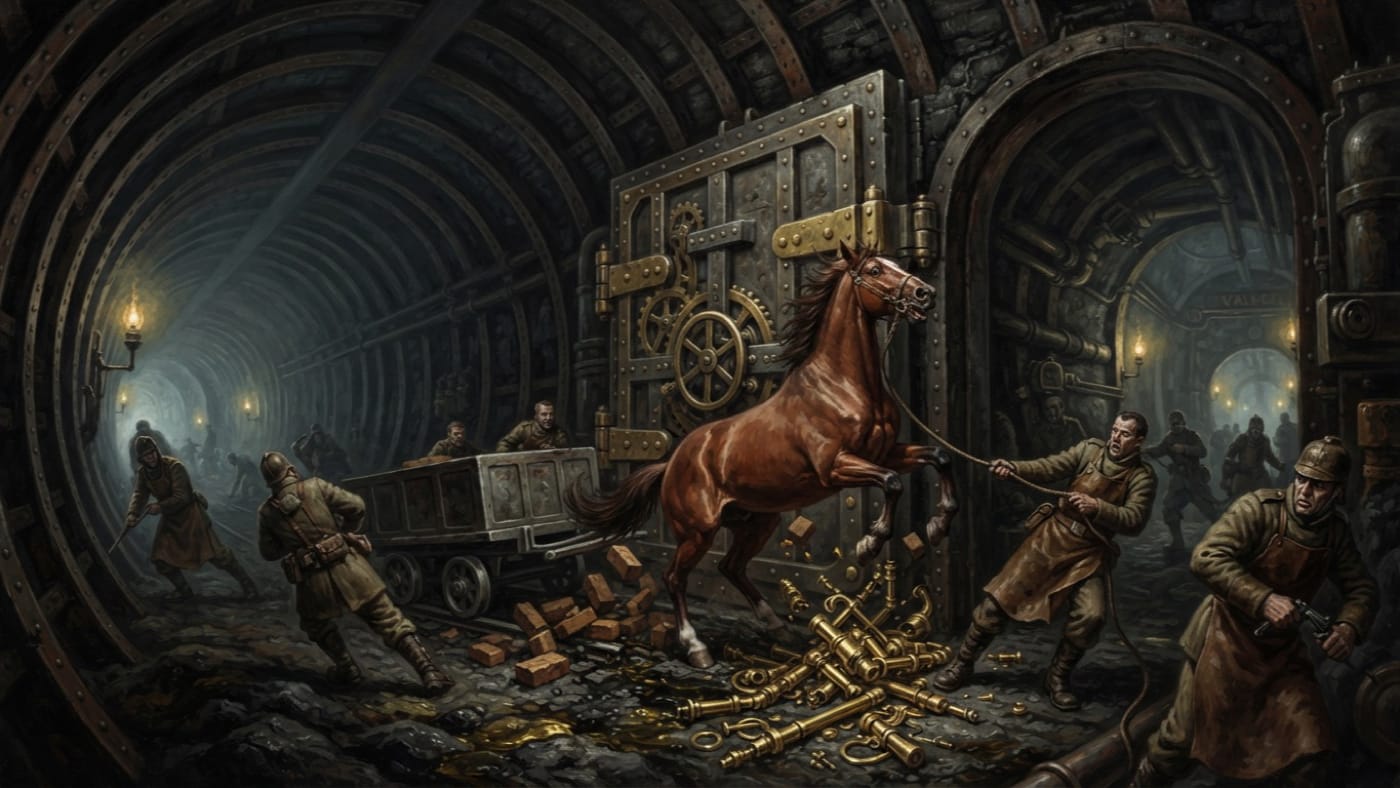
In A.S. 141, which the unconverted reckon as 1851, a gelding was spooked in the tunnels of Bastion-Irongate. A pressure door was involved. So was a quantity of brass fittings, which the Bureau of Ordnance has never satisfactorily accounted for. Horses have been forbidden in the tunnels ever since.
That is the whole record. I have set it down in four sentences because the surviving account gives it about one, and I will not have it said that the Warden of the Sacred Ledger padded a Bureau entry with guesswork. The day is not recorded, and neither is the month. Nobody recorded the horse's name, colour or owner, who rode or led it, what frightened it, or what became of it afterwards. The order in which the gelding, the door and the brass met one another is not preserved. Neither is the number of men who saw it, or whether anyone did.
None of this is sealed. I would almost prefer that it were, because a sealed folio at least tells you that someone once knew. These particulars are simply missing. That is a humbler condition than secrecy and a far more common one. Archivists see it every day and call it Tuesday.
What survives is three nouns, gelding, door and brass, and two consequences that have lasted longer than any explanation of how one noun led to the next. The first consequence is a prohibition. The second is a hole in an inventory. Sixty years later, both are still with us.
#On Passage Through the Mountain
"Sing clean, sleep warm."
The Transit Spine is the main bore of the fortress. It runs the length of the southern cliff face above the Danube at the Iron Gates, where the river squeezes past Orsova between the Carpathian foothills and the Serbian highlands. It is wide enough for a rail cart and high enough for a man on horseback. Off it branch the five great chambers the garrison calls Lungs: the dormitories, the infirmaries, the foundries, the transit staging and the Choir Nave. Convoys running between Bastion-Sibiu to the north and Bastion-Shipka to the south pass through it. So do conscripts, condemned men, grain bricks, and anything else the Sagittal Line needs moved from where it is to somewhere else.
The bore is cut from black basalt that sweats river-damp. Iron ribbing braces it, and it is lit by lamps that make every face look as if it has just been asked for its papers. It stinks of coal and wet stone. Pressure doors divide it into compartments. Gaskets and micro-seals sit at their edges and keep the air where the engineers have put it. Bolts pin the ribbing to the rock. None of these hold themselves in place. They need sound, calibrated and unbroken, and they get it from men singing in shifts. The garrison calls this arrangement the Gasket Choir, and the Choir keeps the tunnels standing. When the tunnel-mouths fell silent for nine hours in A.S. 94, the doors failed one after another and the Third Lung came down on three thousand souls. The Great Hush has its own year and its own article. I mention it only because by A.S. 141 it was forty-seven years past, and the mandatory chant shifts it produced had been running, watch upon watch, for most of that time.
In a fortress like this, deciding what may enter the bore is a matter of administration before it is a matter of space. The tunnel will physically take a great many things. The Tunnel Command and the Transit and Breath Office (Unregistered) now decide which of them it will actually receive. The height of the ceiling is a fact of engineering. The right to pass beneath it is a fact of the Ledger, and the two have never been required to agree.
The record does not say why a gelding was admitted in A.S. 141. Nor does it place the animal at any particular door, lock or Lung. It places the horse in the tunnels, and the Codex places it nowhere more exact.
#On the Brass Account
At the Irongate, brass is not ornament. The Valve Quarter forges the replacement gaskets and pressure fittings that keep the doors seated. It is the one hot district in the mountain, and it smells of oil and scorched metal. Every fitting on a pressure door had to be cast, fitted, tested against the chant and recorded. Gasket-hymn mechanics leave witness marks on their repairs so that the next crew can see what was done and by whom. This fortress measures its seals by harmonic and its men by how long they can keep a candle flame bent. It counts its brass.
And yet the account of A.S. 141 records only "a quantity." It gives no number, no type, no value and no destination. It does not say whether the fittings were lost before the door, at the door, or after it. It says only that the Bureau of Ordnance has never satisfactorily accounted for them.
Notice the adverb. It belongs to the Bureau, and it is carrying a great deal. It allows that accounts were offered and failed to satisfy. It allows equally that nobody ever tried. I hold no document that settles which.
The modern reader has heard of the Underchords and is already drafting an indictment. Put down the pen. Brass fetches a price in any fortress, and wherever something fetches a price, someone has the chance to steal it. That is true of every bastion on the Line and every sacristy in the Church. A chance to steal proves nothing. The Bureau of Ordnance has not written the word theft against these fittings, and the Codex will not write it on the Bureau's behalf. Nor will it write destroyed, recovered or melted down. They are unaccounted for. That is the finding, and the Codex adds nothing to it.
#On the Exclusion of Horses
The prohibition is the incident's one plain legacy, and even that is plainer in effect than in origin. Horses are forbidden in the tunnels. The record says this followed the incident. It does not say how soon after, under whose seal, by what number of order, or after what deliberation. I cannot give a decree that I have not seen, and I have not seen this one.
The Transit Spine was bored to a horseman's height, yet no horseman may ride it. A cleric learns early that the size of a building is no measure of what it permits. The nave of Strasbourg could hold a herd of cattle, and if any cattle have been admitted, I was not consulted. A ceiling sets the upper limit of what may pass. The Ledger sets the actual limit, and at the Irongate the Ledger has set it below the horse's ears.
The rail carts carry what horses might once have carried, and controlled convoys move through the bore on the Command's schedule. I do not claim the incident brought either of these into being. The record links the gelding to the prohibition and to nothing else. Carts and convoys belong to the ordinary machinery of the Spine, which needed no horse to invent it.
As commentary, not as a finding, I offer this. In a fortress that is held up by measured sound and divided by pressure doors, a large, frightened animal belongs to a category the garrison has every reason to fear. The rule needs no grander justification, and the record supplies none.
The prohibition covers the tunnels. Nothing in the record carries it onto the gorge road, into the other bastions of the Line, or onto the mule, the ox or the regimental dog. I will not stretch it. Only the office that issued an order may extend it, and the issuing office is not recorded. A Warden who widens a ban he cannot cite has stopped keeping the Ledger and started writing fiction in its margins.
#On the Remaining Record
Sixty years have passed. Under the present Command, the tunnels the gelding entered are run by men who were not born when it was spooked. The Choir has sung through every watch since. The doors are still in place. The Codex's dossier on the fortress carries the incident as a single clause inside a description of the main bore, and that clause holds nearly everything anyone can now say about it.
Two things remain. Horses are kept out of the mountain, and the brass is still unaccounted for. Each of these has outlasted the story of how it began. The gelding has no name in the record, the door has no number, and the fittings have no count. Nothing in either consequence lets us recover those details. The Bureau of Ordnance's books for A.S. 141 still carry, in some column I have not been shown, a quantity of brass with no satisfactory account beside it.
The Codex records the prohibition as still in force and the account as still open. This article closes neither. It never could.