
#On the Stone Offered for Contact
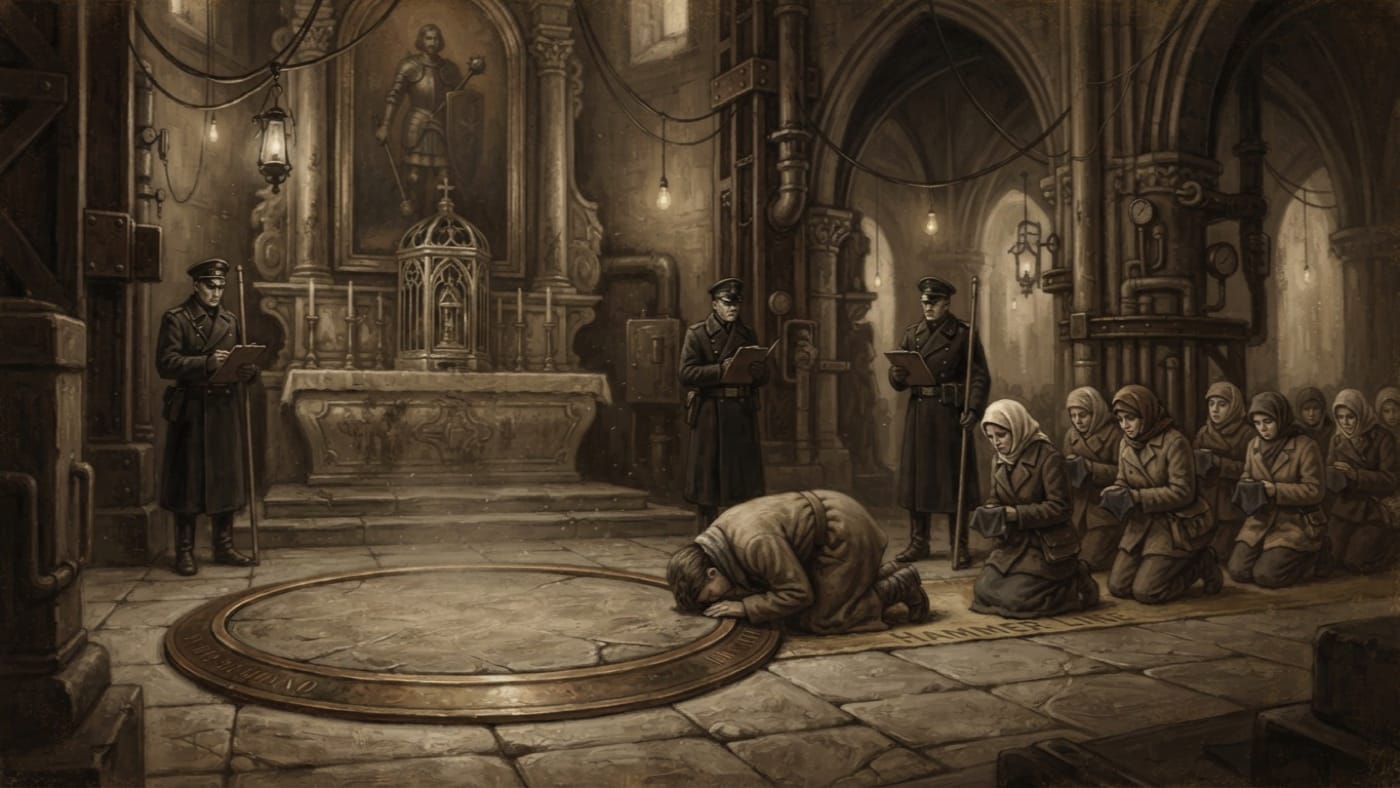
The Impact Plate is a bronze-rimmed stone set into the old floor before Saint Rupert's altar in Vienna-Ruins. Every pilgrim on the Via Stahlhand is crawling toward it. The name misleads the illiterate and the expensive in equal measure. Only the rim is bronze. The rest is stone, and plain enough stone that a mason might walk across it with his cap still on. Much of the Church's effort in Vienna goes into stopping him.
It is a substitute. I say so in the first paragraph because the guidebooks once said the opposite in theirs, and a correction hidden in the fourth paragraph is only a lie with a later date.
The Plate exists to be touched, and it has no other office. The original is in Strasbourg. The Plate gives the faithful a lawful place to rest their foreheads where the Siege of Vienna ended. It gives the Bureau a surface it can sweep, supervise and fill with a file of forty every hour from dawn to Vespers.
#On the Blow and the Removed Stone
In A.S. 95 Vienna had endured nine months of famine, plague and bombardment. Then the wall opened at the Kärntner Gate, and Althazar of Pest came through toward Saint Rupert's altar. Bishop-Warden Clemens Stahlhand met him there with the reliquary mace of Saint Aldebrand and struck him down. Witnesses report that the mace rang for nine seconds. The Siege has its own entry and its own casualty folios. I will not copy either here to flatter a floor-stone.
Pilgrims mix up three objects every day, and they must be kept apart. The mace is a relic of Saint Aldebrand and has its own custody. The original strike-stone was the floor-stone at the place of the blow. The Impact Plate is the stone that now fills that place. No ledger I have sealed says whether the mace touched the floor at all. It may have spent itself entirely in Althazar, and the stone beneath may have cracked from sympathy, from terror, or from Viennese foundations. The Plate's name settles nothing. Names in this city were handed out in a hurry by people who had just stopped starving.
The original cracked into three pieces. Under custody order they were lifted and taken to the Basilica of the Ledgered Saints in Strasbourg, where inconvenient things from the provinces go to become precious. I have nothing to add about their present housing and will invent nothing. The custody order exists. Its wax was considerable.
Earlier guidebooks to the Via identified the Impact Plate as the original stone of Clemens Stahlhand's blow.
Corrected. The Plate is a contact substitute, installed in A.S. 112. The original lies in three pieces in Strasbourg. Pilgrims who bought the earlier guidebook were wrong in good faith, which the Church accepts as a lesser form of being right.
When the substitute was set, Clemens had been dead nine years and beatified for eight, and his canonization was already stuck in the slow lane of Doctrine, where it remains. Nobody asked him. The dead are spared committee work, and it is the chief mercy of their condition.
#On the Warm Dust
The original was not removed for being cracked. Vienna is full of cracked stones, and housing them all would take a second Strasbourg. According to the corrected record, it was removed because the fracture began shedding warm dust into pilgrims' mouths.
Picture the posture. A penitent at the end of the route, face down at the floor, lips near the break, breathing hard after the crawl. Something fine and warm rises out of a sacred crack. What it did once swallowed is not recorded in any folio put before me. Why it was warm is not recorded either. I will not supply what the archive left out.
After that the administration did everything, and in order.
The dust was authenticated first. Some office was handed a powder rising warm from the place of a miracle and found it genuine. I do not doubt it was genuine. The open question was what it was genuinely of. Next it was sold, for an interval the record calls brief and declines to measure. Then it was condemned. And once condemned, it was not destroyed. It was quietly kept in three episcopal cabinets. The record names neither the cabinets' keepers nor their contents.
Authenticated, sold, condemned, kept: four verdicts on one powder, and none of them cancelled the one before. A heretic would call this inconsistency. A clerk of the Ledger calls it a complete file.
The Plate went down in A.S. 112. It sheds nothing. It is the first relic-adjacent object in Vienna that has never once embarrassed its custodians. I count that a qualification for office.
#On Foreheads, Silence and Admission
The Bureau of Pilgrimage allows one way to reach the Plate: on the knees, in a file of forty, each penitent carrying a knee-cloth and a wax token, over the four hundred and eleven metres of the Via. Guides, ward-surgeons and holders of doctrinal office walk upright under licence. Everyone else arrives lower and later.
The last eleven metres are the Hammer Line, and speech stops there. What you hear instead is forty people moving on cloth over stone: the scuff, the breathing through the nose, a token knocking against a fingernail, a knee that cracks and an owner too proud to wince. Pilgrims hear the Plate coming before they see it. By the time they reach it, their eyes have been on the floor for a long while, and the floor has started to look like one long instruction.
At the end the pilgrim leans forward and sets the forehead against the bronze rim. The custom is the rim. The stone in the middle is left to be looked at, and to be walked around by people who have never knelt on anything. Widows put their brows down as if returning something borrowed. Veterans lower themselves in stages, like a gun being limbered by a tired crew, and nobody helps them, because they would strike the helper. The young men from the Corridor towns press too hard, as though pressure could be billed against the result. The children who are carried have their heads tipped down to the bronze by a parent's hand. They mostly look puzzled. In my experience that is the correct theological response to most things.
No separate fee for the Plate is documented. The admission, the cloth and the token have done the arithmetic long before the pilgrim's head comes down. The Bureau of Tithes denies owning anything along the route and has not needed to own the last stone as well. The file moves on. The bronze is still warm from the last brow when the next one arrives, and that is the only warmth along this route that anyone can account for.
#On What May Be Heard
Then the pilgrim listens.
Some report the nine-second note of the mace. Some report bells. In a shrine-town as thick with parishes as Vienna, that is either a miracle or a timetable. Some hear nothing at all, get up, and are moved along with wet faces and a token they no longer want. The admission schedule promises a passage, a cloth and a token. It does not promise a sound, and no office has been foolish enough to add one.
The difficulty, stated plainly, is this. The nine seconds belong to the blow and the reliquary. A stone set down in A.S. 112 was not in the floor in A.S. 95. It cannot remember what it never received. Yet the faithful report that note through it, against the bronze, with their skulls. I have no doctrine to explain that, and I will not write one in the margin of an object entry.
The Bureau of Bells has examined the stone. The Bureau of Engineering has examined what lies beneath it. The Bureau of Records has examined the people who claim to have heard it. None of these examinations has reached my desk in a form fit for the Codex. All three offices remain confident, each in a different direction.
On the first of November, something on the Via hums. The record does not say whether it is the Plate, the floor around it, or the old stones of the Hammer Line. Kneeling pilgrims put their brows to the rim on that day and swear it is the bronze. The date carries other weight in the Church's calendar, as every schoolchild who has survived the catechism of the Sundering knows. I record the shared date and decline to turn it into a cause.