
#On the Returned Dead
The Hymn of Salt is what the soldiers of the Sister Trenches sing at dusk while they pick their dead out of the surf. That is its whole office. Readers who wanted a grander introduction should have arranged to be posted somewhere drier.
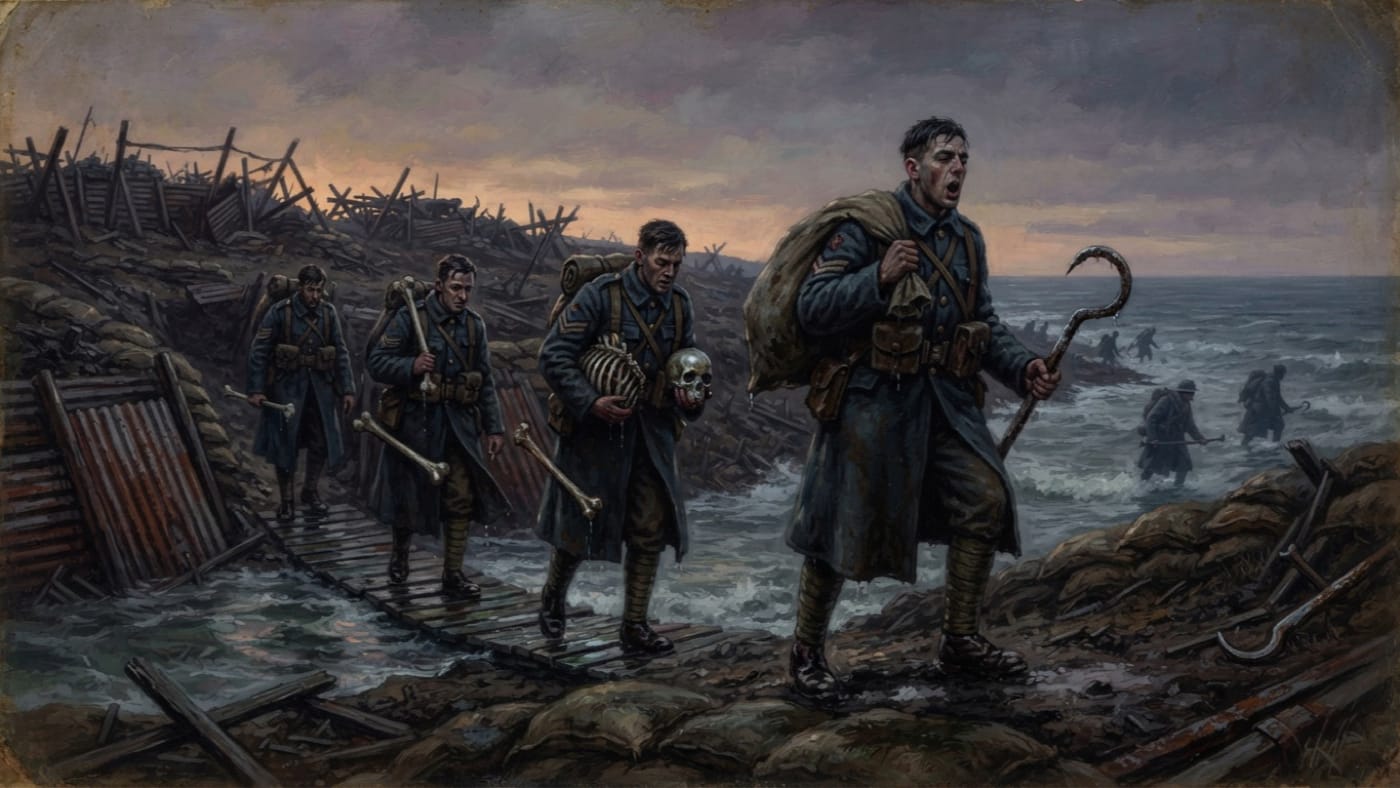
The trenches are Elder and Younger, paired forward works on the Aegean coast in the southern theatre of the Sagittal Line, one to two days by convoy from Thessaloniki. The wash between them is called the Womb of Salt by the survey and the Grave-Tide by the garrison. The tide comes in twice each day, and it brings back the dead. Some are comrades buried that morning under witness. Others are bones no clerk remembers entering. The Lore Book says some of these were buried elsewhere months or years before. They arrive bleached and rattling, as though they had received transfer orders the Bureau never signed.
The soldiers bury the dead. The sea returns them. The soldiers bury them again, and they sing during that second burial.
An early lexicon entry describes the Aegean Sister Trenches as "western forward redoubts along the Aegean shelf."
Correction. They are coastal support works of the southern theatre. The southern terminus of the Line is Bastion-Constantinople. The trenches hold the coast beside it. They are the terminus of nothing except careers.
#On the Dusk Office
The local protocol is short. That is the only mercy the Bureau of War has ever shown the Aegean. In the morning, the dead are buried under witness, and the tag and pit are recorded. At dusk, the collectors go down to the wash, gather what the tide has returned, chant the Hymn of Salt, and reassign the pit if the old one still exists. At dawn the ledger is amended. The protocol forbids the word "failed." I have read a great many protocols, and I have never admired a clause more.
The collectors work in the hour when the light turns the colour of dishwater and the sandbags have been soaking since noon. A wet bag weighs like a sin confessed late. The duckboards float. They step into the wash with sacks and hooks, and with bare hands once the hooks rust through. They bring up femurs, ribs, jaws, finger bones knotted in weed, and skulls with brine standing in the sockets. Teeth turn up in rifle drains. Tags turn up without bodies, and bodies turn up without tags. Each find is carried up the slope through spray and laid on the boards above the waterline.
They sing while they do it. That is the attested fact, and I will not decorate it. The protocol prescribes the Hymn. It does not prescribe a cantor, a tempo, a number of verses or a tune. No text has reached my desk under seal, and I will not print one I have not seen. The dusk returns do not record whether Elder and Younger sing the same words. They record the hour, the collection, the chant and the pit.
The tide comes twice, but the protocol sets the Hymn at dusk only. The garrison has not been told to sing twice. I have not been asked whether it should.
#On Authentication and Reburial
The Lore Book records a neighbouring custom that the soldiers call the Ritual of Bones. Every dusk the bones are fished from the surf and laid out in neat rows. Each is stamped with a red wax seal and buried again. Field tradition holds that an unstamped bone may rise unauthenticated, a heresy in skeletal form. More than one patrol has sworn that its own lieutenant came walking back among them as a skeleton, carrying his old ledger under his ribs. I enter that as testimony. I would enter the lieutenant as well, if he presented himself to Records with a legible tag.
The Hymn and the wax keep the same hour, on the same boards, in the same hands. I place them side by side because the soldiers do. No ordinance in my possession says whether one office governs both. The garrison may simply have found that singing fills the time while the wax heats. The seal certifies that a bone has been handled and entered. It does not make the bone a saint. The Bureau of Doctrine would like the reliquary dealers of Thessaloniki to remember this.
The bureaus dispute why the dead return, as they dispute the causes of everything. Doctrine holds that the sea is guilty and spits back what it cannot absolve. The Bureau of Engineering speaks off the record as Engines and Furnaces. It offers currents and pressure gradients, then admits that the singing beneath the waves complicates its arithmetic. War reports that the dead return to remind the living of discipline. I record all three explanations. The soldiers record the pit.
#On the Other Songs
The coast is crowded with singing, and the uninstructed confuse one song with another.
The Hymn of Rust belongs to the evening rifle-stripping in both trenches. As each flake of corrosion falls from a bolt, the soldiers name it as an hour added to the Line. That hymn concerns iron. The Hymn of Salt concerns the dead. A soldier who sings the wrong one over the wrong object will be corrected by his sergeant with an efficiency Doctrine envies.
The waves themselves are reported to sing. The Lore Book's author claims to have heard the Hymn of Saint Edras there, word for word, in a voice no throat could produce. That song comes from the sea. The Hymn of Salt is sung toward it.
The worst of them is the Drowned Choir at second watch. It is a harmony under the surf that draws sleepers toward the water. The garrison answers it with filthy singing, rifle oil under the nostrils, and a comrade with permission to strike first. No source I hold names the Hymn of Salt as a countermeasure, and I will not grant it a commission it never received. A chant sung at dusk is a poor guard against a choir that sings at second watch. The soldiers seem to understand this, since they are the ones who would drown.
#On Its Present Application
As of A.S. 201, the dusk office continues. The works were hardened in A.S. 72 alongside Thessaloniki's southern fortifications, under offices the later Synod now files under its own names. They have been broken and rebuilt so often since then that the survey treats collapse as a maintenance interval. The Hymn has no recorded date of its own. No composition, ratification or first singing is on file, and I will not lend it a date from a neighbouring rite.
Wrathforged raids come through the surf at low tide under Maldrake's pressure. The tide comes in behind them regardless. The convoys from Thessaloniki bring brine cloth, lime, shells, rifle springs and, in lucky weeks, wax. In the morning the soldiers bury their dead at the edge of No Man's Land. At dusk they go down to the wash with sacks and sing while they gather what the sea would not keep.
The chant has not stopped the returns, and nobody at the trenches claims it has. It is sung because the dead come back. A man carrying his comrade's jaw up a slope of wet sandbags has to do something with his mouth besides scream.