
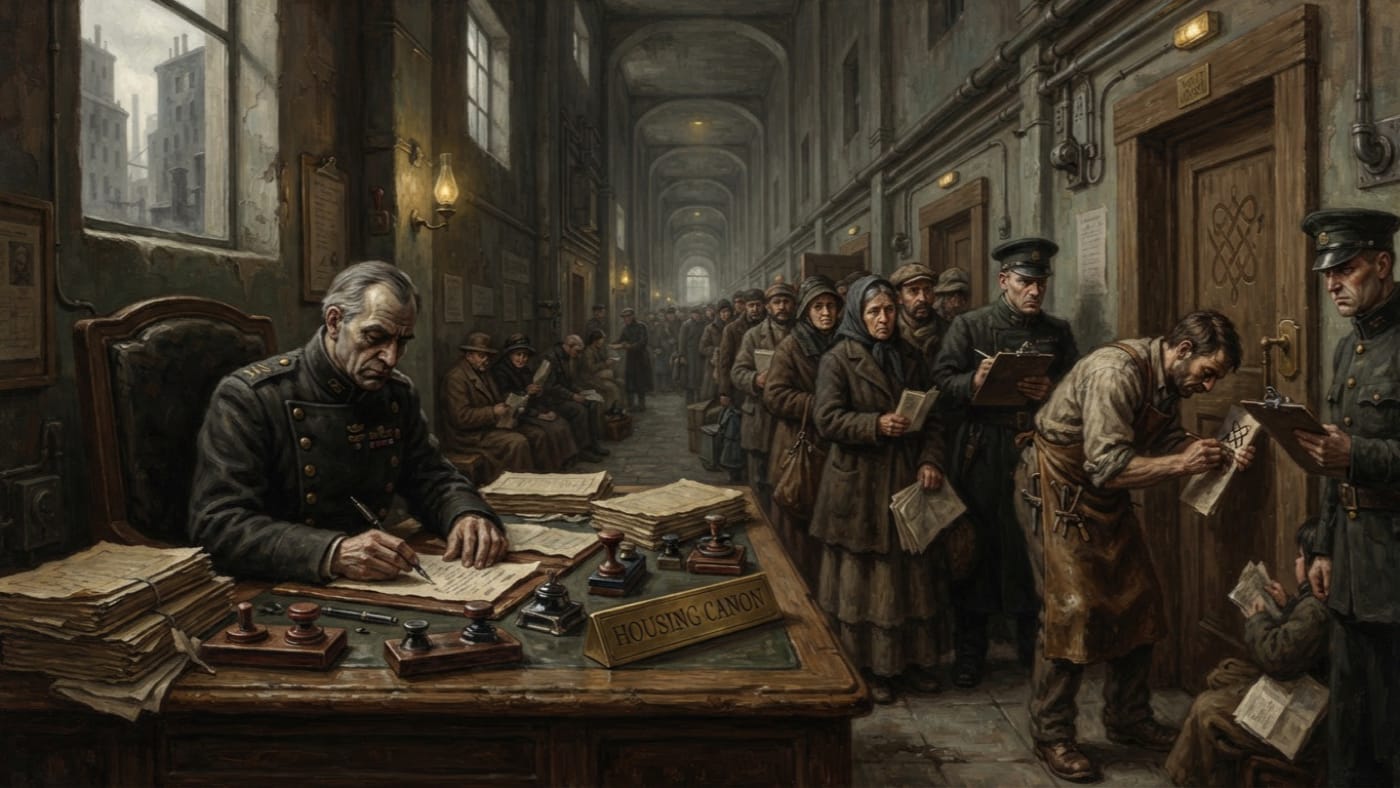
#On the Housing Canon's Station
The Housing Canon is a signature with a chair under it. The Gate-Carvers give the office its full title, the Bastion Housing Canon, and in their trade lore it turns up twice: once among the patrons a Master Knotwright hopes to please, and once among the three officials who can ruin a carver with one signature. The other two are the Sigil Inspector and the Inquisitor. Most offices never get that much attention from the trade.
The Canon's business is where two ledgers meet. One lists the households owed shelter. The other lists the thresholds carved to hold them. A family with papers and no marked door has a grievance and a draught. A marked door with no family registered behind it has used up wax. The Canon stands over the difference between the two, praises whoever narrows it, and later fines whoever narrowed it the wrong way.
I give the office no rank and no reporting chain, because I have found neither written down. The bastion housing offices along the Sagittal Line keep their own habits. A Canon's chair in Bastion-Constantinople and one in Bastion-Irongate may face different windows, but the queue outside looks the same in both.
#On the Household Entered
No household becomes lawful in a single office. It becomes lawful through several, and each has its own clerk, its own stamp and its own cough.
The Ossuary Housing Allocator assigns sanctioned space, issues the permit and occupancy tag, ties the occupancy to a ration entitlement and corrects the map. Then the work order goes to the Gate-Carver. He checks the housing papers against a sponsor or the local ledger before he touches a tool. He chooses the knot class (household, ward, warehouse, grave or ossuary niche) and sets the tri-cord and stencil-frame against the lintel. He cuts. He draws the chalk line, counts three breaths and fixes the wax-tag. He punches the registry with the location and class. Later the Sigil Inspector arrives with chalk and paper, takes a rubbing of the cut and compares it with what was filed.
The carver does not decide who sleeps behind the door. He decides whether anyone may believe the door.
A household without a mark is called unmoored, and the word is accurate. It cannot claim rations. It cannot call upon the Bureau of Mercy. It cannot have its dead recognised. Picture any family you like on a wet stair, with its permit folded into oilcloth and its bedding rolled against the wall, while a cord dries above a stove three streets away. I describe no particular family. The office keeps hundreds of them waiting, and choosing one would be vanity.
In the bastions every citizen sleeps within a reliquary, walled in the bones of the faithful departed.
Narrowed. Ossuary housing is a sanctioned settlement where bone is set into walls and niches, marrow-dust settles on the bedding and occupancy depends on conditions. Most thresholds in the bastions are timber and stone without anyone's femur in them. The Canon's queue includes both kinds of household, and both are equally cold.
#On the Dry Cord and the Waiting Street
At this point the office stops being a desk and becomes a quarrel.
The True Knot carvers insist on the whole ceremony: dry cord, full sequence, witness mark and tool custody counted back into the case. Treating the witness mark as compulsory is their own strictness, since the trade's general practice calls it optional but common. The Fast Hands favour throughput when a block is filling and the bell has already rung twice. These are tendencies inside one licensed trade. Neither is a department, and the Canon has no form on which to file either as one.
Both reach the Canon in the same week. A new block fills, shelter is short, and the corridor outside the housing office smells of wet wool and of people who have run out of patience. A Fast Hand marks door after door before sundown, and the street stays quiet because the families inside have something to point at. A True Knot master leaves more of the block unmarked by nightfall, and the families who are still waiting spend that night working out who skipped them.
The Canon praises whichever carver prevented that day's riot. That much is policy, and a sensible policy, because a riot produces its own paperwork and none of it is pleasant.
Then the monthly tables arrive. The quick carver's returns show shallow cuts, soft proportions, a punch set half a finger from its note, and cords that went wet before they were set. The slow carver's returns show unhoused families, a backlog, petitions about ration claims that could not be honoured, and a patron's letter asking why a block stood dark for three nights. The Canon fines both, each for a different failure, and signs both fines in the same afternoon with the same pen.
The trade's figures for doors completed in a day vary with the speaker. The tallies I have heard are faction commentary, and I decline to promote either into a quota. The Canon needs no quota anyway. A queue does the same work for nothing.
#On the Signature and the Inspection
Among Gate-Carvers the Canon's signature carries more weight than the Canon. The trade's own lore says it can ruin a carver, and the fines fall on both factions. I state no more than that. I have found no evidence that the Canon evicts, quarantines, licenses or executes, and a survey that granted those powers to save the reader's patience would be a forgery with good manners.
A fine survives the month it was signed in. It goes into the carver's record, and inspectors, registry clerks and patrons all read that record. The carver who has been fined learns to cut toward whatever the next table will reward, and so does every apprentice watching him.
The Inspector's work is separate and must stay so. Inspectors authenticate geometry and symbol. They check stencil serials, compare the cut with the registry note, and issue citations, correction orders and confiscations under the sanctioned patterns that the Bureau of Heraldry keeps. The Canon looks at the same door and asks a cruder question: did the household get in, and did it stay in?
Neither question is enough alone, and Cologne showed why. During the Lintel Pogroms of A.S. 112 / 1822 CE, fourteen houses sheltering unregistered persons were found under false Knots with correct geometry. The stencils had been stolen and the registry punches counterfeited. Every one of those cuts would have pleased an eye that wanted to clear a backlog. The trade answered by hardening True Knot discipline and creating the Knotwright Registry. Ever since, a housing office that accepts a handsome carving on its looks has been admitting to a weakness, whatever it calls the practice.
#On Those Outside the Account
The returns count households that were entered. They do not count the ones still standing in the corridor.
When the queue does not move, families do not wait in polite rows. They go out to the grave-field settlements beyond protected accommodation, where the ground is wet and the neighbours are buried. They bargain for dry space, for a room within reach of the bells, for a door that opens onto a clear evacuation corridor rather than a dead-end court. Patrons write letters. Permits turn up twice, once in good ink and once in better ink. Each forged or duplicated permit makes two households claim one door, and two households claiming one door is how a quiet block stops being quiet.
The shadow knotters work in this gap. At night a shadow knotter will carve an outlaw mark over a refugee family's lintel or slip a false line into the registry, and a child may survive the winter because of it. The same carver leaves a door no inspector can trust, and the Bureau of Purity will one day use that as grounds to strip the whole street back to bare wood. The Canon's backlog sends customers to the shadow knotter, and the shadow knotter's work sends the next audit back to the Canon.
Nothing in the record shows a covert understanding between any Canon and the shadow trade, and I accuse no one. Both sides depend on the same queue, but that proves only that both have been looking at it.
#On Present Application
In A.S. 201 / 1911 CE, the year of this survey and not of any founding, the Canon still sits where three demands meet: speed, compliance and a quiet street. Each demand has its advocates and each carries its own fine. The office keeps them together the only way it knows, by praising one demand on the day and penalising the others at month's end.
One entry in the Canon's account has no column. It is the threshold that passed everything: dry cord, matched punch, witness mark, unbroken wax and a clean rubbing in the file. Then a tenant reports that the door was breathing cold at midnight. The returns have no box for a compliant door that failed, so the Canon files the complaint as unverified, notes the door as inspected, and calls the next household forward.