
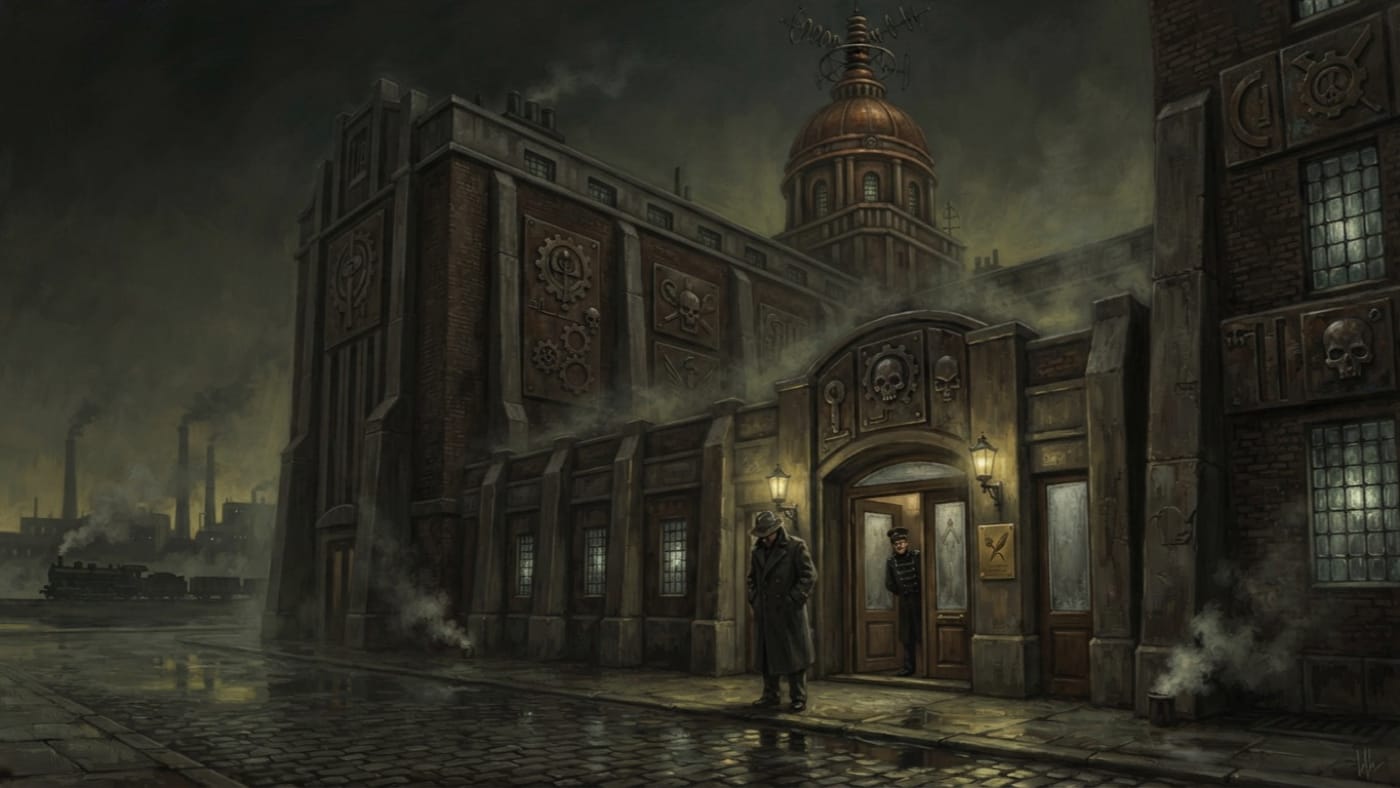
"Only when the wind is east. The wind is always east." — the night porter, Hotel Sigismundus, A.S. 197
The Hotel Sigismundus is a transit lodge in the old city of Warsaw, on the west bank of the Vistula. The Bureau of Pilgrimage operates it for persons whom the Synod has sent somewhere and the railway has declined to deliver. I know it the way a delayed man knows any waiting room: by its smell, by its hours, and by the porter's face.
This is a retrospective dossier. It records the lodge as I met it during my visit of A.S. 197 / 1907 CE, the year a two-day errand for the Bureau of Doctrine became nine days on the Vistula. It does not record the building's founding, licence, rooms, tariff or register. Those are Pilgrimage's affairs. Pilgrimage did not volunteer them, and I was too busy being stranded to interrogate a hotel.
The lodge earns an entry for one reason. It stands on the bank that is supposed to be deaf, and on my seventh night there I heard the Breathing.
#On the Lodge and Its Bank
Warsaw is divided by its river into two ways of lying. The western bank holds the old city and the Bureau Quarter. It has linden trees and pre-Synod cornices, and every major Bureau keeps a forward office there. It also has a population that maintains, through sustained collective effort, the fiction that one hundred and sixty kilometres from the Line amounts to safety. The eastern bank is Praga, where the yards begin, the refugee districts sprawl and nobody bothers with the fiction. Three bridges and a ferry join the two halves. The Bureau of Passage has spent most of a century trying to regulate the ferry, and the ferry has spent most of a century not noticing.
The Sigismundus belongs to the west. Pilgrimage set its lodge among the clerks rather than the coal, and that tells you who it expects to house. I make no claim about who holds its deed. Pilgrimage operates the house, and I have no paper that says more. A Hieromnemon who asserts title without a document is a man asking to be corrected by an archivist, and I have suffered enough archivists.
What I can certify is the smell. It is camphor, candle-wax and mildew, the same triad I have met in every Bureau of Pilgrimage property I have entered, from the pilgrim hostels of the heartlands to this one on the Vistula. Camphor is the Bureau's notion of cleanliness. Candle-wax is its notion of piety. The mildew is what grows when a Bureau holds a building too sacred to ventilate properly. That last is my own judgement. No regulation says it. None needs to.
#On the Two Days That Became Nine
I came to Warsaw to conduct a doctrinal compliance review of the Northern Corridor's chapel network. It sounds tedious and it was. I accepted it because the alternatives were worse, and I have learned to take the tedium I can survive. The review was scheduled for two days.
Warsaw exists to throw things eastward. The Corridor brings sea-cargo in at Hamburg, sorts it at Kanzleiburg and hands it to the Warsaw yards. From there two spurs carry it forward: one north toward Bastion-Königsberg, the other straight across the flat country to Bastion-Brest. When the spurs move, Warsaw is a hand. When they stop, it becomes a cupboard, and whatever it was meant to send forward sits on its shelves: grain, shells, men and, in A.S. 197, one Hieromnemon of the Bureau of Doctrine.
The spurs stopped. A locomotive derailed on the eastern spur and blocked both lines to Brest. I record no cause, because none was given to me. I record no casualties, because none were reported to me. I record no sabotage finding, because the Corridor produces sabotage rumours the way a marsh produces fog, and I will not certify fog.
The Bureau of Engineering estimated four days for the repair. It later revised the estimate to six, and later still to "pending." These were three successive guesses about one obstruction, not three repairs. "Pending" is the word Engineering uses once it has stopped counting, and it has the restful finality of a death notice.
The arithmetic deserves care, because Warsaw's own clerks would bungle it. The visit was meant to be two days and became nine. The seven additional days were spent at the Sigismundus. I have called the whole episode my nine-day confinement there, and I stand by the phrase as a description of my temper. Nobody arrested me. No warrant held me. A derailed engine held me, and it was less polite than a warrant.
#On the Seventh Night
The Bureau Quarter holds an article of faith that the old city lies beyond the reach of the eastern sound. Praga hears the front. The west bank, according to its residents, hears only itself. I held the same belief on my first night at the Sigismundus and kept it through my sixth.
On the seventh night I heard it: a low pulse, irregular, like a heart with an extra beat. It was not loud. Loudness would have been vulgar, and something vulgar can be dismissed as artillery, carts or a drunk on the stairs. It was intimate, which is worse. I do not know what route it took to reach the room, and I will not invent one for the satisfaction of my readers or of the Bureau of Bells. I report what I heard, the night I heard it, and the bank I heard it on.
I went down and asked the night porter whether the sound was always audible from the west bank. He looked at me like a man who has been asked a question a thousand times and expects to be asked it a thousand more.
"Only when the wind is east," he said. "The wind is always east."
That is his testimony, and I enter it under his name, or would if I had his name. I did not check a weathervane. I did not consult a meteorological survey. A Warden of the Sacred Ledger does not audit a porter's weather. He writes the sentence down and lets it do its damage.
The old city, west of the Vistula, lies beyond the acoustic range of the eastern front.
Corrected. This was a belief held in the Bureau Quarter, never a measured boundary. On the seventh night of my A.S. 197 stay, at the Sigismundus, on the west bank, the belief failed in my hearing.
Praga calls the sound the Breathing. The Bureau of Doctrine has forbidden the name, on the theory that naming a sound grants it significance and significance belongs to the Bureau to allocate. No approved term exists to replace it. I use the forbidden one in this entry because the alternative is a blank, and blanks in a Codex attract clerks the way spilled wax attracts flies. Doctrine may correct me. Doctrine will first have to find a better word, and Doctrine has been looking for some time.
#On the Warning
One other conversation from those nine days belongs in this dossier.
A man I will not name suggested that I avoid the Praga district after dark. I was thinking of the Bureau of Shadows at the time, as one does in Warsaw, since that Bureau keeps an office everywhere and the city gives a visitor every reason to remember it. I did not ask the man why. The Bureau of Shadows does not make suggestions in the form of questions, and the answers to questions one never asked are the answers one never wanted.
I do not attach this man to the porter, to the lodge or to any office inside it. The record attaches him only to the confinement. Anyone who reads a Shadows bureau into the Sigismundus's back stairs is writing fiction, and should apply to the Bureau of Festivals for a licence to perform it.
I kept the advice. Praga after dark had nothing to tell me that the old city had not already said through a closed window. The line to Brest reopened, the review was finished, and I left Warsaw with my findings sealed and my coat smelling of camphor, which it went on doing for a week.
Retrospective dossier of the documented visit, A.S. 197 / 1907 CE. The lodge's present condition has not been surveyed for this entry.