
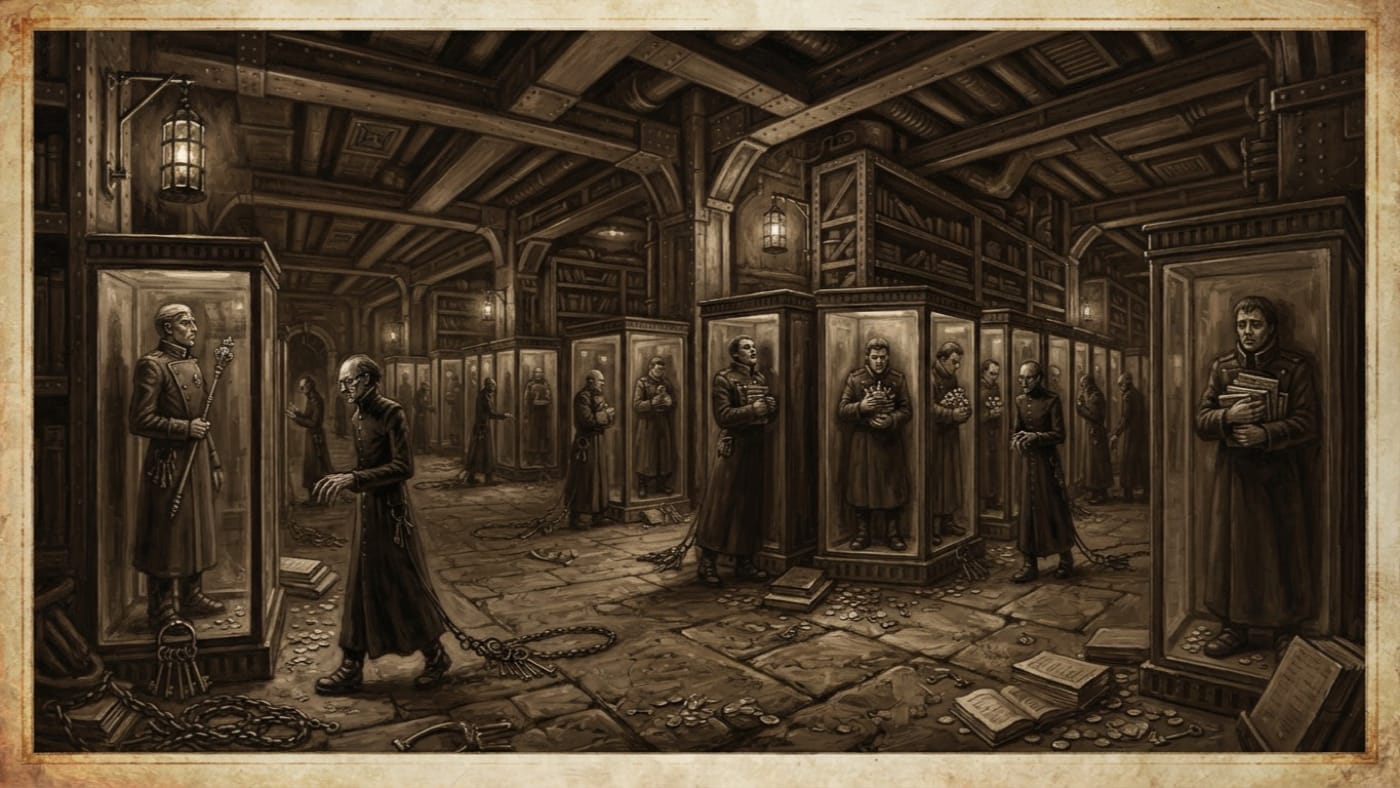
#On Its Station
The Hall of Surplus is the outermost level of the Vault of Ten Thousand Keys. It is also the only room in that establishment a provincial tax-farmer could describe without help. It lies inside the Gilded Chasm, in the Zone 6 country beyond Bastion-Sibiu, where Velmora works the Transylvanian gold-veins and keeps her accounts in Moldavian and Wallachian ink.
The reports agree on the furnishings. Crowns rest on cushions and sceptres lie in rows. Coins from many mints are heaped where a visitor can read their stamps. Silks hang, furs lie folded, and the chandeliers are molten crystal that never finishes dripping. The room is spacious and airy. Several survivors used the word pleasant and were later sorry they had.
The Church does not know who built it or when. Clerks who need to fill a column sometimes put down the Sundering of A.S. 45. That column should stay empty. The level's name comes from the Debt-Binder testimony of A.S. 194, which tells us when the rooms were named and nothing about when their floors were laid. This entry is compiled from expedition reports, that testimony and the published bestiary. I have not been inside, and I intend to go on writing well about the place from Strasbourg.
#On the Surplus
The testimony gives the descent in this order: the Hall of Surplus, the Gallery of Rarities, the Counting Halls, the Appraisal Chambers and the Confessional. Expeditions have observed parts of this sequence. Nobody has observed the Confessional. Velmora's presence there is suspected and has not been confirmed, and I will write it no more firmly than that. The Gallery deals in single, strange objects and has its own entry. The Hall deals in quantity.
That is its economy. The Hall needs no imagination from the visitor. A soldier knows what a crown is. A quartermaster knows a mint-mark. A chaplain may never have touched sable, but he has seen a bishop wear it and has hated him with appropriate humility. Everything in the room is already priced in the visitor's head before he sees it. The Hall saves the Vault the trouble of teaching anyone what to want.
The space also invites a man to stay. A cramped treasury makes him nervous, and a nervous man grabs something and runs. This Hall has room to walk. There is light to read the coin-legends by, and the next case is always a few comfortable steps away. A man is encouraged to inspect, then to compare, then to pick something up so he can inspect it properly. None of this is a crime, and by the time he has done all three he has been in the room longer than he planned.
Wealth is not the diagnosis. Doctrine has never claimed that a man's purse condemns him in the Vault, and nobody has shown that poverty protects him. A poor guard has seen fewer crowns. He has not had the practice in being refused that a rich man gets every day.
#On the Custodians
The Keymasters keep the Hall as they keep every level of the Vault. Witnesses describe thin figures in clerical dress from no century the Registry can identify: high collars, dark coats, spectacles, faces too long for their bones and fingers shaped for locks. Behind each one a ring of keys drags across the floor, and the reports say the sound carries a long way in a room built for carrying sound.
The Bureau of Purity files them as a Vault-bound variant of Velmora's Ledger-Keeper class. A Ledger-Keeper writes down that a thing is owned. A Keymaster decides what each visitor is shown. Their keys are the originals. The keys seized from the Ten Thousand Keys cult in Synod territory are lesser copies, the kind of tokens a provincial lodge hands out at initiation.
This is why a lavish room still works as a prison. The Hall looks like an open treasury, but every case has a lock and every lock answers to a Keymaster. What a visitor sees in the Hall is the selection the custodian has made for him. The display is chosen for the man, and the room is spacious so that he can spend his time looking at it.
Nobody has settled where the Keymasters come from. One school holds that they are former visitors who gained so much access that they became access. The other holds that they are pieces of Velmora's will given clerical shape. No report establishes that a visitor was ever turned into a Keymaster, and I decline to invent the paperwork.
#On Those Who Found Enough
The published record places the Treasure-Locked in this Hall and in the lower cabinets of the Gallery. They are former visitors, alive, standing behind glass and holding the thing they came for. Their eyes move. Their mouths form words that the glass does not let through. Their hands keep hold of the prize.
The prizes in the record are what this Hall would lead you to expect: gold, jewels, crowns, ownership writs, deeds, sealed dowries and purses. Some of these are plain coin. Others are possession on paper, a deed held against the chest or a dowry still sealed. The Locked keep whatever they took.
The Bureau's recorded account of enclosure is short. The visitor accepts sufficiency. He finds enough of what he wanted to stop resisting the room. He stands still. A Keymaster passes behind him. Then the case is closed. I give this as the Bureau's account. No report establishes a general physical law behind it, and I will not supply a procedure that no witness saw.
The faces are the worst of it. The Treasure-Locked show triumph. They do not look like corpses. They do not look like something wearing a dead man's body. They look like men who have closed a profitable deal and are waiting for someone to congratulate them. Velmora's lore is full of people who could never stop acquiring, who count and keep counting and stay hungry inside their own hoards. The Locked are the other result. They are fixed at the point of being satisfied. Both conditions come from ownership turning on the owner, and I will not pretend they are the same condition.
The A.S. 147 account of a man in the robes of a pre-Concordat Macedonian prince, holding a crown too small for his head, is filed with the Treasure-Locked. It does not say which room held him, and I will not assign him this one.
The Locked record once cited early War summaries describing the Locked as "prisoners immobilised by demonic force."
Corrected in the Locked record. They are held by the possession they wanted, granted and then fixed in place. War expected chains because War understands chains.
#On the Record
The record covers fifty-four years. I keep its three kinds of evidence separate: what witnesses observed, what was said in testimony, and what has been concluded from both. Mixing them is how most of our errors were made.
The Second Expedition of A.S. 147 produced the earliest cited account of the Locked. Its observations concern the Vault in general, and Hall-specific detail is scarce. The Third Expedition of A.S. 174 led to the corrected classification of the Keymasters: the early memoranda had called them door-servitors, and after 174 they were understood to decide access themselves. The A.S. 194 testimony supplied the names and order of the five levels. That is testimony from a Velmoran source, and it should be treated as testimony. The Fourth Expedition of A.S. 196 brought back further evidence from inside the Vault, including the lip-reader's transcriptions of satisfied captives. In A.S. 198 the site was placed under standing interdiction and the status of the Locked was settled by inter-Bureau ruling. The Cataloguers entry restates that classification and the ban on recovery.
The Vault's public account reports losses of personnel at this outer level. It gives no roster of who was lost here, and I will not make one up. Some people have come back out. The old claim that nobody ever leaves the Vault is wrong as a count, but it is a sound instinct, and readers should keep the instinct.
What remains to the Church is interpretation. Doctrine reads the Hall as the Vault's cheapest snare: it spends only the desires a visitor already has and saves the stranger temptations for the levels below. I agree with that reading. It is still a reading. No witness has watched the Hall decide anything.
#On the Present Restriction
The Hall falls under the Vault's interdiction. No separate rating has been issued for it, and none is needed, because a level that can only be reached through the Vault's entrance has the Vault's restrictions.
Recovery of the Locked is prohibited and requests are returned unread. That covers a request to recover a crown with its owner still attached to it. No reliable way of releasing anyone has been established. Opening a case may count as accepting the captive's desire as property that can be recovered, which would put the rescuer into the same bargain. Doctrine raised this concern and has not yet seen a reason to drop it.
The standing advice on Keymasters applies in full. Do not follow one. Do not enter a room it opens for you. Do not accept a key from it. Do not count the coins, the sceptres or the keys on its ring. The Bureau of War has twice asked for exemptions on grounds of operational necessity, and both requests went into a drawer. The only sanctioned conduct is refusal at a distance. Visitors are not to ask after the Hall's furnishings or let anyone value them, and no party is to linger in the Hall on the grounds that it is only the first room.
Field officers may assume that their men will find the Hall attractive. The orders are written on that assumption.