
#On Their Office
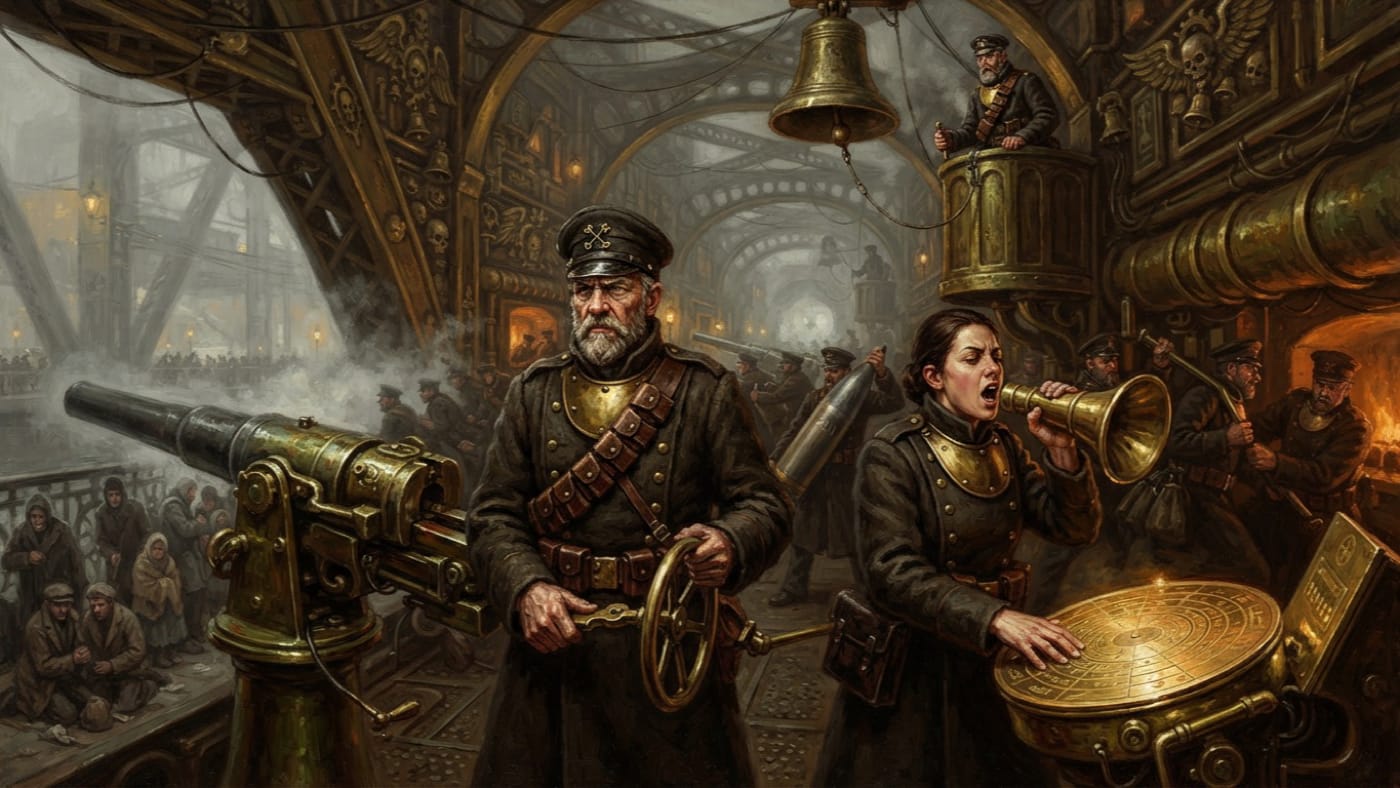
A Gun-Cantor is an artillerist who sings. The Bureau of War approves that definition because it is short. It is also inadequate. Gun-Cantors are trained to bind range, powder, bell and psalm into one firing discipline, so that a shell's arc and the liturgy of its release become one act, performed by one crew between one breath and the next. Where the profession is best documented, at Bastion-Brest on the Bug, they also hold the casemate fire keys, ring the curfew bells and inspect the tokens of anyone who wants to walk from one bank to the other.
The Bureau would like this entry to describe an order spread across the Church, with a charter, a founding seal and a tidy ladder of ranks running down from Marshal to novice. I have no charter. What I have is Brest, a brass-ribbed bridge eight hundred metres long, and the local Gun-Cantor Command, whose public business is defending the river crossing. Its resources are the casemates, the shells and the patrols. Its territory is the Casemate Galleries and the gate towers. Its ranks include a Marshal and a Cantor-Lieutenant. My evidence stops there, so the entry stops there too.
#On Range, Powder, Bell and Psalm
At Brest the procedure goes like this. Before a salvo, Gun-Cantor Marshal Vonn recites the Litany of Correct Arc. Cantor-Lieutenant Sera sings the range tables, turning distance into pitch, and the crews set fuse and elevation to her voice as other men set a watch to a station clock. The casemate bells answer with iron clappers. Each charge of powder gets a thumb-mark of ash. The guns go off together, as a chorus does.
Shells carry numbers and never names. Young gunners are sentimental. A boy who calls a round by his sister's name grieves for it when it leaves, and grief in the casemate stays behind with the crew. A number can go east without anyone mourning it.
This is skilled work. A gunner who mishears the pitch fires long into the marsh or short onto the deck. Wet iron, burned powder and gun oil are the air these crews breathe, and they must keep the tune through it, with recoil hammering the rib and river mist beading on the brass. I have stood in a gallery during drill. The noise is enormous and very precise.
The Bureau of War reports that Vonn's prayers have never measurably improved his accuracy. The finding is correct. It is also beside the point, because the Bureau measured the wrong ledger. No Gun-Cantor claims the psalm steers the shell. The psalm keeps forty frightened men on one beat, and it asks the Creator's attention for what follows. Faith and calculation share a casemate here because nobody at Brest has the room to separate them.
#On the Bells That Govern Movement
Brest's curfew bells do more than end the day. They divide the bridge into permissions. When the hush bell sounds, the West Deck falls quiet, the East Gate is sealed, the Ribwalk is cleared down to single-file truth lanes, and the Pylon Warrens are watched from above. Patrol routes run on bell-time. The people on the deck kneel because the bell tells them to. The Gun-Cantors enforce those divisions with rifles, hymn-shouts and the hard courtesy of soldiers who would rather frighten civilians than bury them.
They also verify absolution tokens, the wax-sealed discs without which no one at Brest moves between districts. Inspecting a token is a different act from issuing one, and the three powers on the span guard that difference jealously. The Bridge Tribunal, under Presiding Judge Elsbeth Krail, decides crossing disputes. The Crossing Bureau, under Seal-Registrar Hett Ruis, keeps the stamps and the identity files. The Gun-Cantors look at the token, look at the bearer and decide whether that bearer walks on or waits. The judge owns the argument and the registrar owns the paper. The Gun-Cantors own whatever happens on the deck once the argument is finished.
Then there is the safety salvo. That is the Bureau's polite term for firing into the crossing lanes during an emergency. At Brest the Marshal decides what counts as an emergency. The Bureau of War has not been eager to look into what counts as safety. One published account says a curfew salvo in the first Confession Echo emergency hit a laundry line and a mule. Vonn's enemies tell that story as farce. Those enemies were not on the deck. A warning shot over a crowded span has to land close enough to be believed, and every civilian on the Ribwalk knows that close enough has no fixed measure.
#On the Custody of Fire
Almost anything at Brest can be bought. The under-deck moorings sell forged tokens, sin-scrip, stolen manifests and passage by skiff through the fog. They cannot sell a casemate fire key. The keys are watched too closely, and the market knows the difference between paperwork, which can be haggled over, and powder, which cannot.
The published command accounts say who holds the keys. Vonn carries one. Sera carries one. The third sits sealed in a reliquary box guarded by two armed novices, who, by those same accounts, have orders to shoot each other if either one starts humming without cause. I report the custody arrangement as it was reported to me. The accounts describe no lock that needs three keys turned at once and no mechanism that knows a sinner's hand from a saint's. The Bureau keeps asking for one, and I will not invent machinery to soothe it.
Holding the keys does not make the guns work. The Brasswright Guild maintains the shutters, the recoil dampeners and the brass of the galleries themselves, at a cost the Bureau of Tithes has never been allowed to audit. Without the Guild the shutters seize and the guns are useless. Even so, the Guild holds no fire authority. A riveter can delay a repair. Only the Command can give the order to fire. The two keep a wary partnership, settled in parts requisitions, and neither side has ever written down how much it depends on the other.
#On the Voices Near Loaded Guns
A trade that fires by voice depends on that voice reaching the right ears. Since A.S. 199, Brest has not been able to guarantee that. The Confession Echo returns sins spoken in the Confessional Lanes hours or days later, in the speaker's own cadence, from shutters, vents, wet rope and deck plates. Whatever the Echo is, it reaches the casemates as noise. A crew that hears its own confessions whispered back by the brass starts singing half a note flat. Half a note at Sera's range tables puts a shell somewhere else.
Vonn's answer was to bar casemate crews from confessing in the lanes nearest the loaded galleries, except under supervised rotation. The order broke Tribunal routing, the Bureau of Doctrine's equal-access sacramental policy and three minor harmonics of the Bell Codex. By the command's own account, misfires fell by half. Doctrine has not adopted that figure as a cure for the wider Church, and I would advise against it. It describes one bridge, one set of crews and one Marshal's restriction.
A Tribunal clerk accused the Gun-Cantor Command of "militarising confession."
Clarified. Confession at Brest was armed long before Vonn arrived. It became armed when absolution was made a condition of crossing and the booths were built inside a bridge under siege. The restriction only acknowledged where the guns were pointing.
The Echo is a problem of hearing. The Nameless Tide is a problem of noticing. In the eastern wire incident of A.S. 200, a patrol reported the approaches clear at second watch. At third watch it found the forward stakes bent inward. No horn had sounded and no sentry had seen anything move. A profession built on bells has a hard time with an enemy that gives no signal before it is already there. The Gun-Cantors do not claim their hymns drive the Tide back, and the registry backs them, since it records that the Tide does not answer to hymns or relics. Judge Krail believes the Blank-Sheet Circle and its nameless crossings have damaged the confessional filter and caused the Echo. That belief is hers. The gunners keep counting shells.
#On Their Present Employment
As of A.S. 201 the Gun-Cantor Command at Brest is on active service. Its guns are loaded, the Guild has oiled the shutters, and the hush bell rings on time. The Command belongs to the bridge's protected class, below the judges and registrars who are warm and well fed, and above the traders, the bridge-workers and the people in the queues who freeze there and go missing in processing. The protection is real. So is the exposure. These are men who sleep beside powder, work in fog and fatigue, and know that a wrong pitch, a seized shutter or a nervous hand can kill the very crowd they were posted to frighten.
The soldiers say the Gun-Cantors never fire late. Civilians say they fire early. The Tribunal says they fire without consulting it. The dead on the deck have filed nothing, which has never stopped the Bureaus from drafting statements in their name.