
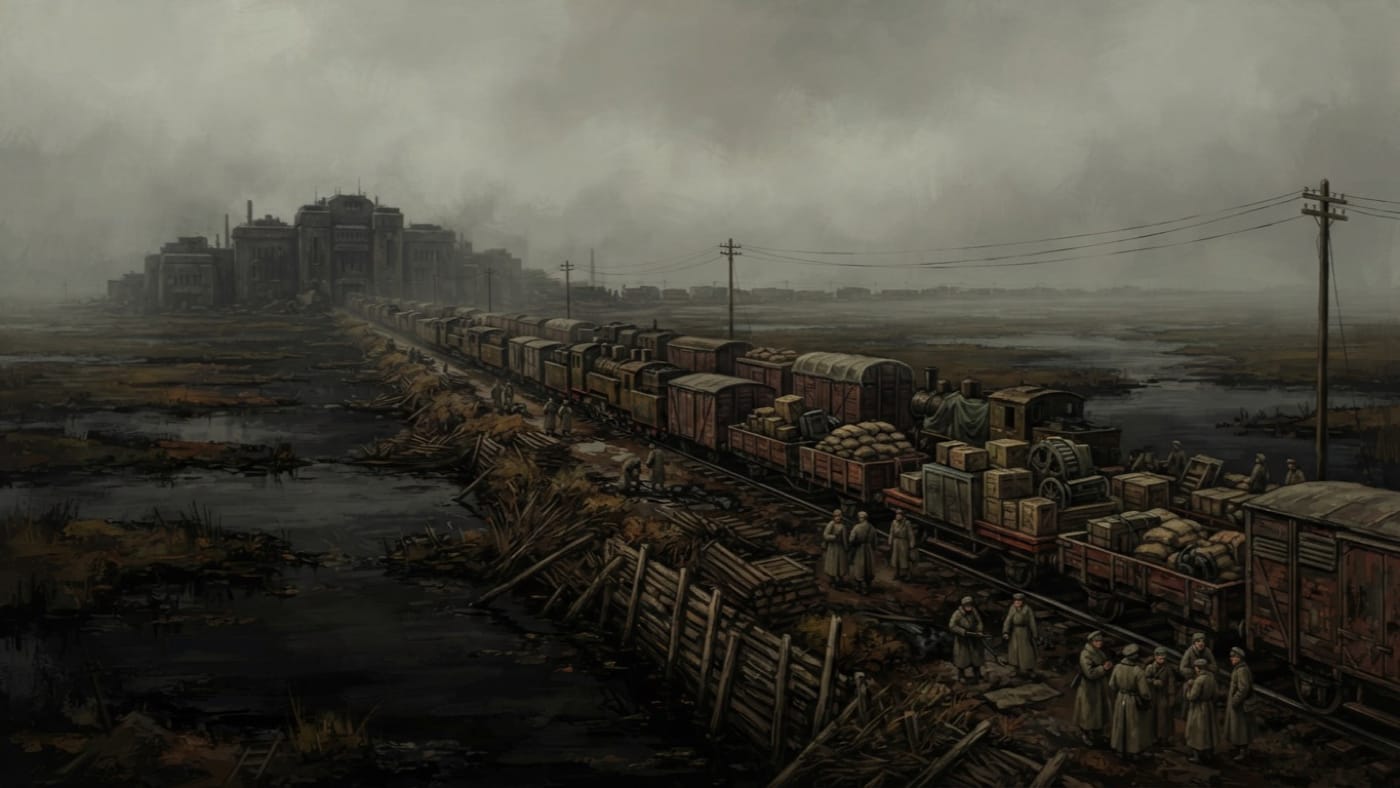
#On the Record Under Review
"Its duty is sterner: they must move." — Bastion-Shipka account, On What Shipka Guards
In A.S. 201 the Bureau commissioned this retrospective of the Grain Riots of the Drava corridor. The commission is generous. The record is not. What survives is one clause in the logistics account of Bastion-Shipka. It appears in the bastion's older working account and again in the published Codex entry. During those riots, it says, Shipka's marsh spur bore burdens far beyond its nominal capacity, trains stood nose-to-tail for days, and clerks in Strasbourg congratulated themselves on "resilient logistics."
That is the whole event as the Ledger holds it: one railway, one queue, one compliment.
None of the sources consulted for this survey gives the year of the riots. They do not name the trigger or the settlements involved. They are also silent on who rioted, which authority answered them, how many died, and how it ended. The date on this survey belongs to the survey alone. The reader who wants a burning granary should look for one in a file that contains one. This file contains a railway.
#On the Reed Road
Shipka stands in the Phocis Marsh Corridor, below the Balkan Mountains and at the western lip of Syrion's fog. The corridor is a trough of black water, reed channels and soft turf. The ground there has never settled whether it is land or water. The Synod drove one raised embankment across it, the reed road. It is narrow and slightly crowned, faced in brush fascines and rough timber cribbing, and it carries the marsh spur of the Sagittal rail. The bastion is built around its inner end as a hand closes on the grip of a knife.
The Shipka account states the embankment's value without ornament: it is the only stable path for leagues. A railway on such ground has no alternatives. No one widens it in a week. No one shunts around it through the reeds or lays a second line on turf that swallows a man to the waist. Whatever the corridor must carry goes along that crowned strip of clay and brush, or it does not go at all.
The older working account dates from when the bastion was still styled Phocis. It gives the general doctrine behind that dependence. Should rot swamp a more direct route, or shells tear up bridges further north, "the marsh spur becomes the last viable thread" by which the downline bastions are fed. It names those bastions Lorraine and her peers. The published account, under the Line's present naming, speaks of coal for the furnaces of Constantinople. Both texts give the spur the same office, which is feeding. Neither says which route failed during the Drava riots, if any did. Neither says where the queued trains were bound. I will not draw an itinerary the record withholds, and the cartographers may keep their pencils in their sleeves.
#On the Burden Carried by the Spur
Nominal capacity is a Bureau phrase. It means the load an engineer will sign for when nobody is shouting at him. The Shipka account does not give the figure, and I will not invent one to make the excess sound measured.
What the account records is a condition. Trains stood nose-to-tail along the embankment for days. Picture it with only what the account supplies: wagons standing over black water, and engines on a crowned strip with no shoulder worth the name. The whole queue bore down on the same clay, the same sleepers and the same cribbing. Beneath it the marsh did what it does to anything heavy that lingers.
The record does not say what those trains carried. It does say what the spur ordinarily carries. Westbound come grain from the western provinces, powder and shell-fuses, coal, lamp-oil, timber, bandage-bolts and tinctures. Rearward go the hospital carriages, bearing the broken to the wards of the Bureau of Mercy. That list describes the spur's ordinary duty. It is no manifest of the riot trains, and any citizen who quotes it as one will be corrected in writing.
Keeping the railway alive has its own ordinary list. Pumps under the west bastion draw the marsh back from the foundations. Line gangs walk the embankment, counting sleepers and checking fishplates. They clear reeds from the culverts, splice broken telegraph wire and replace warped timber. The rail quarter holds one law above all others: no softened stress reading, and no crack left out of the inspection log. A queue measured in days on a single embankment tests exactly those duties. The account does not say who worked those shifts during the riots, what broke, or what was mended. I decline to put words in the mouths of crews whose ledgers I have not seen.
The record states that the spur bore the burden. It does not state that the spur failed. On a line where failure means wagons in the bog, that silence is the nearest thing to a written commendation the rail quarter is likely to get.
#On the Drava Name
The corridor takes its name from the Drava. That river once watered the grain country of the southern Pannonian plain. It is now a yellow-grey artery of Kargath's Blightmarsh, and Cartography forbids anyone to treat its blue ink as water. A river of grain country is a fair name for a grain riot. The name proves nothing beyond that.
Nothing in the record puts Shipka's spur on the Drava's bank, or makes the riot corridor and the river basin the same ground. Nor does it give the Maw any part in a disturbance that the record pins on no one. Hungry men need no demon to riot. The Church has ample evidence of this from its own parishes, and the evidence is filed by diocese.
Three neighbours must be kept out of this file. The Grain Tithe Riots of A.S. 160 were a Rhineland affair, with their own dead and their own saint. They are no alias for this episode. The Shipka account lists the poisoning of the Alpine Marches harvests as a second and separate occasion of overload, set beside the Drava riots and not inside them. The A.S. 130 timing complaint on the Drava spur, and every later quarrel between clocks and trains, belong to the Hourglass files. None of them dates these riots.
#On Strasbourg's Praise
The only human judgment preserved from the episode belongs to the clerks of Strasbourg. They called the logistics resilient. The published Shipka account adds a gloss of its own: the clerks had never walked the reed road at three in the morning.
Fairness to the clerks is required of me, and I discharge it briskly. Their word is accurate as far as a desk can see. The trains moved; the record says they did. Any ledger that eventually receives its consignments will find the railway resilient. Seen from an office, resilience means that no urgent letter came.
Their praise proves less than it pretends. It cannot tell us whether hunger in the Drava corridor eased. It does not say whether bread, soldiers or plain exhaustion ended the riots, or whether every wagon that joined the queue reached the far end whole. It certifies that the system survived. It says nothing of what the survival cost, or who paid. Office praise generally doesn't.
What the clerks admired was a raised strip of clay and brush through a marsh. For days it carried more than it was rated to carry, because the account's own rule for the spur allows no alternative: they must move. Strasbourg named the virtue. The embankment, the pump-room and the line gangs paid for it. The Synod does not crown such places with laurel. It loads them with expectation, and on this occasion it loaded them with wagons.
The riots stay open in the Ledger: year unrecorded, cause unrecorded, end unrecorded. Their consequence for the railway is recorded, and it is hereby certified as surveyed.