
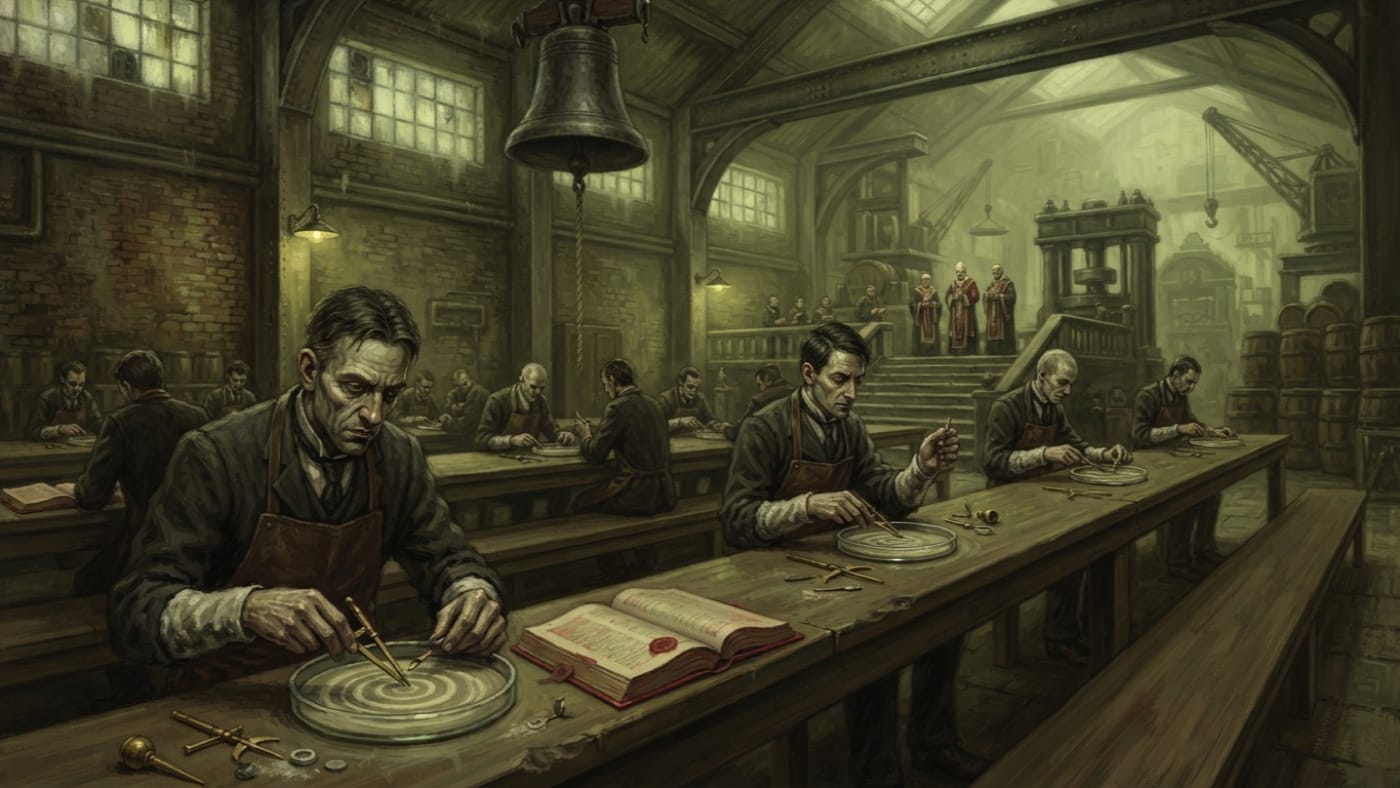
#On the Hall's Station and Approaches
"If it settles, it's true." — Cooperage Compact oath, administered at the Seal Locks since A.S. 104
The Grading Hall of Settled Light is one of the seven districts of the Saint-Dust Cooperage of Mournwater. It is the only one whose silence the other six are obliged to keep. Mournwater sits on its lowland bend in the River-belt of Zone 2. It is a town of pilings, flooded cellars and wharves sweating in perpetual fog, and it sends certified slurry east toward the Sagittal Line. The coopers make casks. The White Steps make purity. The Hall decides whether there is anything worth putting in either.
It smells of chalk and vinegar. The yards smell of pitch and the docks of brine and sweet rot. Cross into the Hall and the air turns sour and dry, as if a sacristan had scoured the fog with pumice. Inside are tables, shallow glass dishes, callipers and vinegar lamps. There are graders in chalk cuffs, and there are ledgers under seals the graders themselves may not break. Entry requires a clean cloth for the doorkeeper. Everything else requires a writ.
The town was a reliquary port by A.S. 110, twelve years after forty-two jars from the Ossuary Shoals broke in the river and the barrels on the wharves drank them. No record gives the Hall's own founding. This suits it. An institution whose business is deciding what happened should not have to prove its own beginning.
#On the Dishes and the Bell
The Settling Bell tolls once each day, and Mournwater stops. Mallets go down in the yards. The lock provosts break off their extortion mid-sentence. Boatmen in the backchannels plant their poles and wait. In the Hall the graders stand over open dishes holding the day's samples, and the silent settling prayer begins. Nobody speaks, coughs or shifts a boot while dust that once belonged to a saint decides how to lie down.
True saint-dust settles in rosary strata: pale concentric rings laid one upon another like the growth of an oak. The graders read them the way a notary reads a signature. The rings identify the material, and the Hall's practice assigns them grades of sanctity. The arithmetic behind those grades lives in restricted books, and I will not pretend to a figure I was not shown. The grader measures with callipers, records the strata and enters a judgment.
The judgment is not a seal. Keep this distinction as the Hall keeps it. Graders observe, measure and record. The certifiers of the White Steps, under Purity Prefect Sister Halvein, press the purity seal. A dish that settles true becomes a recommendation, carried up the hill in a grader's hand. A dish that settles badly becomes a problem carried up the same hill in the same hand, with the grader still attached.
If the strata form, the bell tolls a second time and the town exhales. The approved dust goes into brine and becomes holy slurry. It is coopered into pitch-sealed casks under confession wax, entered on a manifest, and sent through the Seal Locks to the Slurry Docks and away.
If the dust hangs in the air, drifts sideways across the glass or begins assembling itself into something with a shape, there is no second toll. The silence holds while the cause is examined. A dish no wider than a palm can stop a river-town, with its locks, its scrip and its barges, and starve chapels several days' haul to the east.
#On the Hands and the Seals
Graders occupy the anxious middle of Mournwater. They rank below the certifiers and guild masters and above the dock crews and the quarantine poor. They stand close enough to the dust to inhale it and close enough to the seals to be blamed for them. Debt brings many of them to the benches: their futures slips are bought up and turned into mandatory grading rotations. Each grader pays the town in labour-hours and in confession receipts. These are written admissions of doubt, of a tremor in the hand at the calliper, of a breath drawn too deep over the glass. The receipts are taxed, and they are kept. A grader whose doubt is on file can be found in the Crumble Ward whenever that becomes convenient.
The Graders' Quiet Union works at these same benches under the public language of safety standards. Its methods are silence tests and slowdowns, along with whistle codes passed between benches once the bell has released the room. By the account of every party that fears it, the Union holds evidence that Sister Halvein's office passed a tainted batch during the A.S. 197 contamination scare. It marks suspect casks with private signs cut into hoop grooves and wax ridges. Its motives mix in the usual proportions: the safety of its members, the knowledge the Bureau has suppressed, and the excellent price that knowledge fetches.
Pressure reaches the benches from three directions. Master Cooper Vell Arno has his casks staved and pitched before the dish is read, and an empty barrel waiting on a wharf is an argument. Silt-Rook Dema sells counterfeit seals and passage through the backchannels, so every condemnation turns into a sale downstream of the Hall. The futures clerks sit in the taverns turning each minute of delay into a movement of price. A grader's hesitation at the calliper is traded before the grader has finished hesitating.
Beneath all of it lies the baseline ledger, the book of record against which settling is judged. It is falsified. The Hall's entry in the Bureau's survey of Mournwater says so plainly and says nothing more. It does not say who altered it, or when, or which columns, or which shipments passed against the altered figures. Every true reading in the Hall has been true only by comparison with something false. The graders know this, and so do the certifiers. The raids that periodically turn out the Hall's cupboards have produced no original, so far as any record shows.
#On Dish Twelve
The longest silence in the Hall's record fell in A.S. 199. It lasted nine hours.
The accounts agree on the outline. The dust in Dish Twelve rose instead of settling. The suspended grains separated into pale strokes that resembled script. Grader Elian Voss spoke aloud and collapsed. The Bureau of Rites denies that the strokes were legible. Rites has not explained what Voss read aloud if there was nothing there to read.
GRADING HALL INCIDENT 199-SB / DISH TWELVE: Settling failed at first bell. Particulate rose in vertical column and formed ███████████. Grader E. Voss spoke the phrase ███████ ███████ before collapse. Silence: nine hours. Body: unavailable. Dish: melted. Bell: no damage recorded.
"Body: unavailable" is the most carefully chosen phrase in the extract. It certifies neither death nor survival, neither removal nor flight. I have read it in three copies. The wording never varies, which is how one knows it was composed.
Note the bell. The glass melted, and the bell came through without a recorded mark. Whatever happened, it happened at the bench, to the dish and to the grader. The instrument that governs the town was left alone, as though nothing in the Hall had any quarrel with it.
In the same year, three casks stamped pure reached a garrison chapel on the southern corridor. Within hours of the dust being applied, the garrison's dead crumbled into a mobile powder that had gathered at the infirmary door by morning. No document connects that shipment to Dish Twelve. The Hall has noticed that none needs to.
#On the Second Settling
The Bureau of Alchemical Standards and the Bureau of Rites reviewed the anomaly jointly in A.S. 200. The review produced guidance instead of answers. A batch must now pass a second settling before it may go up the hill for a seal. The guidance carries an exception for supply priority, so when the Line runs short, the second dish becomes a courtesy.
A passed dish guarantees nothing on arrival. Crumble-Wrong, the Category Two Irregular Settling Pattern classified in A.S. 194, has turned certified batches in transit. Dust that lay in perfect strata at Mournwater reaches a trench shrine or a field hospital. There it meets breath, fog and the warmth rising from a fresh corpse, and the corpse is reduced a second time. Saint-dust also laces the broadcasts of the Bureau of Orison and Song against the unhymns of the Pale Chanters. The signal engineers who handle it depend on blend logs and custody seals, and every one of those traces back to a grader's entry at a bench.
Lime, salt, pitch burned at thresholds and masks for sleeping all slow the dust. The Hall is supposed to be what stops it.
A.S. 197 memoranda attributed irregular settling to "improper storage humidity and dockside handling."
Withdrawn. Irregular settling has since occurred on the Hall's own benches, in open glass, under prayer and in silence, before any dock hand touched the sample. Handling does not account for dust that misbehaves in front of the graders.
#On the Present Condition
A.S. 201. The Hall is open. The bell tolls daily, and on most days it tolls twice. The Bureau of Alchemical Standards runs Mournwater under second-settling guidance, exceptions included. The Cooperage Audit remains pending, and no date has been set for its completion.
The shapes in the dishes have grown more specific. Early failures gave a curve, a nub, a row of teeth. The red-sealed ledgers now record fragments a grader can match against a catalogue. On my second inspection I watched a sample lie down as a jaw. The grader looked at me, and I looked at the grader. Neither of us spoke, which in that room is the law.
The Ossuary Shoals upstream remain the official source. In A.S. 198 three graders reported that something there was alive, and they were sent to the Crumble Ward for observation. The Bureau's explanation and the benches' suspicion now share the Hall like two clerks who have agreed not to audit each other's figures.
Public seals leave by the Slurry Docks. Private marks leave in the hoop grooves of the same casks. The dock crews have learned to read both.