
#On the Glass Chain of the White-Mantled Inquisitors
Wherein the Warden examines a length of issued glass: its manufacture, its inspection, and the two sounds it is permitted to make.
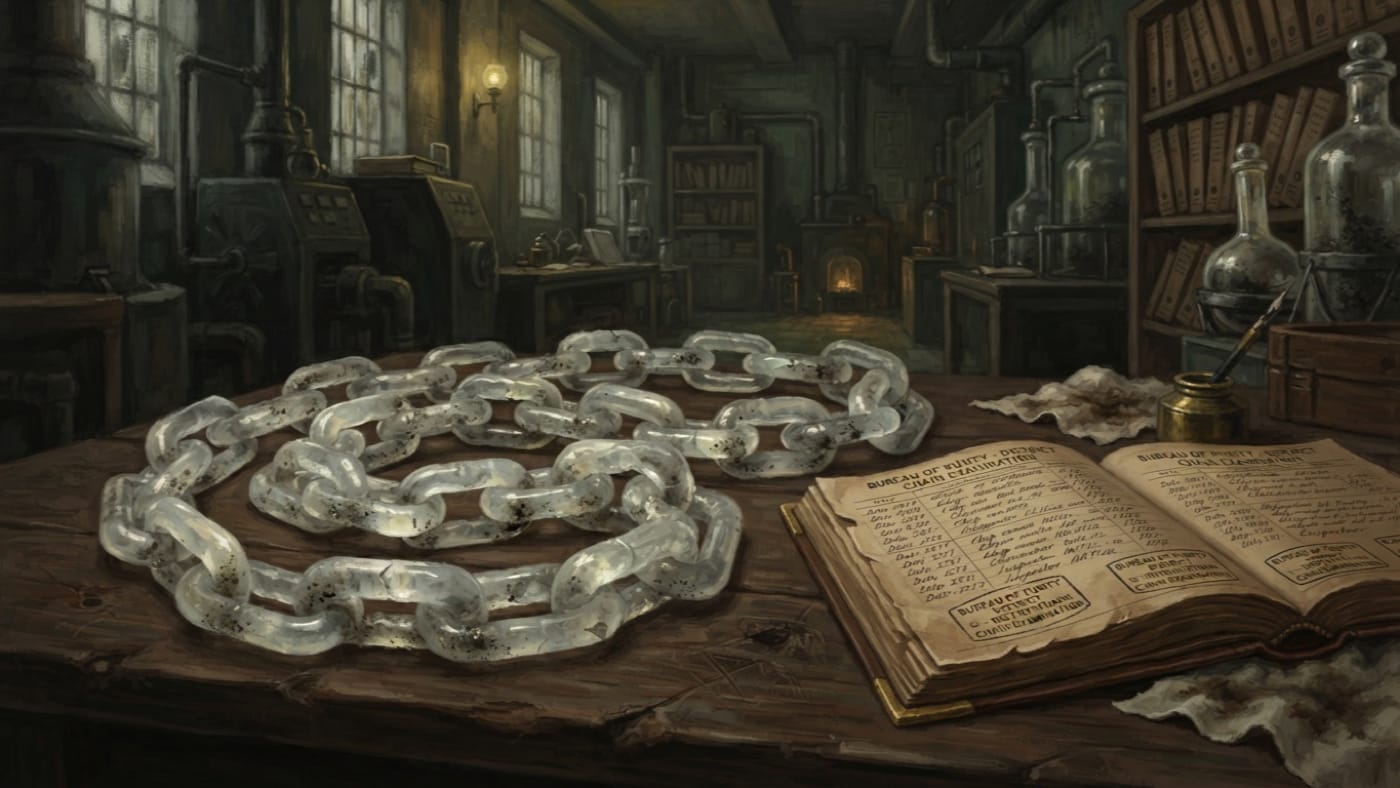
The glass chain is issued equipment of the Bureau of Purity. It is carried by the White-Mantled Inquisitors, who enforce the Bureau's lexicon in market, print-room and tribunal. It is a length of linked glass, wound about the wrists or hung from the neck, and it clicks. That click is the whole of its public reputation. It arrives before the mantle, before the boots and before the warrant. A street that hears it stops speaking at once: mid-sentence, mid-bargain, mid-hymn. It stops with the trained abruptness of a congregation that has learned which syllables cost money.
The street calls the Inquisitors Glasschain on account of it. Certain filing indices write "Glass Chains" in the plural with a capital letter, and this has persuaded more than one provincial clerk that a society of that name exists somewhere in the south. The clerks are mistaken. There is one object, issued many times over. The plural describes a drawer of them.
#On the Restraint of the Corrector
The chain exists for the same reason the Bureau does. The Bureau of Doctrine defines what may be said through the Index Claritatis, which it reissues every seventh day. Purity enforces it, and keeps the Index Damnatus of everything that may not be said, printed, sung or hummed. The Inquisitor works between those two documents, seizing words. A seized word does not cease to exist. It passes into the keeping of whoever seized it.
The mantle came first. Procurator Hildegarde of Mainz decreed it in the Mandatum Candoris of A.S. 62 (1772 CE), so that the instrument of correction might be seen. Being seen proved insufficient. In the decades that followed (the Bureau declines to say how many), Inquisitors discovered that confiscated phrases had a market. They sold them to smugglers. They passed them to the informants of rivals. They spoke them across interrogation tables as a means of pressure, a use the Index does not list among its permitted applications. The Bureau's own officers had become the principal dealers in the contraband they were sworn to burn.
The Glasschain Reform answered that traffic. Its authorship is entered under the name of Chainmaster Veyl. The Bureau has never troubled to say whether that name is a title, a surname or a convenience of the filing room. The Reform carries no date I am permitted to print and no portrait I have been able to find. It does carry a principle: the binder is bound. Every Inquisitor would carry glass, so that the same lexicon governing the citizen's mouth would also govern the hands of those who police it.
Certain school primers in circulation credit Chainmaster Veyl with the institution of the white mantle.
Corrected. The mantle belongs to Procurator Hildegarde and the Mandatum Candoris of A.S. 62. The chain is a later measure, aimed at a different rot: the trade in seized words. The primers remain in circulation, because primers always do.
#On the Glass and Its Wearing
The links are forged in the Bureau's own furnaces from a compound that includes silica, bone-ash and consecrated sand. That is the published formula, and the word includes is doing a great deal of labour in it. The Bureau releases no proportions, no furnace heats and no word about the bone. Questions about the bone are not encouraged.
Each chain is issued at a standard length, which the Bureau measures and no one else in my hearing has stated. Glass of this make is fragile. It chips against a doorframe, cracks against a cell bar and scores against the iron rim of a seizure box. An Inquisitor wears it in one of two ways. One is wound wrist-to-wrist, a loose manacle the wearer fastens personally. The other is hung at the breast in the manner of a rosary. Either way the links hang free to touch one another, and that is intended.
Rank shows in the glass and almost nowhere else a civilian could read it. The Chalkling, at the bottom of the ladder, carries chalk and no chain at all. The Mantle Examiner carries the ordinary issue. The Chainmaster carries heavier, thicker links, which in certain light show a faint luminosity. The Bureau attributes this to the consecration. The foundry workers who make the links attribute it to phosphorescent sand drawn from the outer perimeter of Bastion-Shipka, where, they say, the ground still glows from Syrion's passage. I record both accounts and certify neither. The furnace men have the advantage of having stood beside the sand.
#On the Weekly Examination
Every morning the Inquisitor checks the chain for chips before collecting the day's seizure lists. Every evening the Inquisitor wipes it with an ash-cloth, link by link, before hanging up the mantle. These are the officer's own rites, performed alone. Every chip goes into the log. A Chalkling learns always log your chain before learning most of the Index.
Once a week the chain goes to the Chainmaster's table. The district's links are laid out under the lamp, and the Chainmaster looks for three things: chips, cracks, and the faint grey discoloration the Bureau associates with exposure to forbidden smoke. A clean chain passes. A marked chain raises a question, and the question always takes the same form. The Bureau defines improper contact as any interaction with forbidden material that is not simultaneously recorded, witnessed and sealed. A chip with no entry in the log suggests such contact. A grey cast with no burning on the record suggests that the officer stood near a fire the Bureau did not light.
Suggestion is not proof. The Bureau knows this, and files suggestion in the same drawer as proof. A link chips because a door was narrow. A link greys because a tavern chimney drew badly. The glass records contact with the world and nothing of what was said in its presence, and no unchipped chain has yet certified anyone's innocence. What it produces is a trail: a chip, a date, and a log entry that either matches or does not. The officer becomes evidence against the officer. That was the Reform's intention, and as a filing principle it is elegant.
As a remedy it is incomplete. The trade in seized words has survived every inspection the Bureau has devised. The faction the street calls the Shadow Crew still sells denunciations and trades forbidden phrases like coin, and its members carry chains like everyone else. Some of them carry the cleanest chains in their districts. The Purists, who burn first and file afterward, carry the most chipped. The Chainmaster's table rewards the careful, and the careful include the corrupt.
#On the Sound in the Street
The ordinary sound is small. Glass touches glass as the wearer walks, giving a cold, dry click that can be heard at ten paces in a quiet room. In a market it carries less far than its reputation suggests. It does not need to carry far. The faithful have been trained to listen for it, and a quiet room is easily made.
In Sofia the population regards itself as occupied and complies with a precision that borders on sabotage. There the glass chains belong in one breath with the White Cloaks and with the rooms where the answers are decided before the questions are asked. The city does not separate the click from the interrogation that may follow it, and it has no reason to. For the record, the chains Sofia hears are standard Bureau issue, worn by the Purity detachment posted there. The city's connection to the object begins and ends at its ears.
The wearer hears the chain too, at every step, for years. A chip is a question at the weekly table, and a clean chain is an answer. Inquisitors far gone in service polish the links until their fingers bleed onto the glass they are trying to clean.
#On Singing Glass
The click is the chain at rest. The singing is something else.
Some language crosses from ordinary prohibition into what the Bureau terms lexical breach, the threshold at which a phrase becomes, in Doctrine's judgment, demonic in character. When that happens the glass sings. The tone is high and thin, like a wet finger drawn round the rim of a wine glass. The links vibrate, and they catch the light at angles the lamp does not account for. Most forbidden words never do this. A seditious pamphlet draws no sound from the chain beyond the click of the officer burning it. Singing phrases are rarer, and their rarity is the only comfort the Bureau's figures offer.
The field rule is short enough for a Chalkling to keep: if the glass sings, stop talking. After that the procedure climbs the ranks. An Examiner files a breach report and evacuates the site. A Chainmaster seals the district and summons the Glass-Canons. A Glass-Canon enters alone, carrying two chains and equipment the Bureau does not catalogue in any document I have been shown.
The second chain is black. I can report that it exists and what colour it is. No record open to me establishes what it is made of, what it is used for or how it relates to the ordinary issue, and the Canons I have met have declined to elaborate. Why the glass sings is likewise held open. Doctrine names the event, but to my knowledge it has published no cause, and I will not supply one on the Bureau's behalf.
In this year's account of the Inquisitors, drawing on the Bureau's internal figures, I reported a fourteen percent increase in singing-glass incidents since A.S. 195. I do not repeat it here as a law of nature. I repeat it as a figure the Bureau would prefer went unrepeated.
This week the chains on the Chainmaster's table will be examined for chips, cracks and grey. They will not be examined for song. The examination form has no column for it.