
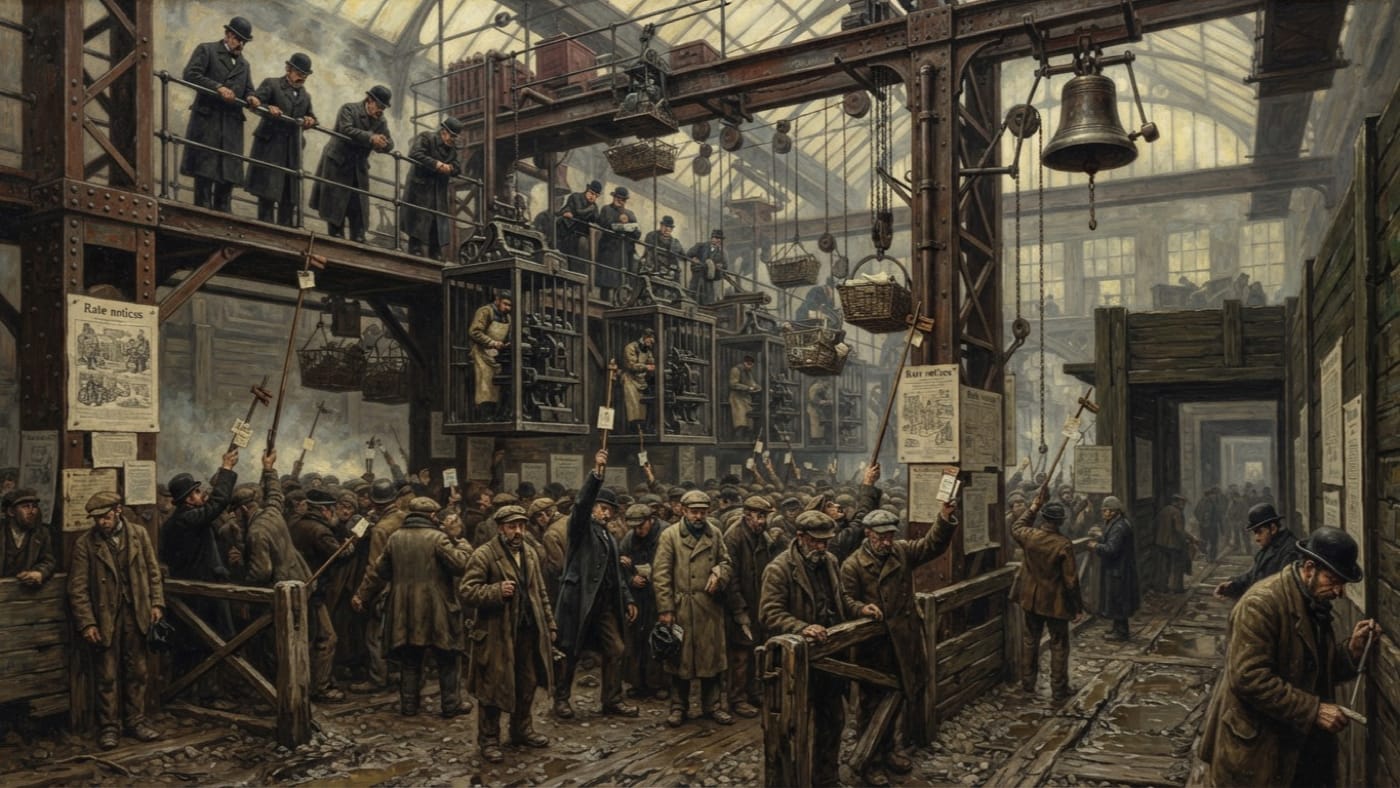
#On the Third Gate
Gate Three of the Queue Road is where a traveller stops being someone in transit and becomes an open account. It is the third of the Road's nine numbered checkpoints. It has neither the largest court nor the cruellest one, since Gate Nine holds both distinctions with its hearings and its collars. Gate Three's distinction is that it does the first counting. The dawn bell-mark is struck here. The Bell-Mark Gantry spans the gate. Past the stamp windows the processed crowd is fed into the wet timber lanes of the Barricade Maze, which is closed at its far end by the grievance screens of Gate Five.
The Directorate keeps the gate and the Gantry strictly apart, because two things can carry two budgets. The Gantry is iron equipment: catwalks, clerk cages, bell-hammer frames, stamp balconies, paper baskets, and the ledger wheel in its housing. Gate Three is everything the iron spans and everything that collects beneath it. That means the approach where the crowd thickens, the passage under the cages, the rate notices nailed where nobody can avoid reading them, the witness balconies, the rope-controlled mouths of the Maze lanes, and the processing station that turns all of this into ledger.
The gate is built in storeys, and the order of the storeys is doctrine. Travellers stand on gravel and soaked plank. Clerks work above them in cages. Witnesses stand higher still and certify that the clerks have done what clerks do. Under the gravel run the drains and maintenance passages of the Maze, where other people move without any stamp at all.
#On the Opening of the Minute Account
At dawn the clerks take their cages and the lane wardens lift the paper poles. Travellers hook their permits, passage slips, witness cards and debt revisions onto the poles and raise them toward hands they cannot see against the morning. The weighted press drops. The bell over the cage sounds for the ledger wheel, since the crowd was never its audience. The traveller now carries a thumbnail of ink giving hour, lane, clerk and rate class.
That mark opens the traveller's minute account. Every interval between it and clearance at the next gate is entered as ledgered waiting. Outsiders keep calling this a toll, and the error is forgivable, because they come from places where a toll is a coin passed across a bar. At Gate Three the ordinary traveller pays no coin to stand. He pays by standing. The Directorate records his standing, values it at the day's rate and turns it into stock. Minute credits are then sold to anyone who can afford faster passage. The purchased hour carries a merchant forward, while the waiting that gave it value stays in the lane with a widow attached.
A missed mark, a failed audit, a body entered in the wrong lane: each of these becomes minute debt, and minute debt compounds. It is settled far down the Road. Gate Nine either conscripts the debtor for labour or reclassifies him out of the record, and the Null Verge takes whatever reclassification leaves. Gate Three only opens the column. It has never had to close one.
The procedure has a pedigree. The A.S. 97 Latch River crush showed the gate courts how much waiting a crowd could be made to do. The Directorate was constituted in A.S. 102, minute pricing began in A.S. 104, and the First Continental Levy of A.S. 110 made the arrangement necessary. Directorate maintenance rolls date the Gantry's first iron frame to A.S. 111. Records keeps a receipt dated A.S. 109. Neither document says when Gate Three first stood as a gate, and I will not settle a quarrel between two offices to spare readers an ambiguity they have done nothing to deserve.
#On the Hands Above the Lane
The Synod Permit Directorate staffs the gate the way it staffs everything, with as many hands as possible and as few names as it can manage. Time Clerks keep the books. Stamp tenders keep the wax hot, the ink wet and the presses clean, and they work the baskets that run between the cages. Permit Wardens inspect documents at lane level and decide which raised paper is worth a clerk's wrist. Queue Marshals handle the crowd itself with rope, baton and the pressure they keep on the mouths of the Maze lanes. Witnesses on the balconies certify that bell came before mark. When an official witness faints, or starts saying that a bell rang from somewhere it should not have, the Witness Rental Houses of Stamp Court Row send a replacement at interval rates.
Authority over the gate sits elsewhere. Director Othmar Vell sets price bands at Directorate House, and Gate Three's boards show his numbers without his ever standing under them. Clerk-Prime Yoren's Collegium defends clerical immunities on Clerk's Mile. Mistress-Court Sera Nox hears appeals at Gate Nine. No roll I have seen names a magistrate of Gate Three. The gate is governed by its rate notices, and nobody has ever appealed against a notice.
#On the Unstruck at the Windows
The Clock Heretics, whom the Road calls the Unstruck, misalign the stamp windows at Gate Three. The rest of their catalogue is small and done by hand. A pebble under a hammer stop makes the stroke fall short or late. Lampblack over a rate board turns the morning's price into a smear. Queue markers swapped between lanes move a whole crowd into another rate class. Ropes are cut at the Maze mouth where the Drift runs thick. And there is singing under the Gantry, pitched a beat away from the authorised peals, until some clerk's hand comes down half a breath behind the bell. No file I have read says who did any one of these things, or when. They reach the Directorate as damage reports. They never come with a confession attached.
Their doctrine is a single sentence: No bell owns the hour. The sentence could have been cut for Gate Three, because this is where the hour is first owned. Before the mark, the waiting belongs to the body that does it. After the mark, the ledger owns it. To the Unstruck, a window knocked out of true is a short restoration of something stolen. The Directorate counts it as revenue injury. The Bureau of Purity counts it as minor temporal sedition, a phrase chosen to sound like a parking offence.
Brother Senn speaks for this doctrine from the culverts under the Maze. Purity's posters show him as a commander. The seized sermons show a preacher. The Unstruck reach the gate through drains and maintenance cuts. What moves them is timing, hunger and the chance of a dry passage, and nothing in the evidence amounts to a chain of command. Their chapels are elsewhere under the boards. They come to Gate Three to work.
#On Marks That Arrive Before Their Hours
The Minute Drift was first formally classified in A.S. 194, in the Maze lanes between Gates Three and Five. The Bureau of Rites classed it as a Category Two Localized Temporal-Scribal Disturbance. The Bureau of the Hourglass classes it Class II-Extractive, and each office treats the other's label as a clerical lapse. The symptoms gather at the mouth of the gate: bells that strike twice, ink that dries before the press has finished, shadows lying at the angle of hours not yet called, intervals that go missing, and bodies that no longer match their papers.
After the spring of A.S. 200, when minute prices doubled overnight and no decree explained why, the Drift spread and came up to the Gantry. Papers took the same mark twice with a blank minute between, and the ledger counted that minute both times. Others took marks for later hours: Vespers at dawn, tomorrow's lane seals before breakfast. Supervisors confiscated the cards. In the autumn Gate Nine closed for sanitation, and the queue backed into the Maze until it was standing under Gate Three's own windows.
Bureau of Rites notice, A.S. 194: Minute Drift within the Barricade Maze is "mild, contained, and non-escalating."
Clarified A.S. 201. Mild means a majority survive it. Contained means it was first observed where the notice says. Non-escalating means no officer licensed to write the word escalation has signed it. The notice remains posted at Gate Three, where the people it describes can read it while it happens to them.
The sealed correlation notes go further. They record Unstruck interference falling in the same districts and periods as reduced extraction volatility from the Apparatus beneath Gate Nine. A stamp that falls late at Gate Three appears in those files beside a surge that failed to arrive further down. Public pursuit grew more vigorous over the same period, and arrests did not keep pace. The doctrine is condemned and the interruption is real. Its usefulness exists in restricted commentary, which is the only form in which the Synod is willing to keep it. What the Apparatus produces, who built it, and whose desk reads these correlations are all blank in the files I have handled. I leave them blank here.
#On Present Passage
In A.S. 201 Gate Three is open and processing under the Road's Amber assessment. The Directorate has added Hourglass observers, double-ledger comparison, ink-delay strips, clerk rotation, sealed bell-hammers and paired witnesses. Each measure creates more records. Duplicate marks still slip through during surges. Future stamps still turn up on wet paper. Pebbles are still found under the hammer stops, the rate boards still have to be washed by mid-morning, and the bell still rings for the wheel.