
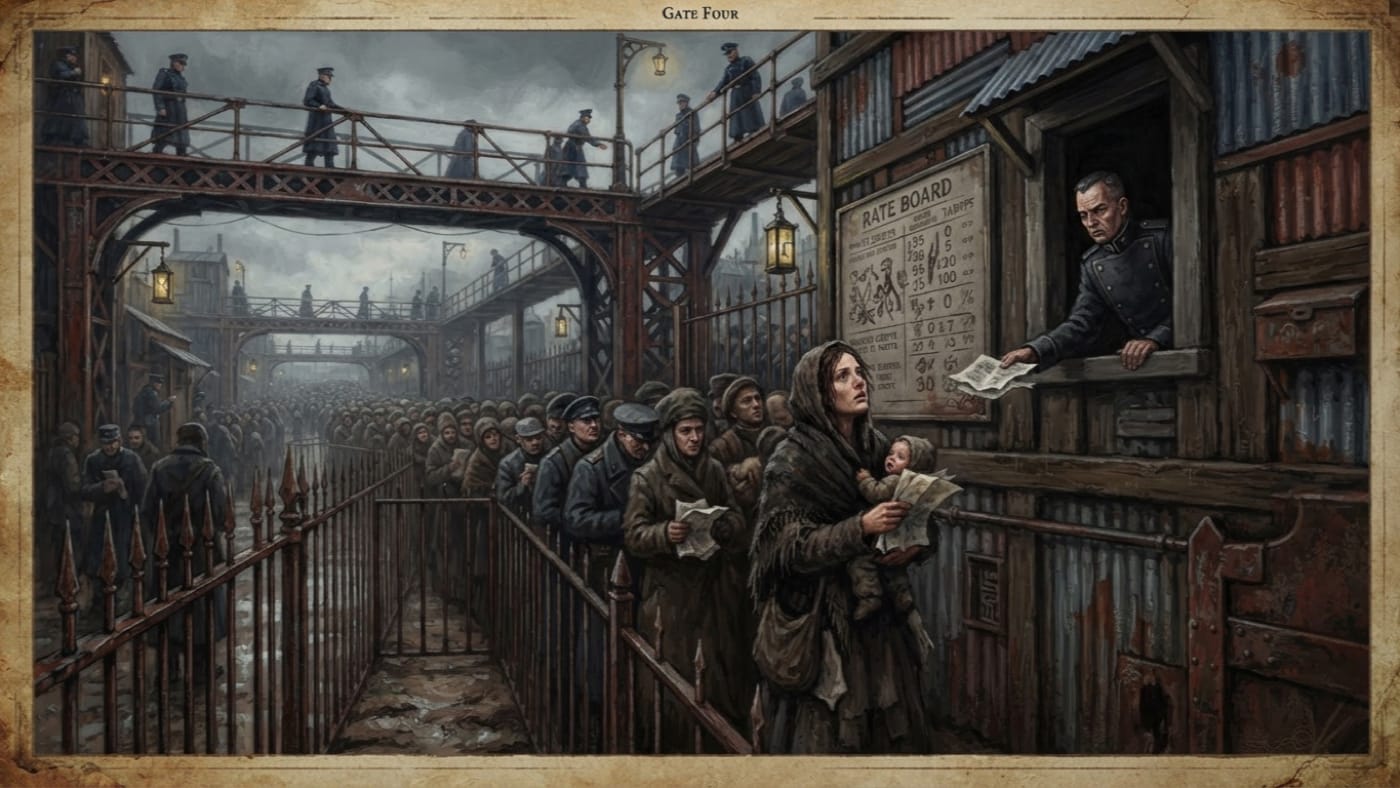
#On the Fourth Gate
Gate Four is the fourth of the nine inspection gates on the Queue Road. It would have no entry in this Codex if the Church's own heretics had not given it one. Nothing about it needs a chronicler. It has no gantry worth engraving, no hearing hall, no chamber surveyed by Engineering and no Director in residence. It has a lane, a window, a clerk, and a line of people waiting to be named. Every gate on the Road has those. Gate Four has them in the usual quantity.
Its distinction is a sentence. The doctrine of the Unstruck, as Purity's seized transcripts preserve it, holds that a mother waiting at Gate Four loses an hour whether a merchant purchases the credit or not. The woman has no name in the record. She has no date, no parish, no stated errand and no recorded outcome. She is an illustration, and heretics choose illustrations as carefully as the Bureau chooses seals. They put her at Gate Four because Gate Four is unremarkable, and an unremarkable gate is where most of the Road's hours are actually lost.
That is reason enough for a file. The Directorate measures its revenue at the great nodes. The minutes themselves are spent at places like this one.
#On the Lanes and Their Custody
The gate stands in the middle reach of the Road. The Barricade Maze occupies the controlled lanes between Gates Three and Five, and simple counting places Gate Four somewhere within that stretch. The surveys available to me do not say exactly where it stands or which lanes feed it. I decline to draw a plan the Directorate has not sealed. A man who invents a site plan for the Queue Road will find that a marshal has moved the fences before the ink dries.
What can be described is what every gate on this reach shares: wet timber lanes, rust-iron fencing, and gravel ground to paste by boots and cart rims. There is a stamp window, sometimes glazed with salvaged booth glass, set at a height that makes the petitioner lift the paper and lower the eyes at once. There is a rate board. Above it all run the catwalks. Clerks, runners and officers of the Synod Permit Directorate cross them at walking pace over heads that have not moved in an hour. Officials travel above the line. On the Queue Road that is no figure of speech. It is joinery.
Each gate sits as a small tribunal of the Gate Courts. Permit Wardens hold the lane and Time Clerks record it. Queue Marshals keep the lane calm, or sell calm by the lane. Stamp tenders stand at the wax. Gate Four follows this pattern. I can certify no jurisdiction peculiar to it.
Two exclusions belong in the record, because copyists keep making the same mistakes. The Bell-Mark Gantry stands at the Third Gate, and its iron does not reach the Fourth. The largest court, final reclassification and the conversion of unpaid debt all belong to Gate Nine. Gate Four is a station of passage. It neither opens the account nor closes it.
#On the Account of Waiting
The Road began as a wound and became a till. In A.S. 97 a false plague rumour at the Latch River ford set off a merchant panic down the central artery. The Road had been built for throughput, and for a week it became a press. Records counted three thousand dead in the crush and five hundred more in the fevers that followed. The Bureau of War answered with nine inspection gates. The Directorate was constituted under joint Records and War seals in A.S. 102. Minute pricing began quietly in A.S. 104 and was policy by A.S. 110. The record does not say which of the present gates rose in that first response, or whether the Fourth was always the Fourth.
Crowd control became revenue within thirteen years. I admire the efficiency. I am paid to.
The mechanism is simple enough to be preached against in a drain. A traveller's waiting is recorded by bell-mark and ledger, and recorded minutes become minute credits. The credits move upward. Licensed traders buy them, and with them a way past the people who produced them. Clerks correct entries for a consideration. The Directorate's rate boards revalue the credits daily. Coin exists on the Road, but the Road prefers hours. Hours are harder to hide in a boot.
The ledger does not record what a minute costs to produce. The traveller at Gate Four must stay where the clerk can call them. The clerk calls once, and an absent name loses its place. So the traveller stands in winter sleet or summer dust, in a lane where the crowd presses from behind and the fence presses from the side. Bread is bought in minutes at the stalls. A bunk in the Hostel Ribbons is rented by the hour and may lawfully be refused. Papers get damp, and a clerk may decline to read a damp paper. Hunger keeps its own count and does not consult the bell.
Minute debt compounds. If it goes unpaid, it ends at Gate Nine in labour conscription, or at the Null Verge in erasure. Gate Four does neither. It only adds to the column.
#On the Unstruck's Objection
The Clock Heretics chose this gate for their parable, and the choice should be read the way a Doctrine examiner reads any heretical example: for what it assumes.
It assumes that time comes before its price. The mother's hour passes whether or not a merchant buys the credit it produces. The purchase changes only who profits from an hour already spent. Brother Senn, the current voice of the Unstruck, teaches that the Creator gave succession — dawn, labour, prayer, sleep, death — and that the Directorate has cut it into stamped fragments and sold them upward. Gate Four gives him a fragment so ordinary that no listener can dismiss it. Every traveller on the Road has stood in that lane, or in one exactly like it.
The congregation meets in the culverts beneath the Barricade Maze. That puts Gate Four's foundations within walking distance of heresy, yet no document I have read names the gate as a site of it. No Gate Four chapel is recorded. No sermon, arrest or act of sabotage at Gate Four is on file. The Fourth Gate is the heretics' example. It has never been their battlefield.
A prior Purity notice described the Unstruck as "mechanical idolaters worshipping clocks."
Corrected after the seizure of sermon transcripts and an oilcloth-wrapped pocket-watch. The Unstruck keep their wrapped clocks as witnesses to time that has passed. They consult them instead of praying to them, which Purity finds more alarming.
The middle reach also suffers the Minute Drift, which was classified in A.S. 194 as a temporal-scribal disturbance of the Maze. Its signs are doubled bell strikes, ink that dries too fast, and people in the line who swear they have stood a week when the sun allows only a day. No manifestation at Gate Four has been reported to this office. The Doctrine file on the Unstruck cites sealed correlations between their interference and reduced extraction volatility from the Apparatus beneath Gate Nine. The same file reports that an office without a name seems to find the arrangement useful. Those observations concern Gate Nine. I note them here so that no clerk moves them to the Fourth.
#On the Present Passage
As of A.S. 201 the Road is under strain. The spring rate adjustment of A.S. 200 doubled minute prices, and pressure in the Maze rose with them. The decree came from the Directorate for the whole corridor. Gate Four received it like every other gate: the rate board changed, and the line did not shorten.
The gate still works. Lanes are assigned at the dawn bell-marking. Appeals surge at midday and are referred onward. At curfew the fences lock and the patrols squeeze the lanes. Whatever forms in the side alleys after dark is the business of the Queue Marshals and, now and then, the Bureau of Purity. The traveller's body keeps one account and the clerk's ledger keeps another, and the two have never been reconciled. The Directorate holds this to be the traveller's error.
The waiting mother remains in the sermon, nameless and undated. As far as this office can establish, she is still in line.