
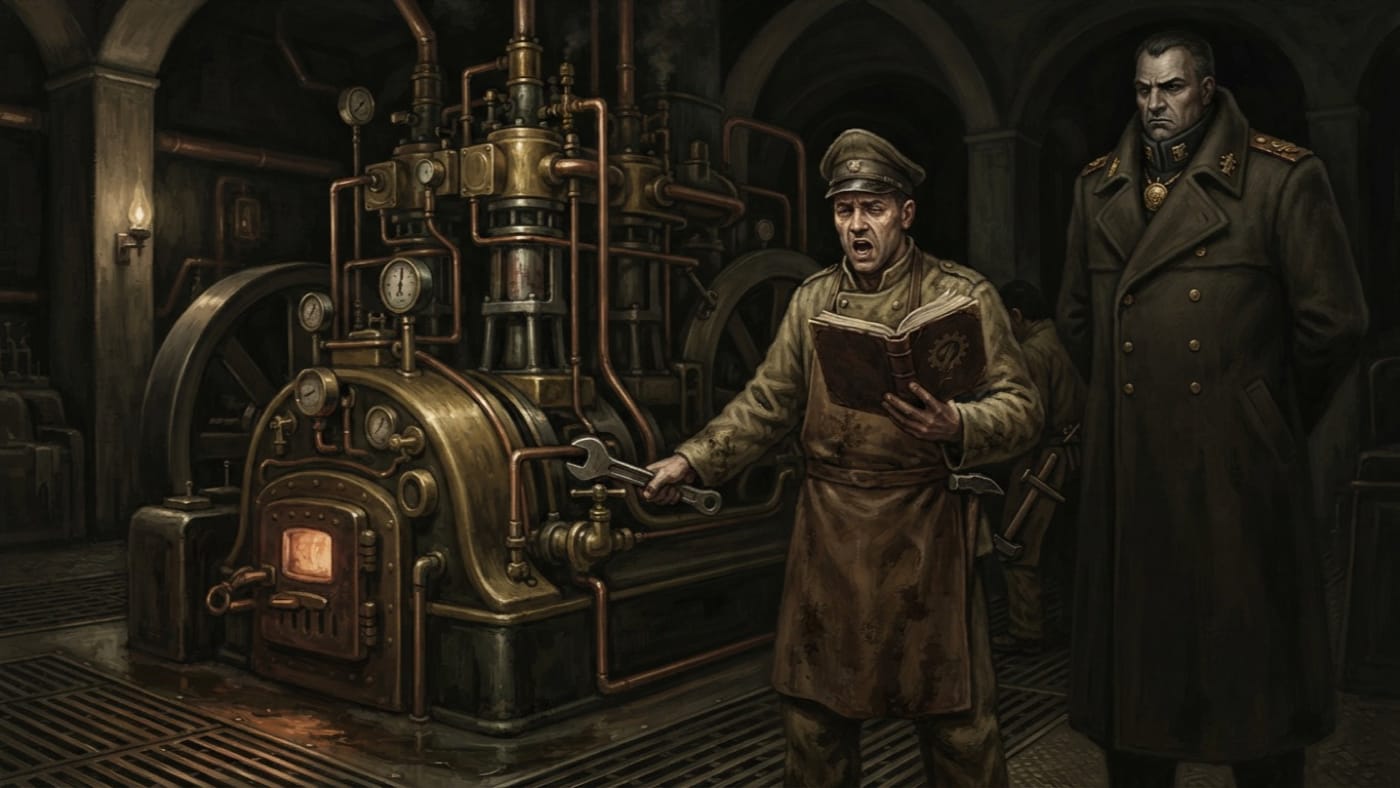
In A.S. 134 the Bureau of Engineering, acting with the Bureau of Doctrine, settled which words an engine may hear. Ignition litanies, calibration cants and closing hymns were made uniform across all seven bastions of the Sagittal Line and every rear-area installation behind them. The motor houses had their own informal melodies, known in the trade as folk tunes. Many of them ran the engines better than the sanctioned cant, and all of them were declared heretical. Nobody consulted the engines, and they have kept expressing opinions ever since.
#On the Origin
"Sing to the spec."
The Litany-Engineer was a field invention long before it was a licensed one. During the Great Retreat of A.S. 48–65, operators at scattered installations found that their engines failed in patterns no amount of wear could explain, and that sound changed how they failed. Certain rhythms steadied combustion. Certain intervals put down the undertones the trade still calls foreign. Nobody issued these discoveries. They passed from hand to hand and throat to throat through pump rooms and convoy bays, and each motor house built up a repertoire as local as its accent and its grudges.
The Black Start Catastrophe at Bastion-Brest in A.S. 97 ended the age of the unlicensed throat. Standing Order 14-E made cant-certification mandatory for engine-rated personnel and placed the profession under a joint registry with the Bureau of War. A certificate has to certify something, though. For thirty-seven years the Bureau licensed operators who then went home to their motor houses and sang whatever their predecessors had sung. A licence from Brest and a licence from Irongate therefore vouched for competence in two different liturgies, performed for two differently tempered machines. No auditor can check a recorded cant code against a melody the codex does not contain.
The profession's own account puts it without ornament. The Synod formalised field cant, then took sole control of the training, so that generating power came to depend on doctrine. A monopoly that speaks in dialects is really a federation, and the Reforms of A.S. 134 abolished the federation. Standing Order 14-E was revised in the same year. Its clauses are not reproduced here, and I decline to invent them.
#On the Authorized Cant
"A clean note is a clean burn."
The Reforms govern three moments in a machine's working life: waking, tuning and handover.
Take an ordinary generator vault before a convoy cycle. The Litany-Engineer listens before touching anything, with the stethoscope probe pressed to the iron housing, sorting harmonic drift from knock and knock from the undertone that should not be there. Calibration comes next: timing, mixture, pressure, belt tension, valve clearances. Each adjustment is accompanied by the prescribed cant, spoken or sung in sequences tied to the engine's operating bands. The calibration whistle matches the engine's speed to the sanctioned tone. Then come the seals: litany plate, wax stamp, chalk wards along the casing. Then the load test under real draw. An engine that holds a clean note at idle and screams under load has lied, and a lie under load ends in a burst seal or a fire. Last, the ledger is closed with the figures, the cant code and the signature of a witness. At handover the closing hymn is sung so that the next shift receives a machine that has been formally given away.
I make no claim that the Reforms invented the whistle, the plate, the wax or the witness. All of them were in use before A.S. 134. What the Reforms supplied was a single text for all of them to answer to. After A.S. 134 the cant code in a ledger at Brest refers to the same codex as the cant code in a ledger at a rear refinery. For the first time a supervisor who had never set foot in a given vault could read its records and judge whether its engine had been addressed correctly.
He could not judge whether it had been addressed well. The codex does not cover that question.
#On Inspection and Correction
"White ears."
The trade's word for an audit is the colour of the auditor's ears, which have never been near diesel. Auditors listen first. They compare the recorded cant codes with the engine's actual operating bands, inspect the seal plates for their micro-etching, and then trace the provenance of every part. Since A.S. 134, a ledger entry that names a melody outside the codex is a confession in the operator's own hand, which is why no such entries exist.
What exists is subtler. A vault can produce a ledger in perfect order alongside an engine that knocks at the third line of the ignition litany every morning. In that case the record conforms and the machine does not, and nothing in the audit procedure can call the machine a heretic. The reverse also happens: a spotless ledger, an engine holding its band through convoy surge, and on the way out the auditor hears a night-shift operator humming something the codex has never heard of. The first case produces a maintenance order. The second produces a file.
Doctrine's part in the arrangement is mostly about language. The Furnace Catechists supervise how technical work may be explained on shift, and an operator who says the engine ran because the old tune suits it has committed an error of grammar before committing one of procedure. The penalty for using a prohibited tune is reassignment to the Paper Mines of Ulm. That threat belongs to the Reforms themselves.
The timeline records, with commendable brevity, that enforcement was inconsistent. I have nothing to add, apart from noting that inconsistency is itself a policy, and that its author never signs it.
#On the Tunes That Remained
With the Reforms of A.S. 134, the folk tune passed out of the motor houses of the Church.
Correction: With the Reforms of A.S. 134, the folk tune passed out of the ledgers of the Church. It was prohibited, and it remains prohibited. It also remains in use. Prohibition and eradication are separate functions, assigned to separate offices, and only the first has ever been staffed.
The tunes survived because they worked. Not all of them did. Many did, enough to keep a convoy motor turning over in sleet when the sanctioned sequence has failed twice and the column cannot wait for a third attempt.
The profession was already divided along the lines the Reforms would later deepen. Codex Purists demand the full prescribed sequence for every operation, and since A.S. 134 the law agrees with them. Field Pragmatists cut corners when a bombardment or a convoy schedule leaves no time, and since A.S. 134 the only thing left to cut corners with is the old melodies. Choir-trained operators come out of the training sheds knowing the codex and very little else. Earborn operators learned by imitation and survival, in vaults where the codex was a rumour, so the old tunes sit in their ears whether they want them there or not. Neither Reform nor auditor can confiscate an ear.
Beyond the licensed crews work the shadow repair rings: unlicensed mechanics in rear motor pools and in the gaps between jurisdictions, using wild pitch and the forbidden folk tunes and taking payment in fuel chits, medicine and clean filters. They exist because pumps, generators and convoy motors have to keep running, and the authorised supply of authorised throats has never been large enough to keep them all running. The rings are prosecuted, and they are relied on. Both statements hold in the same district, in the same week, sometimes about the same mechanic.
There is a temptation to read all this as proof that the cant is theatre. Resist it. Doctrine holds that machines possess no memory. Yet the profession reports engines that answer, with a tone that is in no codex and that rattles teeth and lamp-glass, and wild pitch from an unlicensed throat can draw that answer as easily as any sanctioned error. The folk tune is unlicensed, and it is still not safe.
The Quiet Engine Heresy of A.S. 147, thirteen years after the Reforms, came from the opposite direction. Its sect claimed stable combustion through purely mechanical calibration, without cant of any kind. The folk singer sings the wrong thing, and the quietist sings nothing at all. Doctrine and Purity suppressed the sect, the operators went to Ulm, and Engineering kept a copy of their calibration data. No accessible record shows Engineering keeping a copy of any folk tune.
#On the Present Application
The standard of A.S. 134 still governs in A.S. 201. The same ignition litany wakes generators beneath all seven bastions, the same calibration cant is logged against the same codes, and the same closing hymn hands each machine on to the next shift. The published survey of the profession counts roughly four thousand licensed Litany-Engineers and roughly nine thousand actually at work. The gap between those figures is where the tunes live.
At the Chrismole Furnaces of Brast, in the calibration halls of the Gauge Ward, the warm brass and alcohol-wipe smell of a well-run instrument shop hides a rival chorus that the local file describes as encoded in the tool markings. This is current practice and no evidence of where the Reforms began. It shows only where they have arrived: a sanctioned hall, a sanctioned codex, and a melody scratched into the handle of a wrench, where no ledger records it and no audit thinks to read it.
The question the Reforms posed in A.S. 134, whether an engine should be sung to correctly or sung to well, has been answered the way the Bureaus answer everything, which is twice. The codex is correct. The engines run. The shadow repair rings are prosecuted, and their customers include the installations that prosecute them.