
#On the Basilica's Station
This entry surveys, as of A.S. 201, what the Furnace Basilica presently does and who presently does it. It is no history of the building. The Codex holds no certified record of its construction, its dedication, its architect or the year the Compact Council first carried its seals inside. I decline to manufacture one merely because the reader would find a cornerstone comforting. Cornerstones are for parishes with nothing to hide.
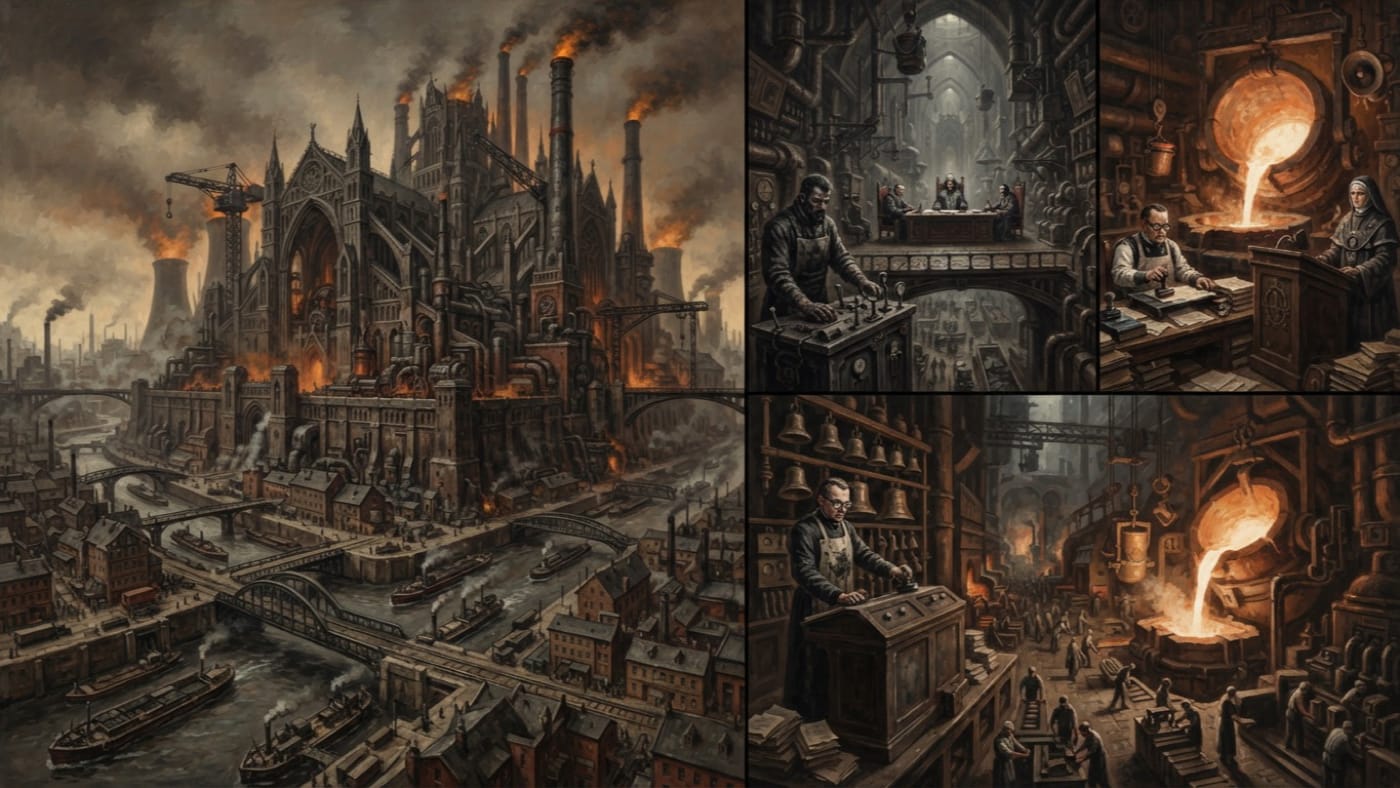
What can be certified is short, and it is enough. The Furnace Basilica is the seat of the Compact Council of Essen-of-Hymnsteel. Through that tribunal the three Bureaus of the Tri-Bureau Compact govern a forge-city on a canalized river fork in Zone 2. The Basilica is a vaulted house of the Church given over to two duties that Essen refuses to separate: governance and the ritual pour. The dedicated record describes its heat as "like a sermon," which is to say relentless, unrequested and longer than anyone present would prefer. Its standing hazard is the flash burn.
The institutions inside are older than any date I can attach to the walls. Procurement officers of the Bureau of Engines and Furnaces reached the river fork in A.S. 108. The Compact was ratified under joint seal in A.S. 110, and the city gave up its old name for the hymnsteel suffix in A.S. 118. These are the city's milestones. None of them dates the Basilica, and none proves the Council sat there on the morning after ratification. The Bureau of Records would very much like the reader to infer otherwise. The Bureau of Records would also like to be paid for the inference.
This Codex previously stated that the Furnace Basilica stands directly above the primary crucible, its heat rising through iron grates in the floor.
That placement is withdrawn as unestablished. The published Essen entry puts the cathedral above the primary crucible. The dedicated Essen record says the Council meets under it. Both accounts agree that the Council sits in the Furnace Basilica. No survey has settled the difference, and the Codex will not invent a stair, a second chamber or a convenient rebuilding to make the two accounts shake hands. The grates are withdrawn along with the floor they were said to be set in.
#On the Three Chairs
Three chairs govern from the Basilica, and each holds a hostage the other two require.
The procurement chair of Engines and Furnaces holds the fire: production, slag fuel, overtime, the furnace schedules and the coal that arrives by barge. Its power-holder at this survey is Furnace-Marshal Kord, whose nails the service has turned coal-black and who measures loyalty in tonnage. He can order a furnace lit. He cannot certify what comes out of it.
The Records chair holds the paper. Certifying every part is a Records act. So is issuing the permit, the work-writ and the ration paper that allow an Essen worker to work and to eat. Arch-Notary Veyl, whose fingers are stained with ink, administers all of it from Ledger Row and the Records spire. A part without a Records seal does not leave the city. A man without one does not leave his bed for any lawful purpose.
The Orison and Song chair holds the voice: the approved calibration stanzas, the bell schedules and the discipline of sound within city limits. Master-Calibrator Sister Rauth, scarred at the throat, decides which stanzas are approved and therefore which pours are lawful. Essen lists the question why this stanza among its forbidden things. I have not asked it. I value my throat as a professional instrument.
The Basilica exists to stage this arrangement. Kord's fire is useless without a stanza Rauth will approve. Rauth's stanza is a liability without a seal Veyl will stamp. Veyl's seal is worthless paper unless Kord's furnaces produce something worth sealing. No chair can move production alone, and any chair can stop it. Heat, certification and cadence must agree in a single decision, under one roof, among three custodians who would each prefer to own the roof.
The dedicated record states the Council's true purpose with refreshing bluntness: to keep Essen indispensable, so that Strasbourg cannot "simplify" it. On that point the three chairs agree. It is their only point of agreement.
The Codex does not record the Council's seating, precedence, quorum or voting form, and I will not supply a presiding officer for the reader's convenience. The chairs are portfolios. Where the furniture stands is a matter for the furniture.
#On the Bell Order and the Pour
The Council governs with three instruments: the decree, the audit and the bell order.
No reader who has lived under a decree or an audit needs either explained. The bell order belongs to Essen alone. Peal schedules regulate the city's shifts, and a bell order changes the city's production tempo by changing those schedules. The Council sends no runner to the furnaces. It alters the peal, and the city, which by custom bows at every peal, hears its new obligations in bronze. Altering a bell schedule without a writ is one of Essen's red lines. Altering one with a writ is government.
Follow such an order down through the city. A changed tempo means a changed furnace schedule, and Kord's chair must find the fuel and the overtime. More pours mean more parts awaiting certification, and Veyl's clerks must either stamp them or let them sit. Every major pour requires a paired choir so that no stanza ends alone. The Choir Quarters must therefore supply voices on the new schedule, drawn in part through the voice tithe, the choir service the law requires of certain classes. One peal moves coal barges, ledgers and throats in the same hour. The workers obey. The Compact records compliance. Consent is not one of the recorded fields.
The ritual such an order accelerates is a sacrament by law. Essen classifies calibration as a sacrament, and in Essen singing is a work permit. Before the furnaces are lit, the choirs perform the First Bell Warming, singing the bearings awake. During the pour they keep the Psalm-Measure, a metered chant that, according to the Bureau of Orison and Song, aligns the grain of the cooling metal. I report the Bureau's claim as the Bureau's claim. The Synod's metallurgists are forbidden to ask, and the steel has offered no opinion.
The Basilica is a seat of ritual pours, but it is far from the only place in Essen where metal is sung into shape. The city's calibration stage is the Hall of Measures in the Foundry Core. It is surveyed under its own entry, with its own platforms and cages, and any reader who moves them into the Basilica does so without my seal. Everything these houses produce, from bell-cannon throats and hymn-drive housings to reliquary rivets, travels by the Sagittal Line to positions from Bastion-Königsberg to Bastion-Constantinople. Whatever tempo the Basilica sets, the Line will eventually fire.
#On Donations and Permission
All freight bound for Essen passes the Seven Locks. There Records clerks check papers, and Orison wardens test the vocal cadence of whoever presents them. A wrong stamp means arrest or conscription. Under these conditions a bribe is accepted in exactly one form: as a donation to the Furnace Basilica.
The Seven Locks and the Basilica are separate places. No record I have seen certifies that coin offered at a lock-gate makes its way to the Council's seat, and the euphemism works without any such journey. It turns a payment to a clerk into an act of piety toward the institution whose chairs employ him. Piety can be audited for sufficiency, never for corruption. The donor buys the stamp, the clerk keeps his post, and the Basilica's name absorbs the sin without ever being consulted about it.
What the donor buys is certification, and in Essen certification separates a lawful body from an unwritten one. Some things are always for sale: expedited seals, choir exemptions marked temporary, safety waivers. The Basilica's charter, treasury and collectors are matters I have not found on any record, for sale or otherwise, and I list none of them here.
#On the Present Condition
The Basilica currently houses an argument that no bell has yet settled. A procurement mandate from Strasbourg demands greater output of hymn-drive siege engines. The published Essen entry says the mandate asks for triple. That figure is the demand. This survey finds no record that it has been met.
Each chair has answered the mandate according to its nature. Rauth's Orison chair will not accelerate calibration without "liturgical stability." Plainly put, faster pours with tired choirs kill singers and spoil metal, and a singer's working voice is already counted in years the Bureau can tally on its fingers. Kord's Engines chair threatens forced conscription to cover the shortfall. The people nearest that threat live in the Ash Warrens, whose refugees are the first drafted in every sweep. Veyl's Records chair profits whichever way the dispute falls: conscription requires writs, refusal requires audits, and both require stamps. At this survey the threat remains a threat. The Codex holds no decree enacting it.
The Resonance Bloom presses on all three chairs at once. Essen's workers report its symptoms: tools humming untouched, teeth aching, rivets shearing, bell-cannon throats cracking along the grain. The Compact calls it holy alignment and blames sabotage. The workers call it the Wrong Choir. Any acceleration the Basilica orders must be ordered into a city whose foundations may answer back. The Codex records no Bloom within the Council's chamber, and I will not supply one for the sake of drama.
The chairs will meet again in the heat. Kord will bring tonnage, Veyl will bring forms, and Rauth will bring the scar. The bell will ring on whichever schedule survives the three of them.