
#On the Foreign Note
"A knock is a prayer unanswered." — motor-house proverb
"Foreign harmonics" is what a Litany-Engineer writes in the ledger when an engine has started to sound like something other than itself. The phrase is trade cant. In the motor houses it is the established word for demon interference and wrong resonance, and the Bureaus have adopted it for their files. It names a drawer in the cabinet. What gets filed in that drawer is another matter, and the drawer does not care.
The symptoms are well catalogued. The harmonic drifts across the RPM bands where it ought to hold. A knock comes that keeps no time with the pistons. An engine stalls for no cause the gauges can show. A fire starts from a spark nobody can name. Men on the night shift report whispering in the casings. The rarest symptom, and the one the trade will not joke about, is a tone that appears in no codex, strong enough to set teeth and lamp-glass trembling. The operators call this an answer. The Litany-Engineer then has seconds to drown it in sanctioned cant, and the dedicated profession lore does not say what happens to those who are slow.
Know the limits of the diagnosis before you take up the sermon. Dirty fuel knocks. Mismatched parts drift. A chant sung at the interval for one RPM band while the engine turns at another will destabilise combustion as surely as any fiend. A counterfeit gasket breathes where it should seal, and a line under the wrong pressure lies through every gauge on the wall. Any of these can sit beside hostile interference, or produce the same symptoms without it. A good mechanic keeps both in mind. A good ledger, under present regulation, may record only one of them.
#On Calibration and Cant
The profession's own origin account places the first observations in the Great Retreat, A.S. 48–65. Operators found engines failing in patterns that had nothing to do with wear. They also found, by trial and by burying the men whose trials failed, that certain rhythms steadied combustion and certain intervals put down the wrong resonances. No discoverer is recorded. No year of naming survives. The offices that took up the practice were the improvised workshops of an interim government, and to call them Synodal is to use the retrospective courtesy we extend to everything that came before A.S. 90. The Synod did not invent cant. It certified it, and in this Church certification is the higher form of creation.
The certification came after a fire. In A.S. 97 an unsanctioned restart in the harbour at Bastion-Brest set the port alight and killed forty-three people. The operator was immured. Standing Order 14-E made cant certification mandatory. The Bureau of Doctrine called the fire a judgment. The Bureau of Engineering called it a fuel-air mixture lit by an untrained hand. Neither office attributed it to foreign harmonics, and I will not do so on their behalf.
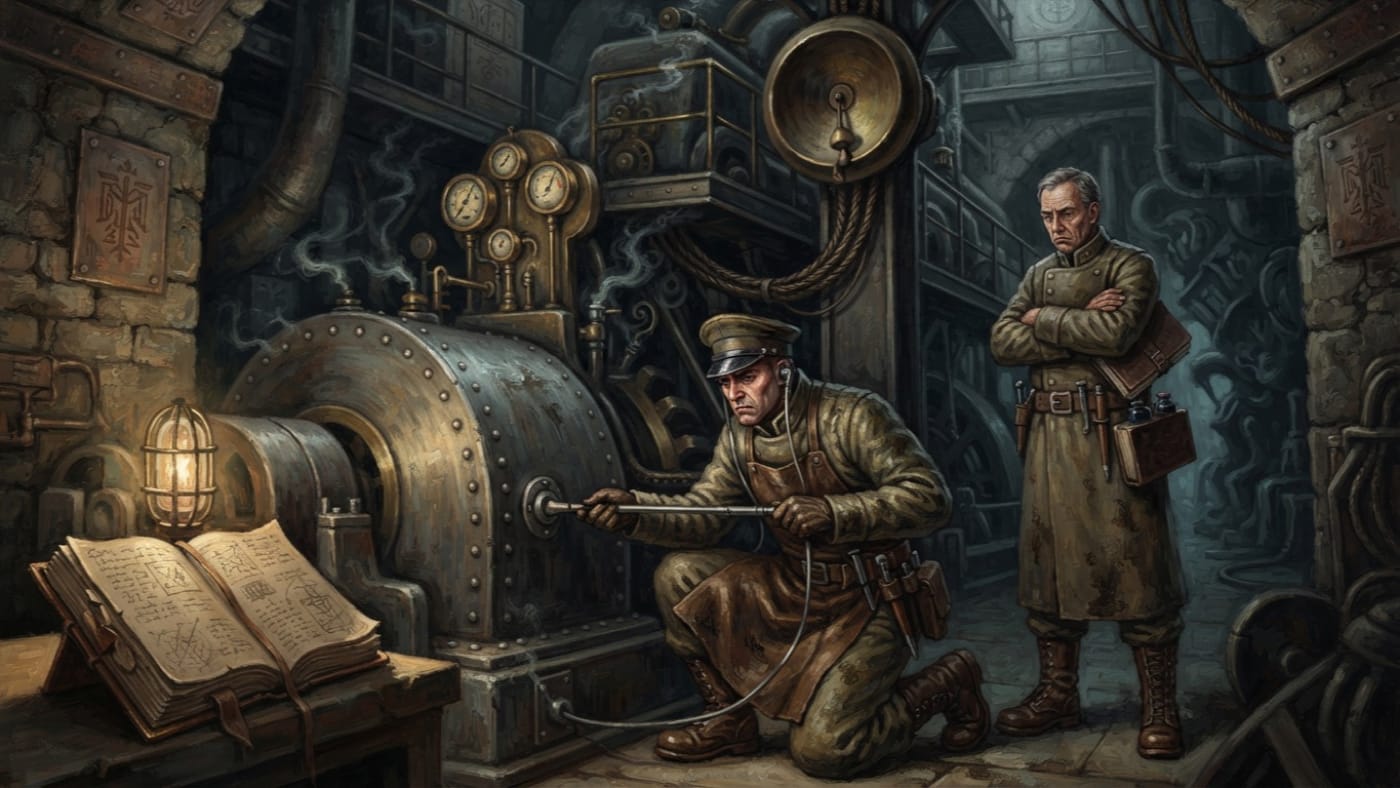
The certified procedure goes in this order. First the Litany-Engineer listens with a stethoscope probe pressed to the housing, because the probe hears what gauges miss. Then they adjust timing, mixture, pressure, belt tension and valve clearance, with the cant spoken or sung in step with the RPM bands the chant codex prescribes. The seal is set with litany plate, wax and chalk wards. Then the engine is run under real load. An engine that holds a clean note at idle can still scream under draw, so a clean idle proves nothing. The ledger is closed with the figures, the cant code and the signature of a witness.
Many faults are not in the engine at all. Motors feed and draw on the resonance mains that carry diesel resonance to bell mechanisms, sermon amplifiers and wards. When the fault lies in the line, the Diesel Resonance Plumber listens, isolates the section without killing the district, bleeds the air, seals, tunes, and checks the bell echo and the ward response. Bleed it before it preaches. The Gasket-Hymn Mechanic inspects, aligns, seats, torques to the timed count, seals under witness, and tests for pressure and vibration. Forged components still kill. A pipe that laughs may be the Great Deceiver, or it may be a gasket bought behind a canteen in Brast.
#On the Permitted Explanation
Four Bureaus have a claim on a misbehaving engine, and each wants something different from it. Engineering wants it running. The Bureau of War wants it running without a pause, because a generator that fails during a bombardment kills more men than a skipped psalm. Doctrine controls which explanations of a failure may be spoken aloud. The Bureau of Purity controls what may be written down, and what is done to the person who wrote it.
Two further offices stand between the engine and the ledger. The Furnace Catechists keep a record of the Trench Sermon Mandate. By their own account it followed sabotage of generators by "foreign harmonics" in the Shipka sector, and after it doctrine became a security layer as well as a teaching. The Bellwardens police unauthorized tones, calibrate the bellways, and lock down sectors when unclean sound rises. Between them, the doctrinal account of a fault is now taught and enforced by the same corridor that carries the sound.
Then came A.S. 199. The Purity advisory of that year requires every report of foreign harmonics to be filed under Classification 7-K. It threatens re-education for anyone who attributes them to mechanical failure, and assessment for anyone who says the engine answered. Consider an operator who has found a counterfeit gasket at the root of a drifting harmonic. That operator must now file the gasket as demonic. The advisory is a reporting policy and nothing more. It makes the 7-K category mandatory. It does not make every knock a fiend, and Purity has never claimed that it does.
The witness requirement has been tightened to match. The witness signs what was filed. What was heard is a separate matter, and no column on the form receives it.
#On Forbidden Remedies
The Furnace Choir Reforms of A.S. 134 standardised the litanies and outlawed folk tunes in the motor houses. Many of those tunes worked. That was never a defence, and in the Reformers' view it was the offence itself. The tunes survived, with the wild-pitch forks and the forbidden harmonics charts, in the shadow repair rings and in the coat linings of men who had kept engines alive under fire.
One contraband item does more harm than the rest. Quieting grease makes an engine sound clean. The drift goes on beneath it, unheard, until the load comes on and the engine fails on the line. The grease is not demonic. It is a liar's remedy, and the trade, which knows the difference, hates it more than the forks.
The distinction the trade keeps is the one the Bureaus keep losing. A mechanic who tunes by an unsanctioned fork has committed a human offence against an office. Enemy interference is a different thing in kind. The officials condemn both under one heading and send both to one docket. A heretic with a tuning fork and the Great Deceiver are still not the same defendant, and a magistrate who treats them as one will hang the first and let the second go.
The trade has watched what happens when knowledge of tuning is taught outside licence. Beneath Bastion-Irongate, the Danube fortress the garrison calls the Gasket Choir, a heretic cell called the Counterkey Circle is said to teach "silent harmonics" by coded taps and forbidden hums from stolen hymn pages. Every office hunts it. Nothing in the record ties its teaching to the foreign note, and I will not supply the link for the convenience of a prosecutor.
The "Quiet Engine Heresy" of approximately A.S. 147 was formerly classified as a minor doctrinal irregularity.
This classification has been revised. The Quiet Engine operators claimed stable combustion without cant, by mechanical calibration alone. The Bureau of Doctrine suppressed them with the Bureau of Purity. Their notes were seized and their members reassigned to the Paper Mines. The Bureau of Engineering kept copies of their calibration data.
The Quiet Engine affair disproves nothing about acoustic hazard. It shows that some engines ran without cant on some nights. It does not show that the nights were all alike, or that the engines kept running.
#On the Continuing Watch
Bell-baffles were fitted to wartime generators during the Trenchline Harmonisation of A.S. 158–172. The hymn-gaskets are seated under witness. The sanctioned intervals are sung, recalibration is ordered, and a vial of saint-dust waits sealed in the kit for a restart that will not take. These are practiced responses. None of them comes with a guarantee, and the Bureau of Engineering has never been foolish enough to print one.
At the Chrismole Furnaces of Brast, a foundry city in the rear far from any trench, the local record describes Sulking Engines. Valves stick "in spite," pressure gauges answer the hymns, and boilers hiss syllables. The countermeasures listed are recalibration choruses, silence protocols, and the replacement of a cursed gauge with a stamped one. At Shipka the sound discipline is severe and the Bellwarden rotations are heavy, and the sector faces an enemy whose auditory disturbances are a matter of record. Those disturbances do not explain every motor that coughs between Shipka and the Baltic, and a sector chaplain who blames Syrion for a fouled injector has merely found a grander excuse for not cleaning it.
The testimony is damaged too. Veterans come out with ruined hearing and voices rubbed raw. The ringing of bell-sickness follows them home and plays tones they never sang. A deafened man's report is not therefore false. A veteran's phantom peal is not therefore an event in the world. The examiner who settles every case one way or the other is lazy, and in the matter of a restart, dangerous.
The night-shift Litany-Engineer goes on listening, probe against the casing, witness at their elbow, codex open at the band the gauges show. If the knock is a gasket, they will replace it. If the note belongs to no codex, they will sing over it. In either case the cause column on the ledger form takes one entry. By order of A.S. 199, that entry is 7-K.