
#On the Voice Owed
Drymouth: Calais slang for a reader kept too long at the chalk.
A Fog-Reader is a person whose throat belongs to the Script Wall on fog nights. The office has no charter, no patron, no founding captain and no uniform I can certify. That makes it unusual among callings under the Church, since it was working before anyone thought to dress it. The work is one act, repeated until dawn. The reader stands before seventy feet of wet chalk between the Gun Galleries and the Crownline of the Chalk Redoubt of Calais and speaks aloud every name the condensation writes.
The Bureau of Doctrine classifies the Wall as a Category Three Acoustic-Relic Event. That classification belongs to the stone. Nobody in particular has classified the readers, which is the usual reward for the people who make a relic usable.
Calais calls the obligation the voice levy. Every household owes night-watch hours and reading service. The Chalk Warrens pay in kind: lantern carrying, slate running, throat relief, name relay, and quarantine notice after a sinking. Those are the support trades. The reader stands in front of them all, mouth open toward the cliff. Readers come from steadier stock, or from whoever debt, a refused pass or a compulsory watch has delivered to the roster that week. Many arrive tired. The rest get tired soon enough.
#On the First Reading and the Register
The first Fog-Reader held no office. He was the sentry Haller, posted beneath the Crownline after the Great Breach of A.S. 71 to watch the cliff for seepage. What he saw was fourteen names forming in the fog-water. He had no priest, no protocol and no superior within shouting distance, so he read them aloud. By morning six of the fourteen had drowned in calm water. Eight lived.
Every reader since has inherited that arithmetic. A reading reduces the danger. It pardons no one, and nobody who has stood a full season at the chalk believes otherwise, whatever the training sheets suggest about diligence being rewarded. The refusals of A.S. 187 showed the same thing from the other side: nineteen names sank while the Unread withheld their voices, and no major breach followed. The sea is a creditor that does not publish its terms.
In that first decade the coastal offices belonged to an emerging Church administration. The Coastal Chapterhouse was a year old and there was no Synod yet. Practice ran ahead of paper for twelve years. In A.S. 83 clerks opened the first standardized reading register, and the profession gained what every profession needs before it can be blamed for anything: a list.
Coastal summaries, and the training sheets still in use at the Wall, date the first chalkscript, and so the first reading, to A.S. 83.
Corrected. Haller read in A.S. 71, after the Breach. A.S. 83 is the year of the first standardized register. The clerks mistook the start of their counting for the start of the thing they counted. Clerks have always been entitled to this error, and they use the entitlement freely.
#On Reading Protocol 9-C
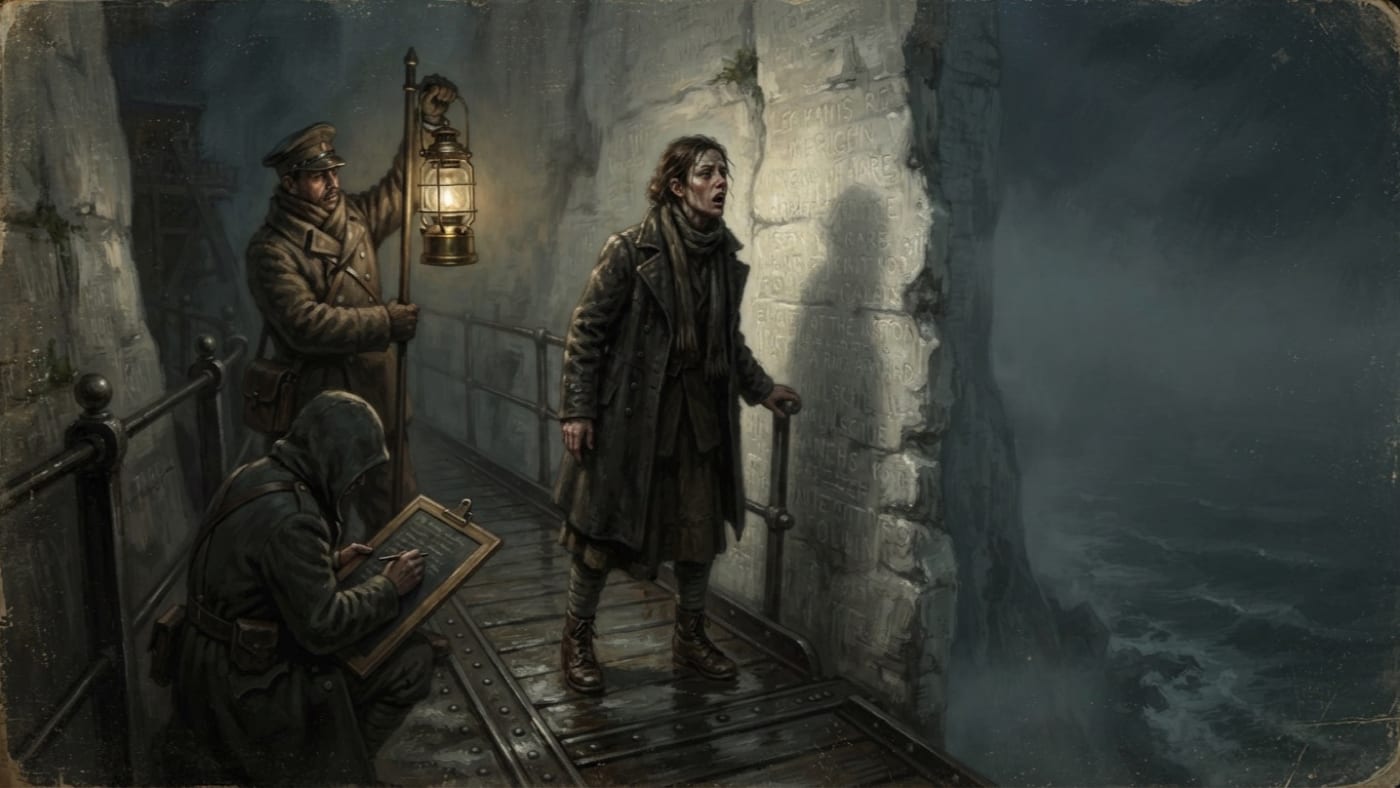
The summons comes from the Fog Bell Tower: three short, one long, three short. Readers go to measured stations along the Wall. Each has a lantern-bearer standing behind and to one side, so the light reaches the chalk and the reader's shadow does not. A Chalk Scribe kneels below with a waxed slate. A Doctrine copyist stands behind the scribe and copies the copy.
Of these four, only the reader has to speak. Protocol 9-C sets the order: left to right, upper chalk to lower, loud enough for the second scribe to hear. Every name is spoken clearly and entered. Hesitation is marked against the reader. The nearest senior reader corrects a mispronunciation on the spot, in front of the stone. If the letters change mid-syllable, the reader finishes the first form, waits one breath, and speaks the new one. The scribe enters that correction in red. An unread name means the bell must be notified at once. If the name sinks, the quarantine clock starts.
The reader does not decide what a name means. The Wall writes legal names and baptismal names, private names and variant spellings. It writes the names of lost Divers, of the dead, and of children not yet born. The reader's craft is accuracy. Meaning belongs to Doctrine. Evidence belongs to the Salt Tribunal, whose officers use the scribes' abstracts in rulings on passes, debts, aliases and quarantine. The reader who supplied the voice has no say in any of it. No reader grants passage or releases a detainee. The Church takes the voice and keeps the verdict for itself.
The low stations are the worst. On bad nights the lowest names form so close to the surf that the reader has to kneel in the water to finish the descenders. Lost Divers' names tend to appear there within seven nights of the loss. Whatever gathers at the waterline during a reading belongs to the Undertide, so the Gunline Choir covers low readings with its fourth repulsion sequence and puts bell and shot into the surf where the name is forming. When the captain gives her low-hand sign, Cantor-Major Pell holds fire and the reader wades in. The manuals do not record what the sign looks like. They record that it works, and that only one person at the Wall may give it.
#On Recognition and the Roster
Fog-Reader Captain Lute Auvray decides who reads, at which station, when and for how long. Other officers command men or guns. She commands other people's breath. Her readers say she weighs voice, kinship, exhaustion, fear and how the Wall has behaved on recent nights, and they call her fair. I record their verdict and leave it as theirs. She still punishes refusal, and she still puts frightened readers on the roster, because the Wall does not wait for anyone to find their courage. Her standing request is for more trained readers from the Warrens, whose families know local names the way the Wall spells them.
The hardest rule of the trade concerns memory. A reader who recognizes a name must carry on in the voice used for strangers. This is discipline. Nobody pretends the reader actually forgets. Some readers fail it. Three have broken rank and run for the harbour after reading the name of kin. Two drowned. The third came back from the Silent Steps alive and mute, writing his sister's name on his own tongue with a shard of slate.
One such failure was entered in A.S. 188. The record does not say who drew up that roster.
INCIDENT RECORD — READING ROSTER 14-F, A.S. 188 Reader recognized name: ██████████████ Relation: daughter Action: abandoned post before final consonant Result: name partially sunk; harbour west-hush within seven minutes; three lamps extinguished underwater; recovered body count █████ Disciplinary finding: █████████████████████████████████
#On Silence Under Warrant
The Fog-Reader is the only person in Calais licensed to say names near the Wall. Everyone else is forbidden to. The Unread Uprising of A.S. 187 withheld voices from the readings for three days. Afterward the Coastal Chapterhouse ringed the Wall-approaches with the Silent Steps. On those corridors a mother may be beaten for whispering her child's name in fear, while ten yards away a reader speaks a stranger's name on command. The wardens give operational reasons. An unsanctioned name might contaminate a roster, draw chalkscript into a seam, or give the Wall a spelling it did not already have. Those are the stated reasons, and stated reasons are always the gentle ones.
The Unread see the reader differently. Their argument, which Doctrine condemns, is that every spoken name feeds or steadies a lure and that the voice levy is bait. Their pamphlets go further and allege that the Wall is a mechanism the Synod installed and now cannot admit to running. The doctrine travels under the name of Brother Vell, who cannot speak. Nobody has explained his silence. Mara White carries the blank pages. To the Unread, the Fog-Reader is the last length of line above the hook.
Doctrine answers with procedure. Private comparison of reading density against Undertide movement is forbidden. Chalkscript rubbings are impounded. Reader rosters are monitored for "pattern hoarding." A reader who keeps track of which nights the water went quiet may find her tally entered as evidence against her. The official position is that no admissible evidence supports the Unread. The word "admissible" holds the whole position up.
#On the Present Watch
In A.S. 199, chalkscript was confirmed on doorframes in the Warrens, some three hundred yards inland, in tunnels fog had never reached. Until then the profession had one comfort: the names came to a staffed surface, at a known hour, under bell and lantern. That comfort is gone. Protocol 9-C speaks of upper chalk and lower chalk. It says nothing about lintels. A child whose name a doorframe wrote seven times was taken to the Undertide Pens. The readers stayed at the cliff, because that is where the roster puts them.
Oil is short in A.S. 201. Less light means slower reading. Slower reading means longer nights, and longer nights make drymouths. The readers are hoarse. The support workers sleep in shifts. The Undertide Divers are understrength and sent down more often, and they still owe roster duty after deep immersion. Auvray has asked for their relief, and the request remains open and ungranted. She has also refused to let the bell's lower pulleys be recalibrated while the rosters are under this pressure, because readers cannot find their stations by a summons that drifts. Commander-Prior Sabelle Morn has asked for more readers, more oil and more riggers. Calais remains Amber.
The bell strikes three short, one long, three short. A lantern is set at its angle. A scribe kneels in the wet with a slate. The reader clears a raw throat and begins at the upper left.