
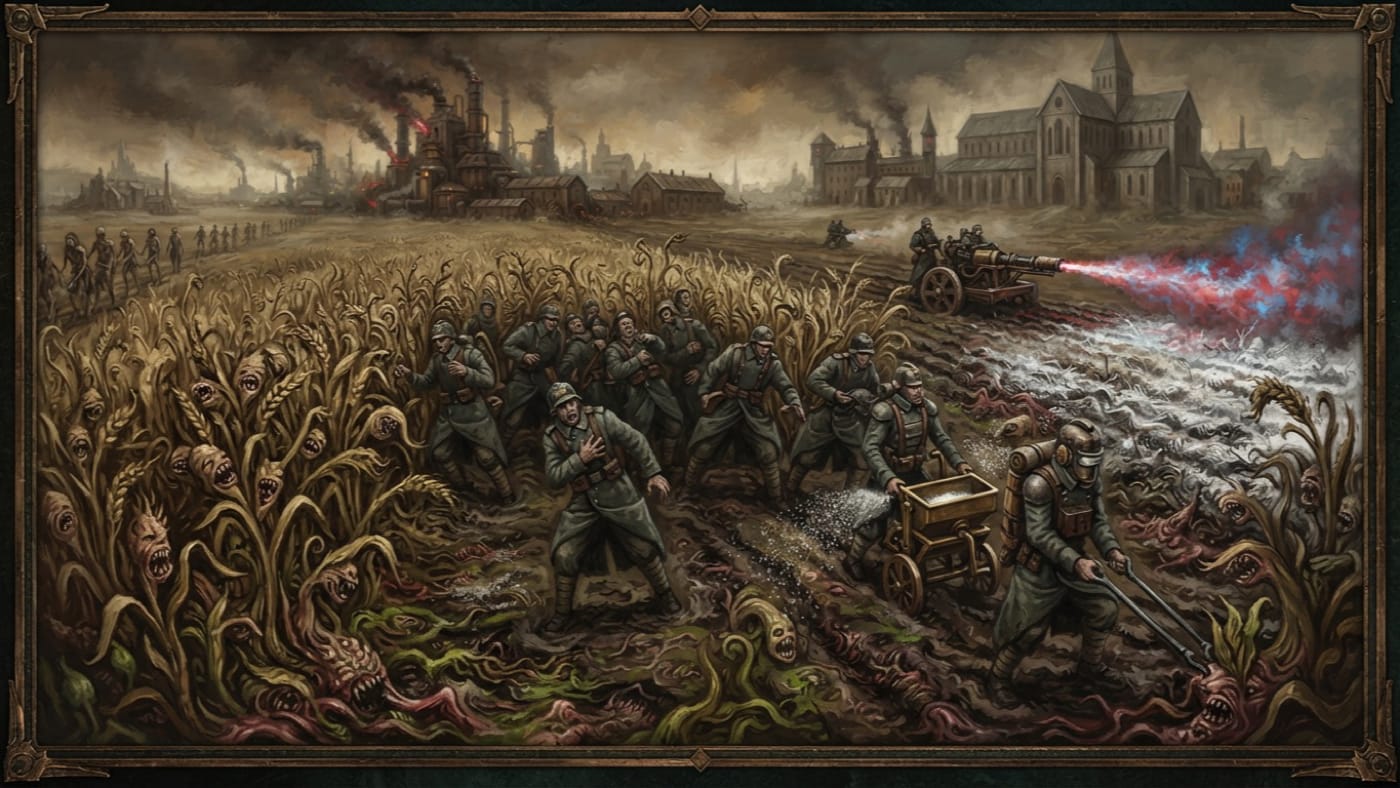
Being a survey of the Gluttonous school of sorcery, of what it does to grain, flesh and ground, and of how far the Synod can answer it, entered in the present year by the Warden of the Sacred Ledger.
#On the Hungry Voice
The Flesh Litanies are the sorcery of Kargath, and their whole doctrine fits on the back of a ration chit: the hungry sing, and the flesh obeys. Everything else the Synod knows about them has been learned afterward, from the condition of whatever obeyed.
The mechanism is the one already set down under Miracles and Sorcery. Power is drawn from beyond the mortal sphere through a material conduit. The only difference between a sanctioned choir and a hungry one is who receives the bill. A miracle charges its petitioners. A Flesh Litany charges the grain, the gut, the field and the furrow, and the account is settled in the flesh of whoever is standing nearby with a spoon.
I cannot tell you what the singing sounds like. The Bureau of Doctrine has recovered no text, no notation and no rite of admission. I advise the reader to report any pedlar who offers one, and the pedlar's route with them. The voice is attested, and its effects are attested in quantity. Beyond that the page is blank, and the Bureau prefers to keep it blank.
#On Flesh Made to Answer
The standard exemplum is Debrecen. There the crops put out lips and teeth. Soldiers who had been marching on short bread came upon standing grain and did what hungry soldiers do in a field. They bit, and the grain bit back. The depositions describe the bite and the counter-bite and very little else, because the deponents had other matters on their minds, chiefly their mouths.
The same depositions report whole battalions withering under rot-bursts, with the livers of the dead swollen, in the deponents' phrase, to the size of tents. I enter the figure as deposed. Its measurement I leave to whoever volunteers to take it.
The hunger-fields are worse, and every field report agrees on this. A hunger-field is ground on which eating cannot satisfy. The food goes down and the stomach takes it, but nothing answers. Soldiers in such zones eat until their throats tear and their bellies rupture. The craving deepens with every mouthful, and for many of them the last act was reaching for more. The ration does its office. The body refuses to sign for it.
The litany commands tissue. I set this down because the Bureau of Purity has a habit of reading a soldier's mouth as a confession of the soul. Grain with teeth, and a stomach that will never close its account, are wounds in flesh and in Creation. The soldier who keeps eating in a hunger-field is starving. Whatever choice remains to that soldier still belongs to them, and the Synod's own doctrine insists that a choice always remains. The Ledger has no column for the crime of eating while starving, and I decline to rule a new one.
#On the Ground That Feeds Nothing
Clerks routinely confuse three conditions of the eastern ground, and the confusion gets surveyors killed.
The Famine Pits are graves. Thousands who starved in the season of the Sundering, A.S. 45, were thrown into them, and their hunger did not stay buried. It radiates outward into the living, including bodies that were fed that morning. Stand near one and your stomach cramps whenever you last ate. Stay too long and the dossiers record the eating of one's own hands. The Hunger Wardens who stake the boundaries have never found a singer at the bottom. The parent entry says the affliction comes "without apparent source," and apparent is the operative word. No one has found the source, and no one has proved there isn't one. I will not put a choir in a grave because a Bureau would like its files tidier.
The Abundance Fields are the opposite complaint. They are green, which nothing else of Kargath's is allowed to be. Grain swells there, fruit ripens out of season, and the harvest never ends. The food is real. It sits in the hand and fills the belly. It also nourishes nothing, and every meal of it enlarges the hunger it was eaten to quiet. Refugees see plenty and run toward it. They eat, and waste away, and lie down in rows among the crop, and the crop keeps growing. Dedicated reports attribute this plenty to the Harvest, the demons in whose wake such fields spring up. The Bureau of Doctrine cannot certify whether any given Field began with a litany, and it has classified the Fields separately. A hunger-field fails to fill. An Abundance Field fills, and fails. A clerk who writes one for the other has sent somebody onto the wrong ground.
The Blightmarsh of the Drava was once good Pannonian farmland. An unnamed Glutton-priest gorged on covenant grain and spat it back into the furrows. Between vespers and matins the soil became meat-bog. Those who sowed there afterward found their crops turning on the hands that planted them. The priest's procedure is not recorded, and neither is the year. I will not christen it the first Flesh Litany for the sake of a chronology. It belongs in this entry because its grain chews, and grain that chews is the signature of the school.
#On Those Who Provide
The Litanies need ground to work on, and Kargath's mortal cells prepare it with the same machinery the Synod uses to feed itself. They go where food moves: relief convoys, farming villages, distribution sheds, ration offices. They create scarcity where there was enough, then arrive with plenty once the scarcity has done its work. A cultist rarely looks like a cultist. A cultist looks like the farmer whose field still yields, or the relief worker first down the road in a famine, or the merchant whose sacks never run short. Their customers grow thinner.
The cells sort themselves by appetite, from the Hungry at the bottom to the Hollow at the top. The Bureau has filed this arrangement as the Hierarchy of Need. Whether any of them sing, the file does not say. The evidence shows provision corrupted. It shows no Gluttonous seminary, no school of cantors, and no orders passed down from the Maw to some ration-clerk in a back office. Cult cells get no audience with a Sin-General. They have a cellar, a ledger and a queue.
Most who join are hungry. The Doctrine of Enough teaches that wanting more than one's share is itself demonic. That is a hard catechism for a population that is short of bread, and the cult answers it with bread. The bread is cursed. The catechism was never bread at all. A mother at the edge of a green field is weighing a slow death against a sanctioned one, and the Synod has yet to send anyone to stand beside her and argue the difference.
#On the Measures Against Hunger
The field kit answers the Litanies with two items. Salt chokes flesh-growth. Fasting-caps resist hunger-fields. The Bureau of War issues both by the crate and publishes neither the dose of the one nor the range of the other. A sergeant learns the limits of each the way sergeants learn everything, by standing past them. Both work, and both work locally. Salt laid on a furrow that has grown a mouth will shut the mouth. It will leave the furrow unfit for grain.
The fasting-cap belongs on the head in a hunger-field and nowhere else. It must be kept distinct from the Dominion's compulsory fasts, which the Bureau of Rites commends as training against appetite. What compulsory fasting has been observed to produce is a weaker body and a quicker ear for anybody offering food. The cap shields a soldier from a field. The fast delivers a congregation to a provider.
Food properly blessed before distribution cannot carry Kargath's curse.
The Bureau of Relics gave this assurance without exception. Produce of the Abundance Fields remains cursed after blessing, and for that produce the assurance is withdrawn. The ritual is retained for its comfort, which the Bureau assures me is considerable.
Relic-fire is the heavier answer. In the Blightmarsh it was loosed against a Flesh Litany's overgrowth and purged it thoroughly. I state the success first because the Bureau will want it stated first. For a season afterward the soil would bear nothing, not even weed or moss. The marsh became a white expanse of husks, and the soldiers bivouacked there walked over cracked roots that had once been men. The overgrowth was gone. So was that season's crop, and the use of the ground for as long as the season lasted.
The doctrine of miracle holds that grace preserves Creation and charges only its petitioners. The account of that purge records the success and the sterile season side by side, in the same hand. I enter both. I offer no reconciliation, since none has been sealed.
Putting down a manifestation and recovering usable ground are entries on separate pages. For the first, the Synod has a reliable instrument.
#On the Remaining Account
Bastion-Constantinople faces Kargath across the Black Sea approaches and the Thracian marshes. There his pressure arrives as supply lines that rot before they reach the gates. The Pannonian ground of Debrecen, the Drava and the Pits lies elsewhere and fails in its own fashion. The quartermaster's orders are the same in both places. Every sack that crosses a contaminated field is to be presumed hungry. Every field that grows too well is to be presumed green for a reason. Every refugee column is to be fed before it finds something greener.
The salt holds, and so do the caps. The fire holds for one season, at the price of that season. The Litanies, for their part, ask for no licence, pay no tithe and keep no ledger. All they require is somebody hungry enough to sing and somebody hungry enough to eat. The east supplies both in abundance, and the word is chosen with care.