
#On a Feast the Calendar Declines to Contain
"Names stay outside." (start-of-shift recitation at the Polisher bench, attributed to no one willing to sign for it)
The Bureau of Doctrine keeps the authorised calendar of the Church the way a sexton keeps the only key to the crypt. Every feast has its folio, its office, its proper colour and its collect. Somewhere in Strasbourg a clerk's whole salary depends on that feast's date never moving. The Feast of Silenced Tongues has no folio, no fixed day, no proper colour and no clerk. What it has is workshops.
It is kept by the Demon-Glass Polishers, a profession the Synod classifies as nonexistent. It honours their patroness, Saint Varda of the Lead Hands, whose canonisation file is missing from every roll the Bureau of Rites maintains. So a craft without a charter keeps the feast of a saint without a file. The arithmetic holds.
The night is chosen by workshop consensus. In practice that means whichever senior hand coughs loudest over the cold-wash basin. The feast is held after Matins and denied the next morning, by the same people, with the same steady faces they show a Purity inspector asking after the contents of a lead-lined box. No bell announces it and no priest presides over it. Nobody writes the date down, because a written date is evidence and evidence has buyers.
A preliminary note from this office held that "a feast entered in no authorised calendar cannot be said to be kept."
Retracted. Absence from the calendar proves only absence from the calendar. The Bureau of Rites has sealed a classification over this observance, and the Bureau of Rites does not spend wax on things that do not happen.
#On the Whisper Behind Solder
The founding legend is short, and that is why it survived the pencil, the folded scrap and the false-bottomed crate.
A shard of demon glass spoke. Varda heard it once and decided once was enough. She did not smash it and she did not sell it. She mounted it in lead, closed the solder around it, and left the whisper trapped behind its own shine. The tradition says that whisper can be heard only by the faithful, and only on the Feast of Silenced Tongues.
Whose voice it is depends on who is telling the story. Port chapels prefer a dead saint, because they like their blasphemies perfumed. Other workshops say a drowned child, a soldier not yet dead, a skeleton from Varna, a craftsman not yet born, or the glass itself putting on a sanctity it has no title to. Varda changes just as easily. In Thessaloniki she is an old glazier's widow. In Marseille she is a deaf solderer with burnt palms. In Varna she is a girl. Each port keeps its own Varda and treats the other two as rumour.
The Mirror Riot of Varna supplies the reason, though not the date. In spring of A.S. 151 / 1861 CE, raw glass was smashed on a harbour quay, the crowd's skeletons walked toward the water, and hundreds drowned. Polisher discipline still takes its first lesson from that quay: shatter it clean or mount it quiet. The feast keeps the second option as a sacrament. When it was first kept, nobody knows.
#On the Order of the Observance
The reported sequence is short. Its brevity is the whole point: a rite that can be finished before a lamp needs trimming can also be finished before a patrol turns the corner.
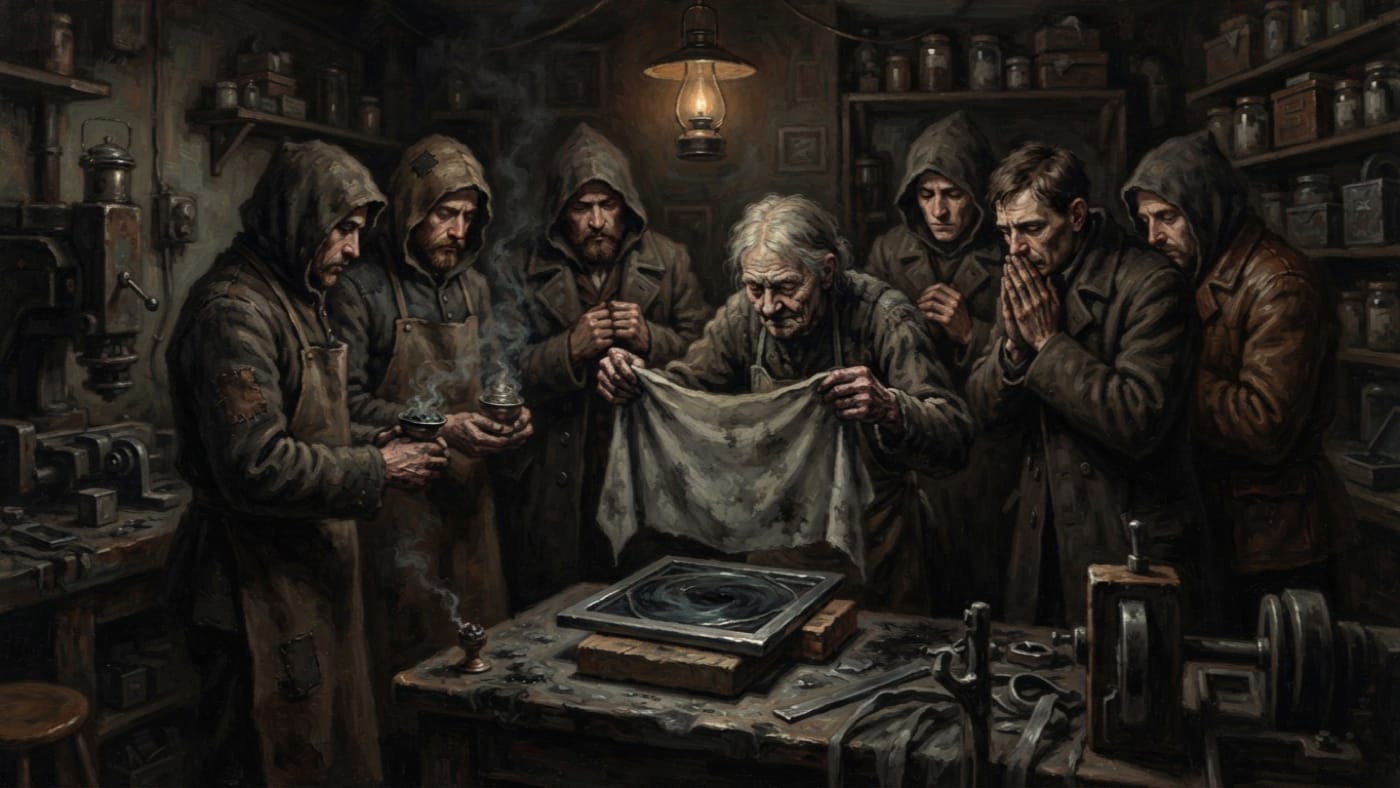
The shutters are closed. The lamp is kept low, as at every bench, because bright light wakes the glass. A mounted shard, framed in lead came and dull with handling, is set on the bench and covered with cloth. The cloth is usually grey linen, and the grey usually comes from lead dust. The room smells as Polisher rooms always smell, of black-diesel film, ash-grit, hot metal gone cold and singed rag. Hands carry the grey into the cloth and the cloth carries it back into the hands.
The apprentices then recite names. They are other people's names: strangers, the dead of other parishes, saints from other calendars, a harbour-master three ports away. An apprentice never says their own name. The bench has always taught that glass steals small words first, and a name is the smallest word a person owns. Say it near an open pane and the pane may keep it.
Then the oldest hand in the room lifts the cloth. Age, and not rank, decides who that is. A Lapper of sixty outranks a Stainwright of forty for this one purpose and no other. The cloth stays up for a single breath and comes down again.
What follows depends on the glass. If it stays silent, Varda is thanked. If it whispers, she is thanked faster.
#On Silence and Its Rivals
The feast honours a whisper and gives thanks for silence. The Polishers see no contradiction here, and they have more practice with the glass than anyone in Strasbourg.
The Quietists read the silent shard as proof that Varda's lead still holds. To them the feast is an inspection carried out in the posture of a prayer, and the thanks for silence is a sign-off on work well done. The Revelators read it the other way. The legend promises a whisper to the faithful, so silence is a lapse, either of the glass or of the room. A whisper is the promise kept, and they will price a pane accordingly by morning. The Bureau-Friends observe that either result can be sold. A silent shard reassures a captain, a whispering shard tempts a widow, and both make good copy for a Purity raid that needs something on the table.
Nobody has settled what the whisper says, who says it, or whether it is anyone at all. The Polishers do not ask the speaker to identify itself. That is wise. Nothing in the glass has ever answered such a question honestly.
The feast should not be confused with the bench's ordinary silence test. That test uses a candle and a read-out list of names, never the Polisher's own, a relative's, or anyone the Polisher has met. It watches the flame for any bend toward a name, and it grades panes for sale. The feast grades nobody. It has no candle and no price. It has one breath, and gratitude for whatever the breath turns up.
#On Custody, Denial and Sixteen First Shards
The Bureau of Rites knows about the feast. It filed the matter under a sealed classification, and that classification's wording and code are not available to this office.
BUREAU OF RITES: CLASSIFICATION SLIP, PARTIAL Subject: observance reported among contraband optics workers, patroness unfiled Classification: ███████████████ Disposition: ███████████ Annotation, unidentified hand: ██████ ██ ███ ████ ███████ ███
Purity's position is simpler and louder. Standing Order 14-K, revised A.S. 172 / 1882 CE, orders all demon glass seized, shattered, blessed and buried in lime, and condemns every hand that grinds or mounts it. Meanwhile the Bureau of War buys the same hands' work for its trench-masks under the filing heading "Optical Supplies, Standard." Commerce, however, is not liturgy. War has bought the lenses. It has never bought the feast, and it never will.
What the Bureaus cannot seize, they cannot suppress. The feast has no shrine to raze, no priest to defrock and no register to burn. Its icon fits inside a cuff: no face, just darkened hands wrapped in lead-grey linen, holding a mounted shard, with three pencil strokes for a sealed mouth. An apprentice can draw it badly and still draw it correctly. The closed-eye mark a Stainwright presses into lead to certify a silent pane belongs to Varda as well. It belongs to the bench and the trade, and should not be mistaken for the feast's icon.
Then there are the relics. Workshop claims include a lead ring in Thessaloniki, a cracked soldering iron in Marseille, a strip of palm-linen in Varna, a quiet-box lid held by a Strait-Rat crew, and sixteen alleged first shards. All sixteen are mounted, all whisper something different, and each owner swears theirs is the original. None has been authenticated. The feast does not need any of them to be genuine. Any mounted shard will serve. Saying so in the hearing of an owner, however, is rude.
#On the Present Condition
As of A.S. 201 / 1911 CE, the feast is kept wherever the glass is ground, and the glass is ground in more places than the Synod admits. A Bureau of Shadows memorandum reports that demon-glass distribution grew about thirty percent across Zones 5 through 7 between A.S. 198 and A.S. 201. That memorandum counts crates. It does not count breaths held over a covered pane, and this office will not pretend otherwise. Nobody has taken a census of a feast that is denied every morning, and nobody will.
In the Maskwright Lanes, Glassman Dimo's apprentices chalk Varda's closed eye under the benches. In Marseille the mark is scratched into lead stock and wiped off before inspection. Whether the apprentices of either port lift a cloth on any given night, after any given Matins, is between them, the oldest hand and the glass.