
#On the Chapel and Its Custody
"A wound gives; a wound takes." — Common proverb among extraction crews
Budapest keeps plenty that the rest of the Synod would prefer not to count: refugees, rail debt, and a river bank it no longer holds. One thing it is glad to have counted is the Extraction Chapel. This is the shrine where a much-corroded iron object attributed to Saint Orren of the Iron Plug rests in a sealed case, entered in the catalogue of the Bureau of Relics as R-0447-BP.
Attributed is the Bureau's word, and I keep it. Relics has authenticated the plug provisionally, pending resolution of metallurgical dating disputes. A provisional authentication is a strange sacrament. It permits veneration, licenses the case and admits the crowd, and it reserves the right to apologize later. Budapest has taken the permission and left the apology on file.
The congregation is a trade. Wound-Site Prospectors and seal-drivers come to Orren the way bell-founders come to theirs and gravediggers to whoever will have them. They want a patron who knows the work. The chapel's literature does not say who founded it, which bank its door faces, who appointed its first priest, or where the case stood before it stood here. I decline to improve on that silence. A shrine may be ancient or merely confident. This one is prosperous, and in Budapest that passes for both.
#On the Nine Hours
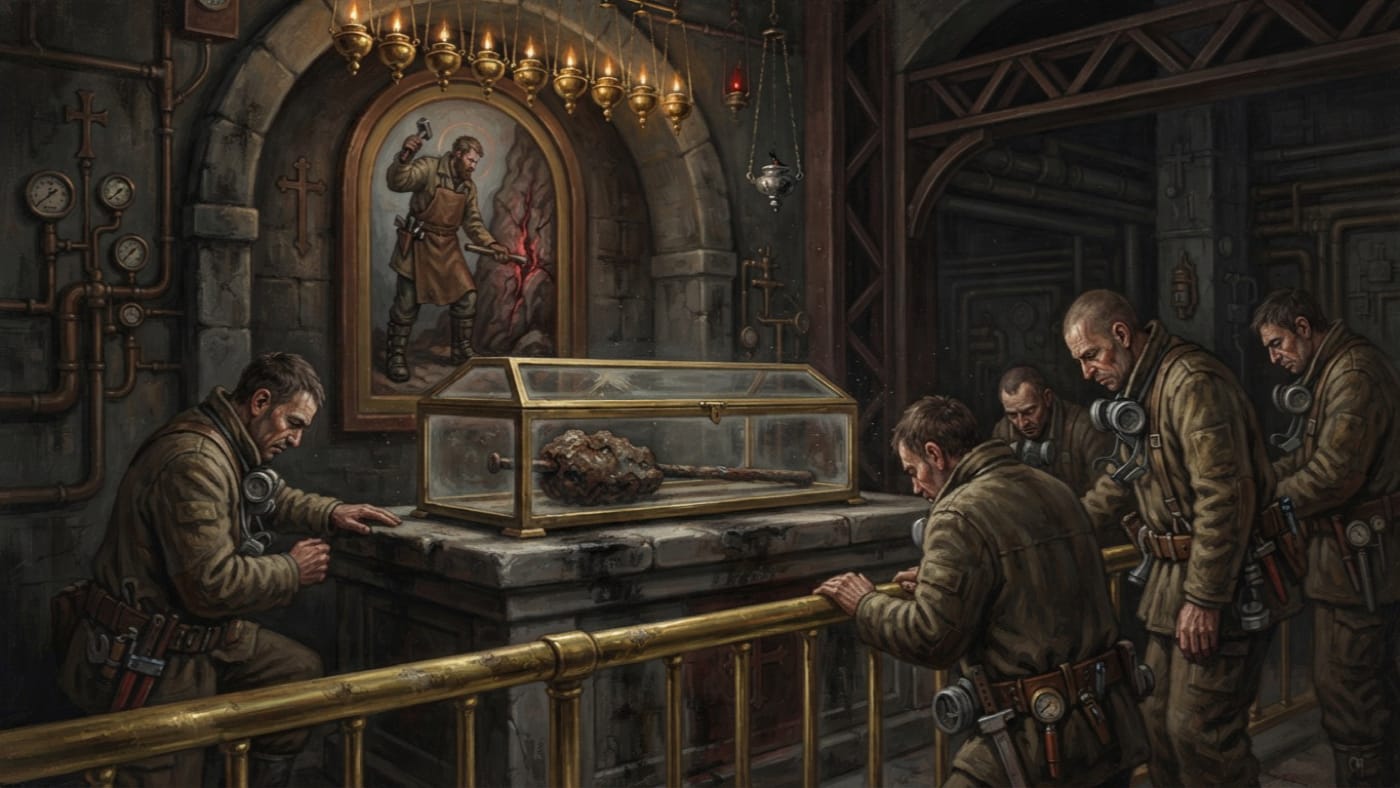
The legend, as the approved iconography tells it, goes like this. Orren holds a hammer in one hand and drives an iron seal into a bleeding fissure. The plug held for nine hours. On the tenth the wound reopened, and Orren was inside it. The published record does not say where the fissure lay, in what year, whether anyone recovered his body, or by what chain of hands the plug left the earth and came under glass. I will not give the reader a grave to kneel at just because kneeling needs a direction.
The legend teaches containment. Healing was never on offer. Orren did not close a wound; he bought nine hours from it and paid for the tenth in person. Prospectors understand that arithmetic better than the theologians who later made it a precedent, because the prospectors are the ones who stand inside the tenth hour for a wage.
Throughout the extraction-chapel system, the Orren arrangement is nine lamps with the tenth left unlit. I have no survey of the Budapest building that tells me how its lamps hang, in what brass or at what height. I know the convention, and the convention is what a man looks for when he comes in off the corridor with his respirator rim still pressed into his jaw. Nine burn and one stays dark. Nobody explains it to an apprentice twice.
The profession's lists name two other objects. One is a fragment of Orren's hammer, which Relics rates "probable"; where it is kept has not been published. The other is a respirator cloth said to hold his last breath, owned by a private collector in Marseille whose provenance is disputed. Neither object is in Budapest. Pilgrims who arrive asking for the hammer are told so. Pilgrims who arrive with coins, expecting to touch the cloth, are told they have mistaken a shrine for a business that charges by the finger.
#On Patronal Invocation
The Fuel Monopoly Acts of A.S. 112 (1822 CE) were issued by the Bureau of Tithes in coordination with the Bureau of Engines & Furnaces. They turned a trade saint into a licensing emblem. Orren's plug went onto permit stamps, drum seals, charter-house safety placards, extraction-chapel lintels, condolence cards and wage scrip. The published record states plainly that the Budapest Extraction Chapel prospered, and Relics enjoyed the sudden discipline of crowds with money.
Keep the date in its place. A.S. 112 is the year the saint was drafted into service. It is not the chapel's founding, its consecration or the year the plug arrived, and anyone who carves it over the door has written fiction in stone.
The Acts also required chapels near major extraction corridors and called them liturgical support stations, a term that makes a pew sound like a supply depot. The nine-lamp arrangement spread with them. Budapest stages supplies toward Sibiu and Irongate, so the city is surrounded by corridor traffic in the way a cathedral close is surrounded by beggars. I will not tell you which statutory register lists the Budapest shrine, because I have not seen it listed. It shares the emblem, the lamps and the trade, and that has been enough to fill it.
An A.S. 119 devotional tariff sheet stated that all Fuel Monopoly charters "operate under Saint Orren's protection."
Withdrawn after two ruptures, one chapel-sled inversion, and a petition from prospectors objecting that the saint was being blamed for managerial greed. Revised wording: "operate under Saint Orren's patronal invocation." The correction applies to the charter system as a whole and is recorded here because it governs what may be said beneath the Budapest lintel.
The correction matters before the case. A prospector who kneels there does not believe the saint guarantees his lungs. The legend he is kneeling to says the plug failed. What he asks for is nine hours, or whatever share of nine hours the Creator will spare, and he asks with the matter-of-fact faith of a man who has watched a gasket hold and watched one go. The charter houses believed in guarantees for exactly as long as it took the guarantee to become a liability.
The same icon then leads two lives. A prospector may kiss Orren's image in a tool shed and spit at the same image printed over a shift schedule. Those two gestures do not contradict each other. One is addressed to a saint and the other to a foreman.
#On Readiness and the Charter
The statute's quieter use of Orren lies in the clauses that follow. Under the system the Acts built, chapel attendance became evidence of readiness. Readiness fed wage standing, and wage standing fed debt relief. A crew that refused a dangerous tap could be accused of technical caution. A crew that refused it after Orren's lamps were lit could be accused of spiritual cowardice, which costs more and is cheaper to prove.
I cannot certify that any clerk sits in the Budapest nave with a pencil. I have seen no attendance register for the place, no local ordinance and no posted fee. The statute does not need a man in that nave in particular. It only needs somebody, somewhere, to be able to say that the crew knelt. The chapel prospers in a world where kneeling is negotiable currency. Whether its own floor is where the currency gets minted, the record does not say.
The offices around the case are easier to name than the hands inside it. Tithes administers extraction rights and the accounts. Engines & Furnaces sets the technical standards for supply and sealing. Relics authenticates the iron. The Bureau of Doctrine supplies the approved interpretation of what nine hours mean. None of this tells us who owns the building, who appoints its clergy or who empties its box, and I will not appoint anyone to fill the gap.
The Budapest shrine should also be kept separate from its humbler cousins. Mobile chapels are dragged on sleds to the wound-lip, where they give the gasket-hymn singer consecrated ground to stand on while the drum is sealed. Their sacrament is practical, and it either holds or ruptures. The Budapest chapel taps no seam, seals no drum, tests no barrels and trains no singers. The Gasket Choir and the Engines manuals govern sealing discipline. The shrine governs nothing. It keeps an object and receives the people the object belongs to.
#On the Hands Before the Case
Look at the hands on the glass, not at the glass.
Wound-site work goes for the lungs first. The cough starts in the second season, and the crews call it "singing back." By the sixth season, speaking between fits takes more breath than a man has. The hands go next. Drums vibrate after filling, augers kick against stone, and the clamps pulse through the sealing hymn, until the fingers keep a tremor that no physician can explain and no chaplain can bless away. The old ones cannot hold a pen. Some cannot hold a cup steady enough to drink the chapel water without spilling half of it down their coats.
These men work under Synodal licence, sing Synodal hymns, seal with Synodal wax and travel under Synodal escort. Their wages come from charter houses, so the Injured Laborers' Provision of A.S. 160, which covers only Bureau employees, does not reach them. The Hospices of Departure run by the Bureau of Mercy receive them at the end. Before that, many of them receive the chapel.
I record no cures here, no visions, no petitions and no roll of the dead, because the record holds none for this shrine and I will not forge one to make a widow weep on schedule. What I can record is the posture. The same prospector who resents the saint stamped on his scrip will press a shaking palm to the case that holds the saint's iron, and he means both gestures. Exploitation by the charter houses does not make his faith counterfeit, any more than a forged seal makes wax a lie. He knows who sold Orren to the clerks, and he has no intention of handing the saint over to them.
#On the Outstanding Authentication
The plug is still corroded, still sealed and still provisional. The Bureau's own notice says that iron of the specimen's apparent age should have crumbled to powder, and it has not. The notice gives no figure for that age. It offers no mechanism, and it declines, in its own words, to speculate as to why. Doctrine has not overruled that refusal and Relics has not withdrawn it. The dating disputes remain unresolved under the same catalogue number they have always carried.
I have nothing to add to that refusal, and from me that is a considerable concession.
Behind the case, the hammer and the bleeding fissure hang in the approved style. In front of it, the brass rail where the crews put their hands has worn bright in a band about a palm's width, and the band is uneven, as if it had been polished by hands that shook.