
#On the Fragments and Their Attribution
“Measure twice. Praise once.” — engine-house maxim, chalked above more ignition boards than any auditor has counted
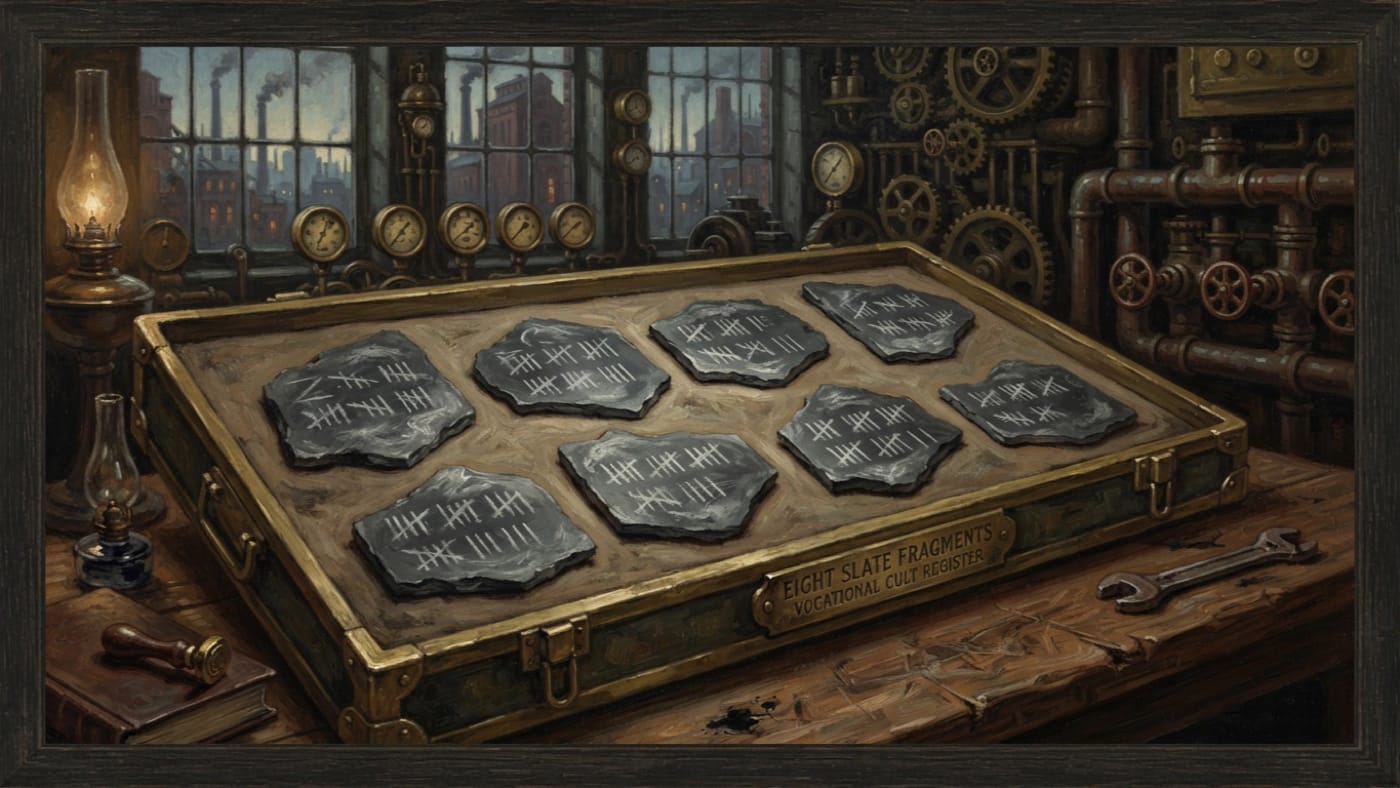
The cult of Saint Edrin of the Eight Strokes keeps a short list of principal reliquaries: the Timing Wheel of Kalnik, the Burned Wrench, the Throat Cloth, three finger bones that nobody will vouch for in daylight, and the Eight Slate Fragments. The cult's account of the last item is brief and, for once, modest. Early apprentices, it says, supposedly wrote the Strokes upon them in soot.
I keep the word supposedly. It is the only honest word in the entry, and honest words in a relic register are rarer than intact throats in a generator vault.
Here is what the record gives: slate, eight pieces, soot, and an attributed apprentice origin. The rest is missing, and a Relic Authenticator would want all of it before touching a seal press. The cult register names no apprentice. It gives no size, no quarry, no year of recovery and no keeper. It does not say whether the pieces ever lay edge to edge or came from eight sheds and eight bad winters. The register does not settle the question, and I will not settle it for the register. Eight is the cult's number. The slates come to eight.
#On the Road Behind the Relics
The fragments take their dignity from the Kalnik Road, and that debt has to be stated before anyone bows. In A.S. 48, during the years the Bureaus later grouped as the Great Retreat, Edrin was an engine hand attached to a retreat column. Near dusk the column's generator seized, spat oil and went still. He found cracked insulation, fouled injectors and a bent timing pin. He set the pin by thumb because the gauge had cracked. He did the mechanical work and sang eight beats against the casing while he did it. The engine caught. The lamps held, the pumps worked, and sixty-three wounded crossed the ford.
He died three days later of burns, fever and a throat that had closed around the work it had done.
Several western devotional sheets report that Saint Edrin died immediately after the eighth stroke.
Corrected. He died three days later, after asking whether the lamps had held, whether the wounded had crossed and whether the engine still turned. Every slate pedigree built on the instant martyrdom rests on a corpse that was still asking questions about the lamps.
The generator, later registered as KAL-ROAD AUXILIARY 6, ran for eleven years and was decommissioned in A.S. 59. Those dates belong to the man and the machine. None of them belongs to the slates. No deposition I can cite puts a fragment on the road, in the column's reliquary chest or within reach of the hot casing. The register makes no such claim either. The fragments are relics of the Strokes and of the boys who learned them. They are not relics of the night itself.
#On What the Strokes Preserve
The Strokes come down in three versions, and they do not agree.
The Life gives the narrative order. Wake fuel. Seat air. Bind spark. Shame metal. Steady heat. Close the wrong interval. Deny whatever has begun answering inside the casing. Command rotation.
The authorized apprentice manual gives the examination order: intake, compression, spark, correction, flame seat, harmonic denial, witness, rotation.
The sheds give the version that gets taught once the inspector has left: wake up, bastard; breathe; take fire; stop lying; burn clean; spit out the wrong note; hear me; move.
Put them side by side and the joints show. The Life places denial on the seventh beat. The manual moves denial to the sixth and gives the seventh to witness. The sheds turn witness into hear me, which could mean the crew, the engine or the Creator, depending on how badly the lamps are guttering. I will not force the three into one text and present it as the reading of the slates. No complete transcription of the fragments appears in any record I can cite. Whatever soot survives on them, the Codex does not know what it says, and I prefer an empty column in the ledger to a forged one.
The medium needs no forger, though. Slate is the ordinary schoolroom of the engine trade. It is cheap and flat, a sleeve wipes it clean, and every shed with a stove can supply soot. If the attribution holds, the apprentices did what apprentices always do with an order they are afraid of getting wrong: they wrote it down where the master could see it and correct it. That is a hypothesis about practice. It is not a finding about these eight pieces.
What the Strokes keep, in any of the three versions, is a procedure that will not split cleanly into prayer and engineering. Serious Litany-Engineers read it as breath control, timing discipline, fuel-air sequence, a structure that holds panic down, suppression of harmonics and a rhythm for the witness. The pious read it as prayer. The trade sums this up as sing to the spec, which means the ritual has to match the measurement. A maintenance ledger closes on numbers, cant code and a witness signature, all three of them. Remove any one and an auditor with white ears will want to know why.
#On Certification and the Useful Saint
Before A.S. 97, Edrin was a legend told in sheds and invoked by men with oil in their cuffs. Then came the Black Start Catastrophe at Bastion-Brest on the Bug. An uncertified operator restarted a lower-harbour generator without the ignition cant. Half the port burned and forty-three men died. Standing Order 14-E followed and made cant certification mandatory. It also formally constituted the Litany-Engineer vocation, along with its stationery.
Edrin's relics multiplied after that. The Eight Slate Fragments appear on the cult's list of principal reliquaries. The record does not say when they first entered a register. It also does not say whether the apprentices who supposedly wrote on them came before certification, after it, or long after it with the sincerity of men who needed a pedigree in a hurry.
Their usefulness is easier to see than their age. The Bureau of Doctrine wanted obedience that looked ancient. The Bureau of Engineering wanted a procedure that could be repeated. The Bureau of War wanted frightened mechanics who would accept drill. A slate that shows an apprentice's hand practising the eight-stroke sequence answers all three at once. To Doctrine it is a pedigree, to Engineering a primer and to War a drill card.
The Furnace Choir Reforms later standardized the litanies and banned folk tunes from motor houses. The shed version survived because it is spoken, and no reform yet written can confiscate a curse. Then came the Quiet Engine Heresy of A.S. 147. Licensed Engineers achieved, or claimed, stable combustion without cant. Doctrine and Purity suppressed them, the operators went to the Paper Mines of Ulm, and Engineering kept the calibration tables with the face of a dog sitting beside an empty pantry. No record I can cite brings the slates into that inquiry, and I will not drag them in. After A.S. 147, though, any relic that showed apprentices writing down a sung order was useful to the side that had won.
#On Present Devotion and the Unproven Hand
This survey stands at A.S. 201. Today every apprentice in a licensed training shed rinses their throat, touches the casing and counts eight breaths before speaking the torque litany. On Edrin's feast, senior men give eight hammer taps on cold casing. Pilgrim stalls from Brest to Bastion-Constantinople sell blessed chalk slates ruled into eight columns, alongside stroke-cards, timing beads and throat rinses that taste of salt and ash.
These are different objects. A chalk slate from a stall is a slate, blessed for a fee and wiped clean by Thursday. The Eight Slate Fragments are a named relic group with an attribution attached. Parish cards blur the two because blurring sells. The Codex keeps them apart because the Bureau of Relics eventually comes asking, and a clerk caught calling a stall slate a relic will spend a long winter grading bone splinters in an unheated annex.
The procedure is proven every shift under real load, in every vault where the lamps keep burning. The provenance is not proven. The fragments are attributed to early apprentices, the soot is said to record the Strokes, and the record gives no name, no hand and no verdict that would turn supposedly into anything firmer. Venerate the Strokes. Count the breaths. List the fragments as a relic of the cult whose writers are uncertain, and let no stall, sermon or card call the soot Edrin's hand.
Breath counted. Seal withheld. Move.