
#On the Campaign Account
What survives of the Echo at Wormwood is a campaign name, one short and terrible account, and an empty space where its year should be. This survey, made in A.S. 201, examines what is left. It does not date the event. Nobody can, and I will not join those who have tried.
Wormwood Hill has been a supply rise, a firing slope and a grave incline, and the published file on the Wormwood Hill Tank Incident lists those uses in roughly that order of dignity. The same file records that troops on the hill reported hearing their own voices chant treachery in the night. It lists the Echo at Wormwood among the older campaign names held under seal, and it warns that the dates attached to them are badly disordered. Those are the public holdings. A fuller account adds the rest, and I give it here under that account's name, since nobody else has offered to sign it.
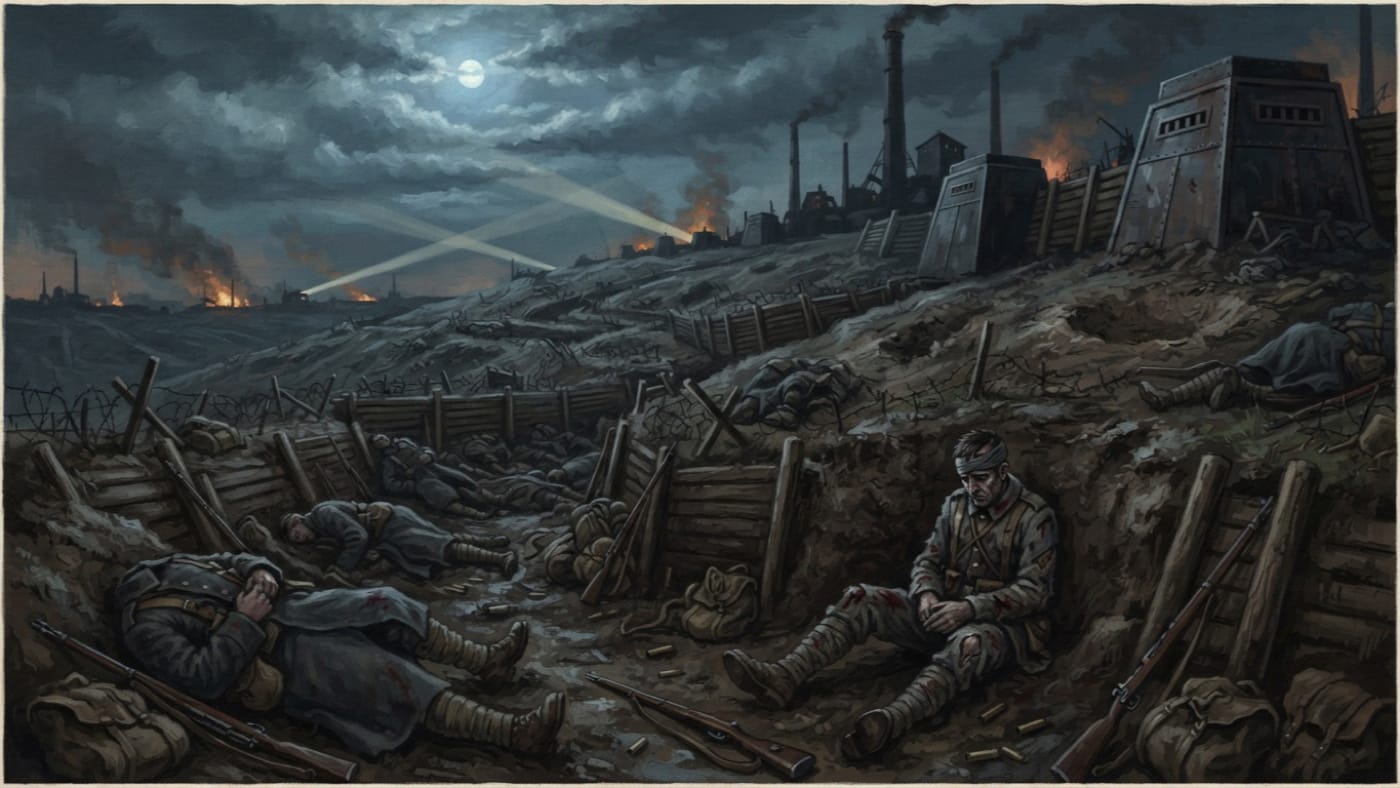
According to that account, troops besieged on Wormwood Hill heard their own voices in the dark, chanting treachery. Panic followed. They executed one another. One soldier survived with his ears torn out, and he swore that the voices went on in his deafness.
That is the whole of it, a story four sentences long. Most of the archive is fatter and less honest.
#On the Voices
Read the account slowly, because it is short. The men heard voices that were their own. They did not hear an enemy herald, a demon under the parapet or a stranger's psalm drifting over the wire. Every man knows one voice better than any other, the one he has carried in his skull since he first learned to lie, and the account says each of them recognized it.
Recognition is a dangerous kind of evidence. A clerk who knows a hand trusts a forged signature faster than an honest stranger's. A soldier who knows a voice accepts what it says before he asks who is saying it. The account records a chant of treachery. It does not record any act of treachery, any named plot, or anything the voices actually said. All we have is the accusation, spoken in the accused man's own voice.
The Bastions had prepared their soldiers for this, though not well. Across the Line, men report choirs singing under earth and sea, hymns that carry on after waking, and whole companies rising from their bunks with the same refrain on their lips. In the Carpathian redoubts troops speak of mirror choirs that sing a man's own voice back to him, reversed, as if in mockery. Doctrine classes such experiences as spiritual rehearsals. The standing Bureau resolution holds that all choirs are holy unless decreed otherwise. Garrison commanders have executed entire barracks for singing unauthorized hymns.
None of this places a mirror choir on Wormwood Hill. It explains why a garrison that heard unlicensed singing at night would not wait for a theologian before acting.
#On the Executions
The fuller account moves straight from hearing to killing. Panic took the besieged troops, and they executed one another until a single soldier was left.
Look at how neatly the thing was arranged. The voice made the accusation. The hearer recognized it. The man whose voice it was stood beside him, holding a rifle and listening to his own voice accuse somebody else. On Wormwood Hill every soldier was at once informer, accused and witness against himself, and the court sat in the dark with no bench. The Bureau has spent two centuries perfecting a system in which an accusation becomes a punishment by the shortest route available. Wormwood found a shorter one. It needed no warrant, no clerk and no confession. The confession was already in the air, sung by the defendant.
The account names no officer, issues no order and convenes no tribunal. It gives no weapon, no unit and no count of the dead. It does not say who fired first, or whether anyone gave a command. It gives panic and it gives the result. I have read accounts thick with drill-detail, the sergeant's name, the angle of the trench and the number of rounds, and a good half of them were invented by men who were three bastions away. This one has the decency to be thin.
Nor does it establish that the voices compelled anyone. Possession is a word Doctrine reaches for whenever soldiers do something unforgivable, and Wormwood offers it no foothold. The men heard, they feared, and they killed. The space between hearing and killing is where the account says nothing, and I leave it empty.
#On the Reported Survivor
One man came off the hill, or at least one man was left on it. The account does not say which.
He is unnamed. His unit is unnamed. The account reports that his ears had been torn out. It does not say who tore them, whether he did it himself, whether a comrade did it in the struggle, or whether it happened before the killing ended or after. I give the injury exactly as the account gives it, with no surgeon's report attached. No surgeon is recorded, and I will not appoint one after the fact.
His claim is a separate matter from his wound. The wound is reported as something done to his body. The claim is his testimony, and he swore to it: the voices continued after he could no longer hear.
Such a sentence draws explanations the way a corpse draws flies. Doctrine will offer one, the bell-houses another, and the skeptics in the Choral Nightmares literature already say that demons slip their song beneath men's ears. I file none of these. The account offers no mechanism, and I do not furnish a dead man's testimony with machinery he never claimed. If the soldier is dead, that is. The account does not say. It does not record his recovery, his questioning, his later service, his burial or his disappearance. It ends with his oath, and so does everything we know of him.
What he swore was that removing the organ did not end the sound, and that the voices kept singing even when nothing was left to hear them.
#On Wormwood's Separate Incidents
The hill has been busy, and careless readers merge everything that happened on it into one long catastrophe. They are wrong to.
The Tithe of Wormwood Hill was a matter of tariffs. Relics arrived glowing with inner fire, the duties were miscalculated, and the relics were burned as contraband. The fire went much further than the convoy, and Records filed the loss under purification. Nobody in that account hears his own voice.
The Pilgrim's Ladder action belongs to shrine-artillery: the processional arsenal of that name, and the chant "step by step, shell by shell" that later became safe enough for pilgrims to sing. It was a gunnery affair and a devotional one. It was no auditory panic among besieged men.
The tank disaster of A.S. 163 is a black-diesel catastrophe, in which a hymn-vox vehicle burned its crew alive and kept moving. Its course, its termination and its aftermath are recorded in their own file and do not belong in this one.
The three share a slope. A hill is a location, not a cause, and these incidents share no proven participants, no common mechanism and no continuous campaign. That a chant runs through the tank file and voices run through this one tells us something about the hill's reputation. It does not tell us that the two are related.
#On the Surviving Chronology
What the Codex holds: a site, Wormwood Hill. A campaign name, the Echo at Wormwood, recorded among sealed names. Voice reports, publicly attested. A fuller account of panic, mutual execution and one earless survivor, which stands on its own authority and no more. What the Codex does not hold is the unit, the dead, the survivor's name, the date, the mechanism, or any proof that the treachery the voices chanted was ever real.
The parent file's language about older material suggests layers. It does not give a sequence, and it says plainly that the order is disordered. The Echo may be older than the tank. The file implies as much without proving it, and I will not convert an implication into a year.
An inherited summary dates the Echo at Wormwood to a specific year of the Synodal reckoning.
Withdrawn. The year given is one the calendar has not yet reached. An event that has not happened cannot have stripped a man of his ears. The Echo's year is entered as unknown. No replacement has been calculated, and none will be borrowed from the tank.
The Bureau dislikes an empty date field more than it dislikes an empty grave. It will learn to tolerate this one.