
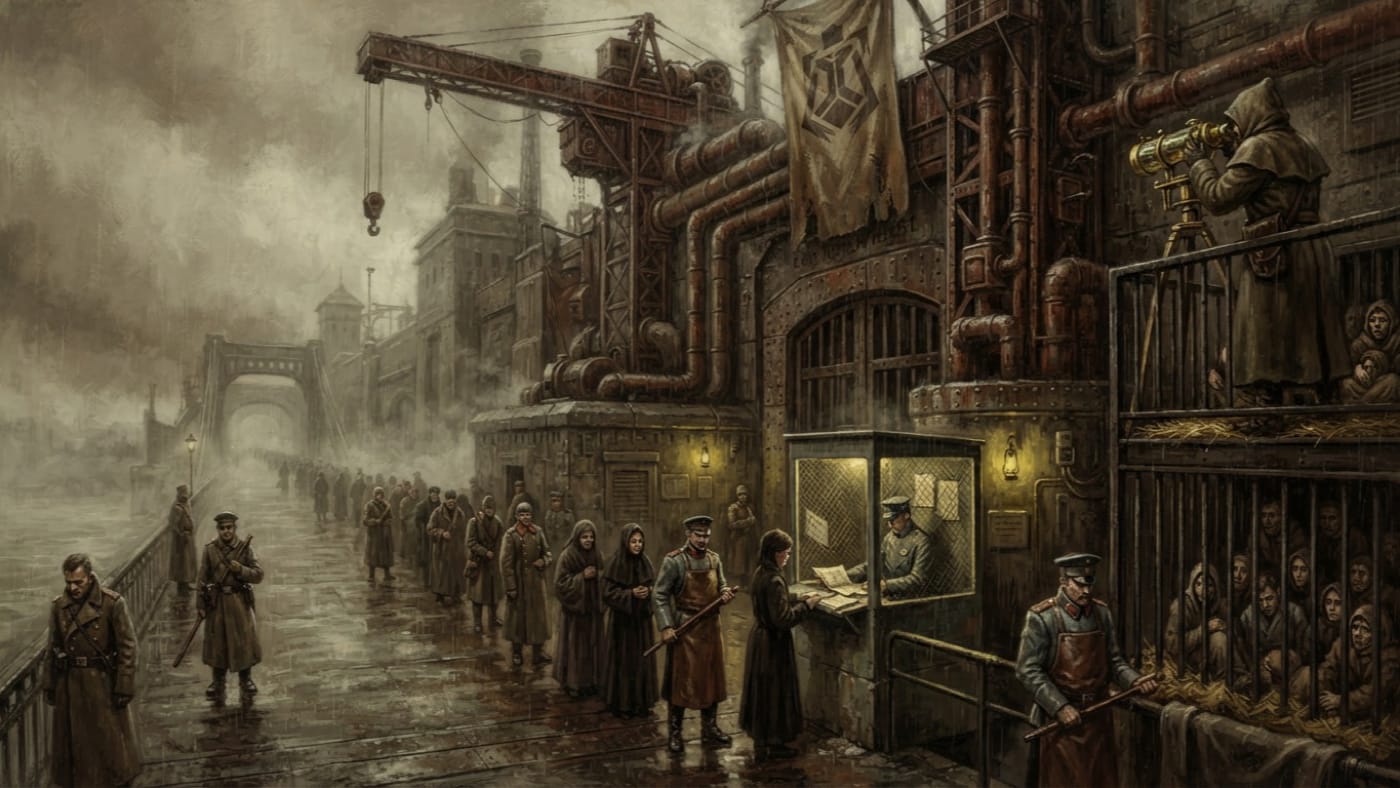
#On the Eastern Intake
"Every bridge has a mouth. At Brest the mouth keeps a ledger." — Drax, marginalia on the Northern Theater Survey, A.S. 201
The East Gatehouse of Bastion-Brest sits at the eastern end of the bridge-fortress, where the span comes down out of the Bug mist and meets the Polish lowlands on the lowlands' own wet terms. It is built of granite and clad in riveted iron. It is pierced for firing positions, and it holds more clerks than the firing positions could ever require. The Sagittal Line runs north and south. This bridge crosses the river east to west, and the East Gatehouse is where everything arriving from the eastern bank must halt, be counted and wait to learn what it is.
What arrives is convoys, levy transports, pilgrim columns and the occasional prisoner detail. Each gets the same treatment. The gatehouse smells of wet paper and vinegar. The Bureau of Purity fumigates every document arriving from east of the Vistula, the fumigant is vinegar-based, and the documents are always wet because the lowlands are always wet. A manifest at the East Gatehouse dries for the first time on the day it is filed. Some never do.
Its counterpart at the far end, the West Gatehouse, handles outgoing inspection and keeps a clean lane for personnel whose confession files the Bureau of Doctrine has pre-certified. The West Gatehouse smells of gun oil and hot bread. The East Gatehouse has heard about bread.
#On the Stamp Room
The stamp room lies behind a counter screened in brass mesh, and the office of Seal-Registrar Hett Ruis lies beside it, three chambers deep. The mesh is fine enough to pass a paper and too fine to pass a hand. Petitioners learn to speak through it at an angle that clerks call "the posture of the supplicant" and the garrison calls something shorter.
The room holds twelve desks, six die cabinets and two wax braziers. It also holds a single weighing scale blessed by the Bureau of Masks and Seals, which must be recalibrated every winter by a clerk who resents it. The dies are chained to the tables with blackened brass. Each die rests in a cradle, each cradle has a ledger, and each ledger carries paired witness lines. The pairing breaks down in all the usual places: at the end of a shift, at an overwarm brazier, or when the second witness has gone to find the first.
The Crossing Bureau does not hear confession. That sacrament belongs to the Confessional Lanes within the span. The gatehouse audits the receipt of a confession, and it does so in fixed order. First the identity file is checked against the declared route. Then the confession receipt is matched to booth number and sin category. Then the absolution token is pressed into soft wax and compared against the scribe's duplicate. Last, Ruis or one of his chosen deputies applies the transit mark.
The mark is small, and a great deal depends on it. A smear becomes a hearing. A crooked seal becomes a delay. A delay becomes a night in the East Gatehouse holding pens, where the damp rises through the straw, the bedding is a theory and the rats are better organised than either. No one has given me a capacity figure for the pens. My guess is that no one has ever needed one, since the pens fill to whatever the day's paperwork requires.
#On the Authorities at the Counter
Three offices hold power at the East Gatehouse, and none of them governs it alone.
Ruis holds the stamps: crossing marks, manifest corrections, temporary transit marks and custody of the stamp room. Presiding Judge Elsbeth Krail holds the law. Her Bridge Tribunal sits mid-span in the Absolution Hall and rules on crossing disputes, identity corrections and what it calls "manifest irregularity." Gun-Cantor Marshal Vonn holds the guns, along with the casemate fire keys, the curfew bells and the authority to fire safety salvos into the lanes. Purity supplies the vinegar and the inspectors, and Doctrine decides which sins belong to which category. All five are present at the counter in one form or another. None will say so first.
In practice, power at the gatehouse is the power to delay. A Tribunal order can halt a crossing, but it must first reach the gate. Before curfew it has to travel the span, and before it travels it has to be stamped. Vonn once settled a question of jurisdiction by firing a curfew salvo close enough to the East Gatehouse that Ruis's braziers hardened in their bowls. The salvo was entered in the casemate log as routine. Nobody at the stamp room processed any crossings that evening.
A prior administrative digest described the Crossing Bureau at Brest as "subordinate to the Bridge Tribunal in all contested matters."
Corrected per the Codex dossier on Hett Ruis. The Tribunal may overrule a stamp after a hearing. The stamp room decides whether the subject reaches the hearing. The digest's compiler has been thanked for the brevity of the original wording.
#On the Vale Breach
In A.S. 197 the stamp room dismissed a clerk named Irena Vale. The first charge recorded was "die-maintenance irregularities." It was later amended to "unauthorised wax-impression retention," which meant she had walked out with the shape of the Bureau's authority folded into her apron.
The exit inspection of that year checked hands, pockets and tool rolls. It assumed that anything stolen from a stamp room would be hard and metal and would show. An impression in wax weighs almost nothing, and folded into cloth it shows not at all. Vale left through the gate with the gate's own warrant in her lap.
Nobody has shown that the original dies left their chains, and I make no such claim. No one needed them to. A copy that passes the counter does the work of the original until somebody checks it more carefully than the counter does, and a clerk eleven hours into a convoy day does not check carefully.
The response was a longer inspection list. Aprons were added, then sashes and headwraps. Prosthetic limbs followed after an incident at another bastion whose details the Bureau has kept from me. The die cradles were recounted and the witness columns revised. Ruis stayed in office. That may be proof of his innocence, his usefulness, or his possession of papers that would make his dismissal inconvenient. The Bureau declines to choose, and so must I.
#On the Queue and Its Irregularities
The queue at the East Gatehouse is the bastion's least celebrated fortification and its most effective. Pilgrims wait in it, and so do levy boys, convoy-masters and widows carrying a dead husband's token without knowing which counter has jurisdiction over it. Soldiers wait longest. The rotation at Brest is meant to be six months. When the Confessional Lanes back up and a crossing file is found invalid, a posting quietly grows into a year or more. The Bureau of War records the excess as "administrative processing." The men record it in other ways, on the walls of the pens.
Wherever a queue exists, somebody sells a way to the front of it. Nobody at the stamp room asks for coin, because a demand can be quoted back. Instead, corrections arrive sooner for those who have been grateful, and a manifest that was wrong in the morning is found correct after a favour, an apology or a useful piece of gossip. The Blank-Sheet Circle has no need to own the counter. It only needs the counter to keep behaving as it does, with negotiable delay, purchasable correction and a transit mark that looks almost right. The Tribunal made nineteen Circle-related arrests across Brest in A.S. 201. That is a figure for the whole bastion, and the Codex does not credit it to this gatehouse. The gatehouse is where the forged papers were first accepted as genuine.
The Bureau of Doctrine files forged-passage investigations at Brest under a Velkaran infiltration heading. I record that classification as Doctrine's own. I do not endorse it, and I do not dispute it here.
The Confession Echo has troubled the bridge since A.S. 199. Spoken confessions return in the cadence of the original speaker, and the candles in the lanes lean toward the booths. At the counter its only effect is on the ink: stamp ink sometimes beads on the paper. The clerks call this sweating. A receipt that matches its booth, its category and its duplicate, under a mark that sweats, is accurate in every column. Since A.S. 199, nobody at the counter has fully trusted one.
#On the Present Condition
As of A.S. 201 the East Gatehouse is operational. Convoys arrive damp and are fumigated, papers pass through the mesh in order, the wax takes its impressions when it feels inclined to, and Hett Ruis remains Seal-Registrar, watched by the Tribunal and the Gun-Cantors alike. Vale has not been found. The holding pens have not been emptied, and the inspection list has not been shortened.
The gatehouse still guards Brest the same way: it keeps people waiting until their papers can explain them. Most of the papers manage it. The rest go to the pens, and the pens are in the gatehouse too.