
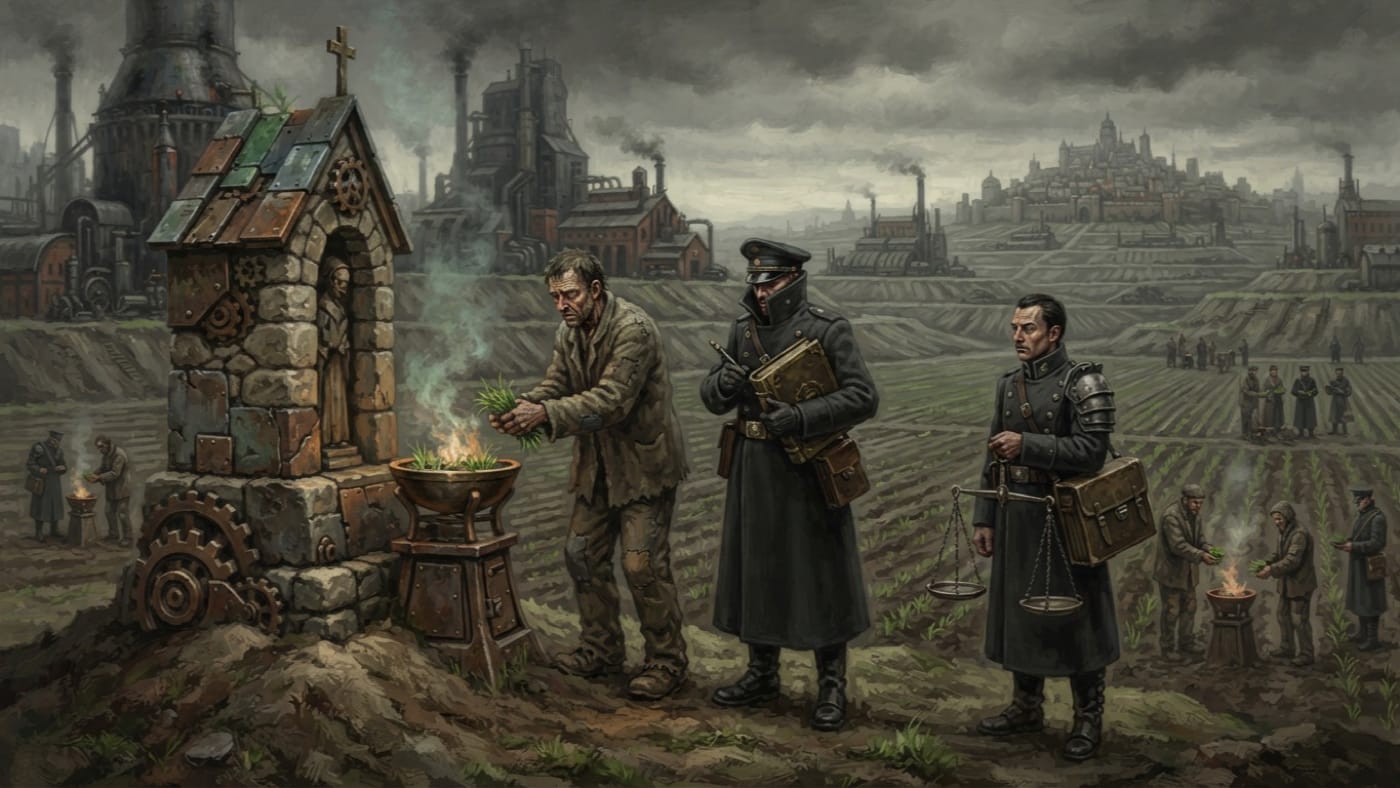
#On the First Growth
"What rises first is owed first."
The Day of the First Seed burns no seed. Every clerk sent out from Strasbourg makes the same mistake. He arrives at a parish shrine expecting a sack of grain to be tipped solemnly into the flames, and instead he finds farmers holding fistfuls of green shoots a hand's breadth tall, still wet from the furrow, with soil on the roots. The seed went into the ground weeks earlier. What the farmers bring to the shrine is what came up.
The calendar of the Bureau of Festivals lists the observance among its named rites, and the whole of its substance fits in one sentence. Farmers present the first grain shoots of the season at their parish shrines, and the shoots are ceremonially burned. The Church teaches that this proves the harvest belongs first to Heaven. In the same entry, the Bureau of Festivals adds that the harvest belongs second to the Bureau of Tithes. Both clauses are in the calendar. Only the first is ever preached.
The rite follows the field. Shoots come up when soil and weather allow, and a parish in the western Heartlands keeps its day by its own ground. The calendar I consulted gives the observance no fixed date. It does not name whoever first lit the fire, either. The Bureau has never supplied a founder, and I will not invent one for a rite that has managed perfectly well without.
#On the Offering
"Green into ash, by the hand that sowed it."
Before a single shoot breaks the surface, a field has been ploughed, harrowed, sown and watched. The watching is the part the calendar leaves out. A farmer who walks to the shrine with the first growth in hand is carrying the season's first evidence that the field may not fail. The Church has decided that this is exactly the right moment to set fire to it.
Every shrine I have visited keeps its fire in its own way. I have seen a brazier, a ring of hearth-stones, and once an iron pan that had obviously done years of service under eggs. If the Bureau prescribes a vessel, those parishes never received the circular. What the observance does require is the burning, and green shoots burn badly. They hiss. They spit sap. They give off a pale, sour smoke that clings to wool for the rest of the day, and they leave less ash than you would expect from something that took so much work to grow.
The farmers watch it burn. I have never seen one look away.
Doctrine explains the meaning without embarrassment. A handful of shoots is nothing set against a field, and the Church says so openly, because the smallness is the lesson. Heaven does not need the grain. The farmer needs to know whose grain it is. The first growth goes to the Creator so that everything after it is held as a grant rather than owned outright, and the farmer walks home knowing that the field is on loan.
As a matter of farming, the handful hardly counts. As a matter of instruction it is everything, and the Church has always preferred lessons that cost the pupil something he can see.
#On the Harvest's Claimants
"Heaven takes in ash. Tithes takes in sacks."
The calendar names two claimants and ranks them. Heaven comes first. Tithes comes second. I have spent my career defending the order of precedence in the Church, and this is one of its tidier arrangements, so long as nobody asks what each claimant actually receives.
Heaven receives smoke. Its claim is settled at the shrine, in public, in a few minutes, and when it is over nobody has a sack more or a sack less. Heaven holds no seat among the Holy Bureaus. It keeps no counting house, and its claim is the only one in the farming year that arrives without an armed escort.
Tithes receives everything else. That Bureau oversees every coin, harvest and levy that flows into Strasbourg, and its Assessors travel with scales, ledgers and guards, preaching that to withhold a tithe is to starve the Synod's soul. When the Assessor arrives at harvest, the shrine's ash counts for nothing. A farmer who gave Heaven its shoots in spring owes Tithes its full share in autumn, measured, receipted and entered. The burning discharges no part of that debt.
So two different things happen to the harvest, and the Church uses two different verbs for them. A sacrifice is accepted. An obligation is collected. The Bureau of Doctrine has never confused the two, and neither has any farmer I have met. The farmer can tell them apart by weight. Doctrine tells them apart by grammar.
The order matters to the institutions, and that is why the calendar spells it out. Heaven's priority makes the field sacred. Once the field is sacred, holding back its yield is no longer just tax evasion. It is impiety. Tithes did not invent the Day of the First Seed. It simply arranged to stand directly behind it.
#On Verification and Forgiveness
"The offering must be true. The account must be paid."
Because the doctrine requires the first growth, the first growth must be proved. The Bureau of Festivals employs three auditors in each province for this one duty: to confirm that the shoots burned at the shrine really are first-growth, and not shoots from the third or fourth planting passed off as the first.
Three per province. A province contains a great many parishes, every parish lights its own fire, and the fires do not all burn on the same day. The auditors cannot be at every shrine, and no document I have seen says they try. The figure tells you how many people the Bureau pays to stand behind the doctrine. It does not tell you how many fires they watch.
How an auditor tells a first shoot from a third is not written down anywhere I have been allowed to read. The calendar records the duty and the staffing, and it says nothing of the method. I have no intention of supplying one.
The reason for the substitution is plain to anyone who has held a hoe. The first planting is the one a farmer trusts. The later plantings are cover against frost, flood and bad luck. Burning a handful from the planting a family relies on hurts more than burning a handful from the planting it planned to lose, and the shoots look much the same at a hand's height. Farmers are not theologians. They are, however, very good at arithmetic.
Fraud is common. The Bureau of Festivals says so in its own calendar, which is more candour than the Bureau usually allows itself.
Fraud is also forgiven, on one condition: the tithe must be paid on the genuine first-growth as well.
That sentence is the whole design. When a farmer lies to Heaven about the offering, the auditor's job is to catch it. When the auditor catches it, the cure is an assessment. The false offering has already burned and cannot be taken back, and nobody suggests burning the true first-growth after it. That grain goes to Tithes. The farmer who tried to spare the best planting from the fire ends up paying for it in grain on top of the ordinary harvest obligation.
The calendar does not say how much "as well" comes to in sacks, and I will not guess in a Ledger that lasts longer than guesses. No rate is published and no formula is given. All I can confirm is the condition.
The Bureau of Tithes calls this arrangement "flexible orthodoxy." The phrase deserves admiration. Doctrine stays rigid, because the first growth belongs to Heaven and no auditor may concede otherwise. The flexibility is all in the collection. The Church watches closely to make sure Heaven is not cheated, and then lets the cheat settle the matter with Tithes.
The farmers call it something shorter.
#On the Present Observance
"Primitiae caelo."
The rite still runs on its old terms. Farmers carry the earliest green of the season to the parish shrine, the fire takes it, the smoke clings to their sleeves, and they go home to a field that is now officially on loan. The calendar entry names no choir and no pageant, and it does not mention a Chorus-Master. The farmers bring the offering and the parish provides the fire. For an office that traces its authority to the Charter of Prescribed Observance and spends most of its budget on banners, this is close to free.
Tithes does even better. The burning reminds every farming household, once a year and before a single ear has formed, that the harvest already has an owner. The forgiveness clause turns every exposed substitution into a fresh entry in an Assessor's ledger. Heaven loses nothing by the arrangement and Tithes gains something by it, and the Bureau of Festivals can point to both outcomes as proof that the observance works.
The farmer has done this arithmetic every spring for longer than the calendar has been printed. A handful goes to the fire. A share goes to the Assessor. If the handful came from the wrong planting, a second share goes after the first. The field keeps what is left.
I find the system sound, and I have audited sounder systems. None of them has been this honest about what it wants.
Primitiae caelo; decimae Argentorato. The first growth goes to Heaven and the tithe goes to Strasbourg, and in this observance the second has always been the larger.