
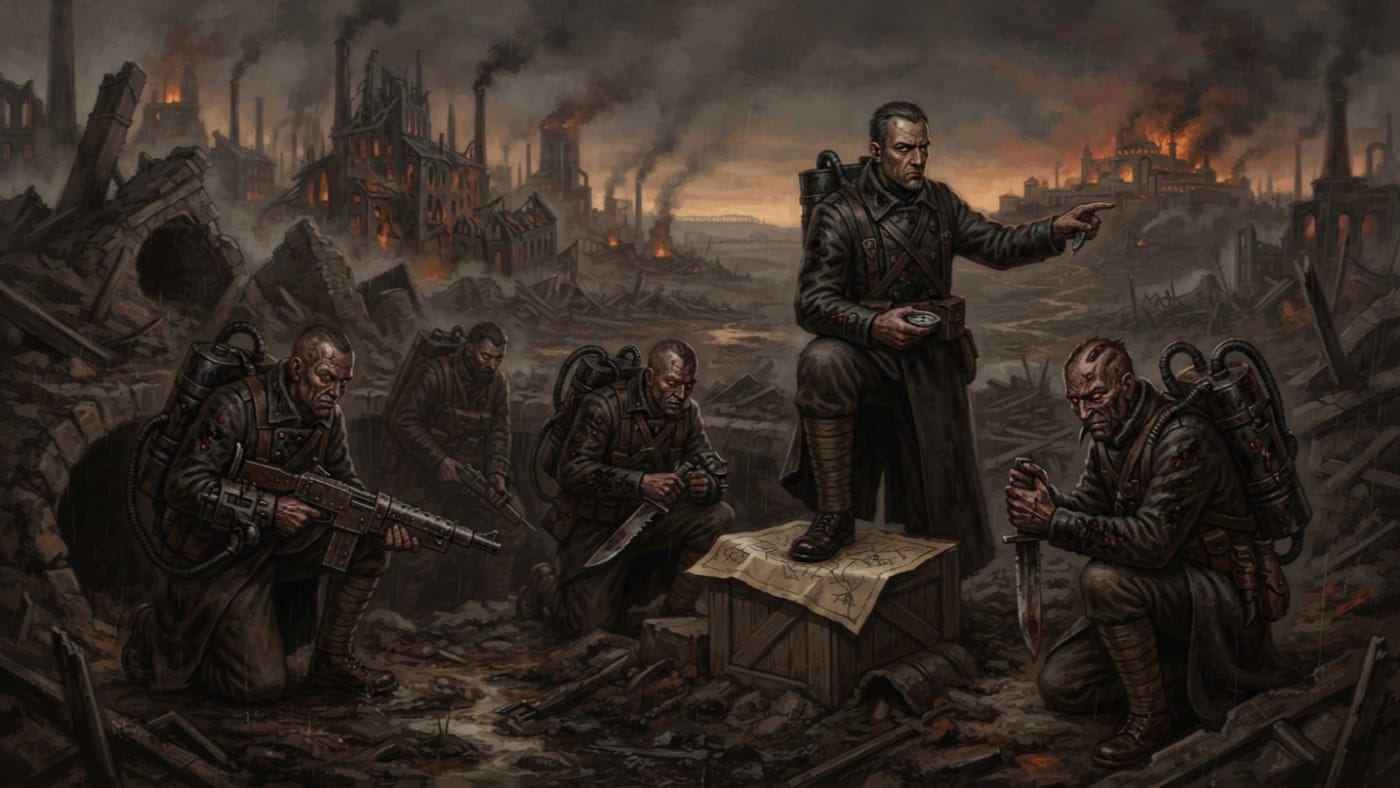
#On Their Nature
"An Ember-Soldier will kill you. A Crucible-Born will remember your face while doing it." — Drax, annotation to the Wrath dossier
The Crucible-Born are human. I set this down first because the Bureau of War files everything that marches out of Thrace under the same heading as the slag, and that habit has cost the Church more than the Bureau of War will ever enter in a ledger. They were men and women. They went into the Crucible Cities of Maldrake's domain with names, with parishes or the memory of parishes, with grievances. They came out transformed, and they kept more of themselves than any servant of Wrath has a right to keep.
What they keep is the problem. Their intelligence survives the refining, and so does their personality. Memory survives only in pieces: a face, a street, a hymn-tune, the shape of a wrong once suffered. The Doctrine of the Church holds that no demon may take a human choice, and the Crucible-Born are the proof the Bureau least enjoys citing. They chose. They wanted to be made into weapons, and they were.
Set them beside the rest of the host and the distinction is plain. Ember-Soldiers are the rank and file. They are charred and close to mindless, and they hold formation through shared purpose and Maldrake's direction. The Hammered are demons beaten into shape in the Eternal Forges, and they carry no human memory at all. The Crucible-Born are survivors who think. That is the whole of their horror and the whole of their value to the Sin-General.
#On the Crucible Cities
The Crucible Cities stand in Maldrake's territory, in the furnace-country of Thrace that borders and bleeds into the Iron Wastes. They are urban centres given over to a single industry, and that industry is people.
The process is slow. The Bureau's propagandists leave this fact out, because a slow process implies method, and method implies a mind behind it. Humans are brought into the cities as raw material and kept there for years. Rage is tended in them as a sacristan tends a lamp that must never go out. Violence is channelled through ritual and repetition until it stops being an act and becomes a discipline. What comes out at the far end has been refined in the metallurgist's sense: the impurities have been burned off. The Bureau of Doctrine will not say which part of a human being Maldrake counts as the impurity.
The cities do not hold still. As the fighting inside them redraws the streets, their buildings melt and set again, so a quarter mapped in one survey has become a crater or a wall by the next. No two maps of the same Crucible City have ever agreed. The Bureau of Records has classed this as expected and stopped commissioning maps.
I can tell you nothing of their names, their founding, their gates, or how many who enter come out again. No reliable account in the Church's possession records any of it. Anyone who quotes you a survival rate for a Crucible City is selling something, and in Thrace the price is usually your life.
"The process takes years of carefully cultivated rage, violence channelled through ritual and repetition, until the human element has been burned away and only the instrument remains." — Maldrake, the Wrathforged, On His Domain
The sentence stands for the general product of the Cities. It does not stand for the Crucible-Born, in whom the instrument and the human element remain lodged together. The Bureau of Doctrine regrets the elegance of the original phrasing, which was mine.
#On Their Intelligence
Wrath is supposed to be stupid. Chaplains of the southern bastions have preached this for generations as a comfort: the enraged man swings wide, overreaches and charges the guns. That is half true of the Ember-Soldier, who is aimed rather than reasoning. It is false of the Crucible-Born.
They plan campaigns. The Wrath dossier says so flatly, and the southern front has never sent a dispatch that contradicts it. They lay ambushes. They wait. Picture a servant of Wrath crouched in a ruined culvert through a night, a day and a second night, with the fire banked behind its ribs, rising only when the relief column is strung out along the road. That servant has made fury into a matter of timing. The Bureau once assigned patience to Kargath alone. In the Crucible-Born it has become Maldrake's as well.
Inside the host they supply what the Ember-Soldier lacks. Maldrake commands legions with officers, siege trains and direction, and direction has always been his difficulty, because rage left to itself turns inward and devours its own formation. A thinking servant who shares the rage can carry his direction down to the ground, choose the hour and name the wall. I do not claim that every Crucible-Born holds rank, or that they form an officer caste, or that some forge-academy in the Wastes graduates them by class. The Church has no evidence of any of that. It has enough evidence that wherever they are present, the host fights with a mind.
This matters most at the southern anchor of the Sagittal Line. Bastion-Constantinople looks north and west across the Thracian Plain, where the Hellbow Legion musters. I cannot certify that any given Crucible-Born marches in its waves. I can certify that the officers of Constantinople no longer assume the enemy in front of them cannot count.
#On Their Devotion
The Crucible-Born believe that violence is salvation, that destruction is devotion, and that Maldrake's war is the only righteous cause left on the earth. I enter these convictions here the way a clerk enters a heretic's confession: accurately and without endorsement. They are wrong. They are also sincere, and sincerity has never once stood in the way of effectiveness.
The general record of Wrath sets out how a person arrives at that creed, and the record is unkind to the Church. Maldrake's corruption begins with a grievance that is real: a stolen ration, an unjust quota, a pension refused on a technicality. The anger is justified. The strength that follows is genuine, and so are the first victories. Righteous anger is not corruption, and a soldier who strikes in defence of a wall has committed no sin the Bureau of Purity can name. The corruption comes afterward. The anger outlives its justice and goes looking for new work, and the burning comes to be held holy and therefore without end.
As far as the Church can tell, the Crucible City adds time and permission, years of both. The grievance becomes a vocation. Because the Crucible-Born keep their minds and their fragments of memory, they keep their reasons too, or the remnants of them, worn smooth like a reliquary handled too often. They are no simple berserkers. Nor are they innocents whose wills were taken from them, and the Doctrine denies the Bureau that comfort. Each of them walked through the gate of a refinery that advertised its product, and asked to be made into it.
#On the Captured Testimony
The published Codex dossier on Maldrake records one specific case. I reproduce its substance without ornament, because ornament is how such accounts grow. A captured Crucible-Born was questioned at Bastion-Constantinople in A.S. 196 (1906 CE). Throughout the interrogation he maintained that he was "still serving the faith." When asked which faith, he smiled. The interrogation was ended, and the prisoner was killed shortly afterward.
That is all of it. The record gives no name, no former allegiance, no rank, no account of the capture, no interrogator and no day of the month. It does not say which faith. Persons of rank have asked me to supply the answer, and I decline. The silence belongs to the record, and any clerk who fills it is writing fiction on Bureau vellum.
#On the Countermeasures
Against the Crucible-Born the Church uses the same instruments it uses against all of Wrath. No remedy specific to them exists, and no weakness peculiar to their kind has been documented.
The Doctrine of Cool Hatred tells the soldier to kill coldly, from duty and without passion. Against an enemy that feeds on rage it is sound doctrine, and it is nearly impossible to keep once a man has watched his file-partner burn. Discipline protocols tie violence to orders, but structure breeds frustration, and frustration is kindling. Cooling rituals of cold water, ice and slowed breath help with small angers and do nothing for deep ones. Units running hot are put on rage fasts, and those who cannot keep the fast are confined, sometimes permanently. Confession is offered for violent thoughts. It sometimes helps, and sometimes it gives the penitent a fresh grievance.
Anyone who shows the signs of transformation is executed. The signs are bodily heat, scars still warm long after healing, an ember behind the eyes, hardened muscle, and armour or weapon growing into the flesh. These marks belong to Wrath's corruption generally, and no anatomical register guarantees that every Crucible-Born carries them all. The policy does not wait for one. There is no rehabilitation protocol. The Bureau calls this mercy.
Because the Doctrine requires it, I note that the Church teaches no human choice is beyond the reach of a different choice. The execution order does not contradict that teaching. It simply declines to wait and see.
#The Ratification
The Bureau counts Ember-Soldiers. It studies the Crucible-Born, because they study us. The category stands as entered in the A.S. 201 assessment of the Wrath dossier: human in origin, intact in mind, devoted by choice, and patient.