
#On the Signal
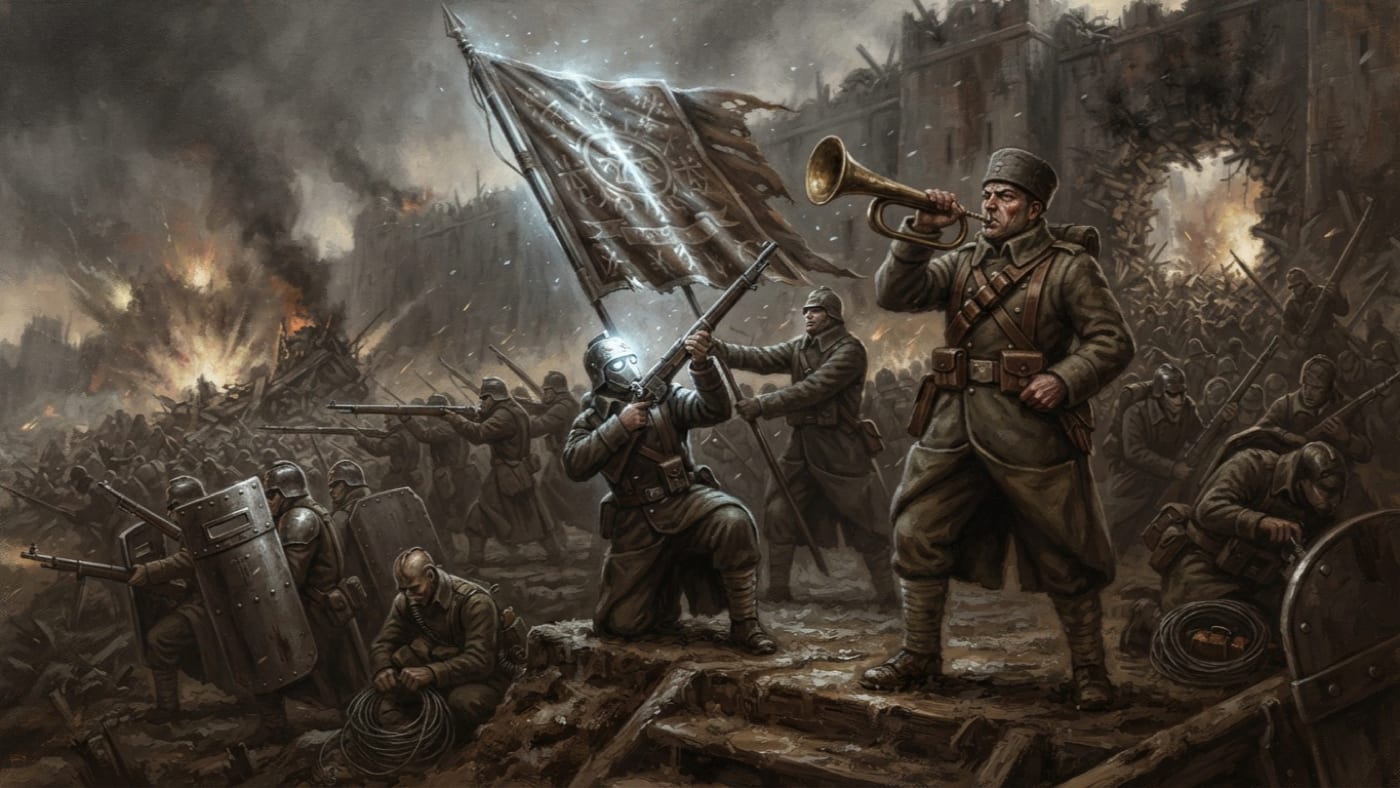
The Creed Volley is a horn call. In the breach choreography of the Doctrine of Layered Death, the Processional Band holds its horns back for this purpose alone: to call the Radiant Fusiliers into the action, if Fusiliers are present. Officers learn the first half of that sentence in an afternoon. The second half takes most of them a career, and some of them a breach.
The conditional clause is the only honest part of the arrangement. A horn can be blown into an empty trench. It cannot bring a rifle company up out of the mud, carry powder up a flooded sap, or give back to a sector the companies that War has already moved to a neighbouring front. The call assumes that someone within hearing was trained to answer it. Where nobody was, the horn sounds anyway, and the Shield Paladins learn from the quiet that follows exactly how alone they are.
#On the Fourth Layer
The call belongs to the fourth layer, rhythm, and adds nothing to the count. There are still five layers: wall, charge, ash, rhythm and dividend. The Creed Volley is the horns' share of the fourth layer.
The Band divides its labour by the men it must keep alive. Drums are tied to the Paladin brace-step. Pipes are keyed to the detonation sequence. The horns wait. Each family of instruments answers to a body of men whose work would kill the others if it came at the wrong moment. The Lock buys time with knees and jawbones. Immediately behind it, the Litany-Engineers recite Counter-Sorcery Verses Twelve through Nineteen and drive charges into breach-side earth. On the rearward height the Ash Chaplain swings relic-ash and leads the Litany of Stones, so that the iron and the powder keep one count.
The Fusiliers are called into this arrangement, and that is where the difficulty lies. The horn's shape tells them to fire low into the breach. Low is where the enemy is thickest. Low is also where the Lock is closest and where an engineer may still be lying on his belly with a fuse between his teeth. The drums do not stop for the horn, and neither do the pipes. Recruits picture the layers as rooms entered one at a time. In practice they are voices in a single choir-stall, singing over one another, and the horn has to be heard through all of them without anyone mistaking it for the brace-step.
Older recensions, including one of my own margin notes, summarize the doctrine as three barriers: wall of shields, earth detonated under litany, and hymn carried in the lungs. "Wall, charge, hymn. Three layers, one Creed."
Corrected. The current field copy sets out five layers, and the Creed Volley sits within the fourth. The three-barrier synopsis was an abridgement that left the Band and the Fusiliers out entirely. I admired its economy. The economy was the fault.
#On the Banner's Answer
The horn calls. The banner fires. Cadets confuse the two in every intake, and Doctrine's vocabulary encourages the confusion.
A Fusilier does not watch the enemy. His eyes stay on the consecrated banner above his line, and the mirrored plates of his helm reflect it back at him until the holy cloth fills even the corners of his sight. When the banner flares, the first volley goes. When it dims, the second follows. When it blazes white, the third goes, and that one, as every Fusilier will tell you before you have asked, belongs to the Creed entire.
That third discharge is not the Creed Volley, whatever the shared word suggests. The horn reaches the ear and tells the company that the breach has need of it. The banner reaches the eye and releases the shot. The field copy does not print the handoff between the two, and I will not print one for it. What matters to the doctrine is the order of authority: no Fusilier raises his weapon because a horn told him to. The horn opens the door and the banner says when to step through. The horn opens the door The horn summons the company to the parapet; the banner alone looses it.
Doctrine holds that sanctified lead fired in the Creed's cadence strikes sin itself and only incidentally strikes the thing standing in the breach. The Fusiliers believe this. The breach is rarely asked for its view.
#On Obedience and Mistiming
To fire out of order is heresy. To fire alone is damnation. Neither sentence is a figure of speech. Fusiliers have been shot in the back by their own brethren for raising a musket before the banner gave its cue, and I have watched a general executed for ordering a volley ahead of the prescribed cadence. The breach choreography puts the matter in two clauses, failure of synchronization meaning breach collapse and the penalty being a tribunal, and the tribunal reads those clauses with great care and very little patience.
In a breach the reasons are physical. A low volley loosed a breath early goes through the second rank of the Lock and leaves powder-scorched cloth on a Paladin's back where his shoulder used to be. A volley a breath late finds the enemy already over the shields, the engineers' charges unfired, and the chaplain's litany down to a single cracked voice. The horn-player stands in the middle of these outcomes with a dented bell, a split lip and lungs full of relic-ash, and the tribunal considers him a combatant. "A missed note is a misfire." An Ash Chaplain wrote that before Vienna. The Bureau kept it as truth and as regulation, and found no reason to separate the two.
#On the Call That Fails
The Pale Chanters do not trouble themselves with the horn. They go for the space between a command and the hand that ought to obey it.
At the Night of Silent Steel at Prague, a regiment of Radiant Fusiliers prepared its triple volley under banner-light. As the banner rose, Pale Chanters across the field began their unhymn, a slow, droning inversion of the Church's own plea for mercy. The banner flared white, and no volley came. The Fusiliers stood with their eyes open and their rifles loaded, and they simply forgot to fire. The enemy came on. Their commanders swore that these men had never once disobeyed. The annals record "command miscommunication." The soldiers call it the day the Creed went silent.
The annals do not say whether a horn sounded first. They do say the banner was seen, and Prague shows that being seen was not enough. Transmitting a cue is one problem and obtaining obedience is another, and the Chanters work on the second. A cue that reaches its men cannot make them carry it out. Doctrine calls the banner sacred, and it is. No source anywhere calls it a ward against song.
The horn has more ordinary enemies too. A first barrage can wipe out a Processional Band before it has played a bar, as at the Saint-Malo Flank Collapse, where the Lock went on by jawbone chant and the engineers' charges went off two beats early. Rotbelcher bile has got into brass and made it wail with nobody playing it, which teaches a company to distrust every horn on the field, its own included. A Silence Dome does not destroy the instrument. It removes the meaning from the air between the bell and the ear, and the bandsman keeps blowing while his comrades watch his cheeks swell and hear nothing at all.
Inside a dome the Covenant falls back on its silent liturgies: hand-shapes, mirror-code flashed from lantern-shards, knotted rope tugged in lexicons as dense as any psalter. These are general practice. The field copy names no silent equivalent of the Creed Volley. Shield-rim pressure and jawbone chant keep the Lock alive, and they are the Paladins' own communion. Nothing in the record shows that they reach a Fusilier company or move it. I have read commanders' reports that claimed otherwise, and I have read the casualty returns filed beneath them.
#On Present Application
The field copy of A.S. 201, surveyed this year under the joint seal that War, Doctrine and the Bureau of Orison gave the protocol as a whole, keeps the horn reservation word for word. Its revision table records amendments for Wormhost rupture, for Pale Chanter cadence and for Shadow Noon. It records no amendment to the Creed Volley. Mercy has not asked for one, and that may be the only thing Mercy has ever left alone.
The doctrine is taught at every major bastion on the Sagittal Line, and every one of them teaches the call. Whether anyone answers it depends on assignment rolls, powder returns and how War has recently been spending its rifle companies. Bands drill the horn regardless. A Band that let the call go stale because no Fusiliers were posted that season would play it badly on the night they finally arrived, and the tribunal would ask who allowed that.
When the call works, a breach that was about to become a dividend stays a breach for a little longer. That is all the field copy promises, and it is more than most documents in my keeping can honestly claim.