
#On the Breath of the Wall
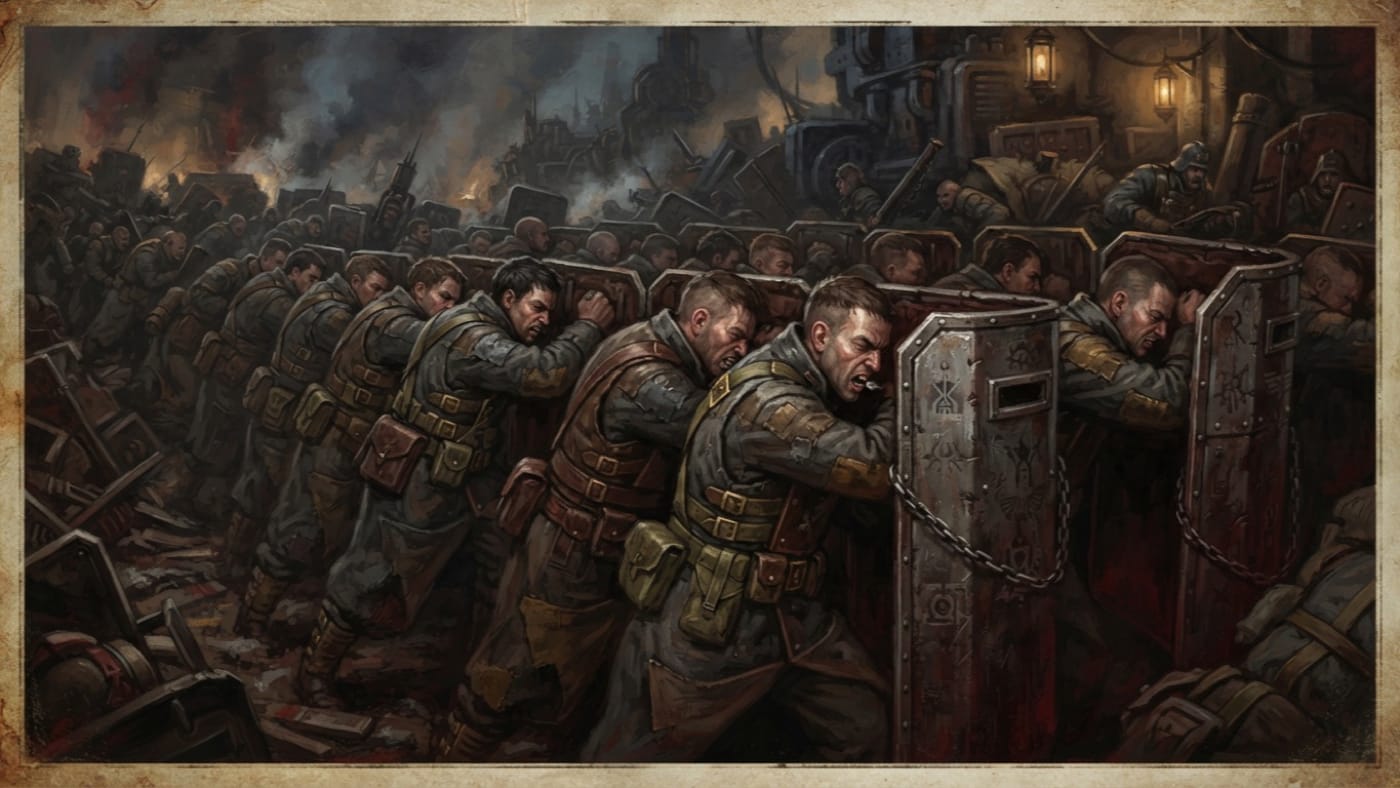
Credo Lapidem is two words spoken on the out-breath by men who have no other breath to spare. It belongs to the second rank of a Shield Paladin Lock holding a breach in the Saint Ardent variant of the Lock Formation. It sits inside the first layer of the Doctrine of Layered Death, which is the layer made of iron, shoulders and an inability to step back. The Ledger records no composer, first performance, founding vision or ratifying decree for it. It records one line of breach choreography and the wear on a great many jaws.
The Bureau prefers it that way. A hymn with an author gets a feast day, a biographer and a forty-year quarrel about the second verse. Credo Lapidem has none of these. It has an exhale.
Its stone needs little explanation. The enemy calls the Paladins the Wall-born, and the Paladins have spent generations of drill agreeing. In their catechism the soldier is a brick, the shield is a course of masonry, and the Lock is a wall that happens to bleed. A chant that names stone, said by men trained to behave like stone, has never needed a translator from the Bureau of Doctrine, and it has never been given one. The words stay in their Latin.
#On Lock, Brace, and Exhale
The Saint Ardent variant splits the work three ways. The first rank interlocks its tower-shields with the edges chained, overlapping iron until the breach faces a single surface of plate. The second rank braces forward against the first, sets shoulders and forearms into the backs of their brothers' shields, and chants Credo Lapidem on each exhale. The third rank waits, and its waiting is work. It recovers fallen shields and puts them back in the wall before the gap realises it is a gap.
This tract exists because of the second rank's assignment. A man pushing with his whole frame cannot sing. He can breathe out. The brace draws the breath in, the push spends it, and the chant rides on the spending. Forty men who exhale in one interval also push in one interval, and that makes them a wall instead of a crowd. The Lore Book calls the Lock "a miracle of monotony," with shields interlaced, edges chained and chants muttered until each breath falls in with the next. The monotony is the miracle. A Lock that improvises has already lost a file and simply hasn't counted it yet.
The shields add their own catechism. Scripture is carved on the inner rims, and splinters of saint-bone are hammered into the iron. For the whole of a breach, a bracing man's face sits a hand's breadth from that carving, and he reads it whether he wants to or not. He is trained to fall forward onto his shield, so that if he dies in the second rank his body goes on bracing the first. The chant continues over him. It has no verse for him.
One separate formula has to stay separate. The Paladins also recite a drill-cadence: "First shield holds the world; second shield holds the soul; third shield holds the Creed entire." That cadence belongs to drill, and the breach sidebar ties the Engineers' detonation count to it. It is not a lost stanza of Credo Lapidem. Any clerk who copies it under the chant as though it were will get his copy back with a blot. The older Paladin custom of whispering a Lock's patron saint on the exhale adds no verses either. A Lock may honour its saint as it likes. In the Saint Ardent variant the second rank's out-breath has already been assigned, and the assignment is the only text the Ledger recognises.
#On the Voices Behind the Lock
The wall is the first of five layers. Behind it the doctrine stacks charge, ash and rhythm, and last of all the dividend by which Records turns a lost breach into usable vocabulary. Each of those layers runs to a timetable, and every timetable starts at the Lock.
The Litany-Engineers crawl in immediately behind it. They drive charges into the earth at the breach while reciting Counter-Sorcery Verses Twelve through Nineteen, and they detonate in sequence with the shield-lock cadence. If the Paladins' breathing drifts, the Engineers' count drifts with it. A charge fired two beats early lands on friends.
The Ash Chaplains stand above them on high ground to the rear, swinging relic-ash thuribles and leading the Litany of Stones to bind Paladins and Engineers to one tempo. The Processional Band ties its percussion to the Paladin brace-step and keys its pipes to the detonations. It saves its horns for the Creed Volley, which calls in Radiant Fusilier fire if any Fusiliers are on hand.
That makes four voices and four kinds of text, and clerks who blur them should be issued smaller desks. The Engineer recites verses against sorcery. The Chaplain leads a litany for the whole breach. The band signals. The second rank breathes two words into a shield. Because the Litany of Stones draws on the same mineral vocabulary, more than one tidy-minded archivist has tried to file the chant as a passage of the litany. No source supports that filing, and the archivist's tidiness has been noted on his record.
#On Cadence Under Interference
Breaches are loud. Artillery swallows the air, and the first rank's iron rings so hard that a man cannot hear his own vowels. The parent doctrine's answer is to lower the chant and drive it inward. Credo Lapidem is carried through collar and jaw, passed from one braced body to the next through plate and bone. The first layer has to hear itself, and when it cannot hear, it has to feel itself.
This is exactly where the Pale Chanters attack. Their counter-hymns sit below the range of the ear and rattle helmets and marrow, and they go after the will rather than the body. The victim feels a sudden hollowness and stops wanting to lift his shield. At Mainz one Paladin was heard to ask "Why resist?" before he walked out of the Lock. The current field copy answers with an amendment that puts spoken cadence second to jawbone vibration and rim pressure. Doctrine holds that a chant carried in bone is harder to steal than one carried in air. Doctrine has never claimed it cannot be stolen, and this tract will not claim it either.
Inside Silence Domes, spoken command dies outright. The Ledger does not certify that a jaw's vibration reaches across the dome's dead air. Communion by pressure exists for this situation: press, hold, release along the shield-rim, from bearer to bearer, until someone answers. The doctrine gives no vocabulary beyond that. Any clerk who invents a pressure alphabet to pad his promotion file will be asked to demonstrate it on his own forearm.
Ledger DCLXVI, the Saint-Malo flank collapse, shows the order in which voices fail. The first barrage wiped out the Processional Band. The Paladin Lock carried on by jawbone chant for six minutes. The Engineers' charges went off two beats early. Brother Mathis of Rouen, Ash Chaplain, climbed the parapet and kept the Litany of Stones going for nine hours, and his lungs were found cindered. The six minutes and the nine hours measure different men doing different jobs. Neither marks the birth of Credo Lapidem. The incident appears here only for its arithmetic.
"Observe the elegance: wall, charge, hymn. Three layers, one Creed." — margin summary to the breach sidebar.
Corrected. The current field copy of the Doctrine of Layered Death, A.S. 201, counts five layers: wall, charge, ash, rhythm, dividend. The chant belongs to the first. The earlier note promoted the hymn to a layer of its own and left the band and the Ledger unpaid.
#On the Bureau's Explanation
The Bureau of Doctrine teaches that hymn and obedience hold the breach. On that reading the chant is faith expressed through the lungs, and the Creator, attending to faith, stiffens the wall. Asked about the same breach, Engines & Furnaces answered "It is the powder." Rationalist observers once wrote "panic effect due to cohesion" and were duly despised for it. Under both answers Records keeps a redacted line: Both, but never admit this.
This tract decides nothing. It records what every party concedes. Forty men breathing out together brace together. War's drill-masters hold that a brace kept in rhythm tires more slowly than a brace kept in terror, because each man knows when the next push is coming and can spend his strength in the gap before it. The timing passes back to the Engineers. Cohesion keeps a frightened boy in the second rank long enough for him to become a useful one. Whether the Creator adds anything to this machinery is Doctrine's question. Doctrine has ruled on it, and the ruling is in Doctrine's drawer.
The Bureau of War doesn't trouble itself over the mechanism. It counts minutes. A second rank that chants buys more of them than a second rank that screams. The cost goes into the books as jaws locked for an hour, teeth cracked on the hard consonant, throats scoured by the Chaplains' ash, and shoulders that will never sit level again. War calls this favourable exchange. The Bureau of Orison calls it prayer. The Paladins call it the back half of the breath and save the rest of their vocabulary for the latrine.
#On Present Application
Under the current field copy of A.S. 201, breach drill along the Sagittal Line teaches Credo Lapidem inside the first layer, together with the brace that gives it a reason to exist. A chant learned apart from the push is only a song, and the Line keeps bands for songs. Drill-masters judge it by ear in the hall and by shoulder in the mud. They also teach the fallback that the chant's own failure requires: lower the voice, carry it in bone, and once bone is no longer enough, press the rim.