
#On the Court Beneath the Baffles
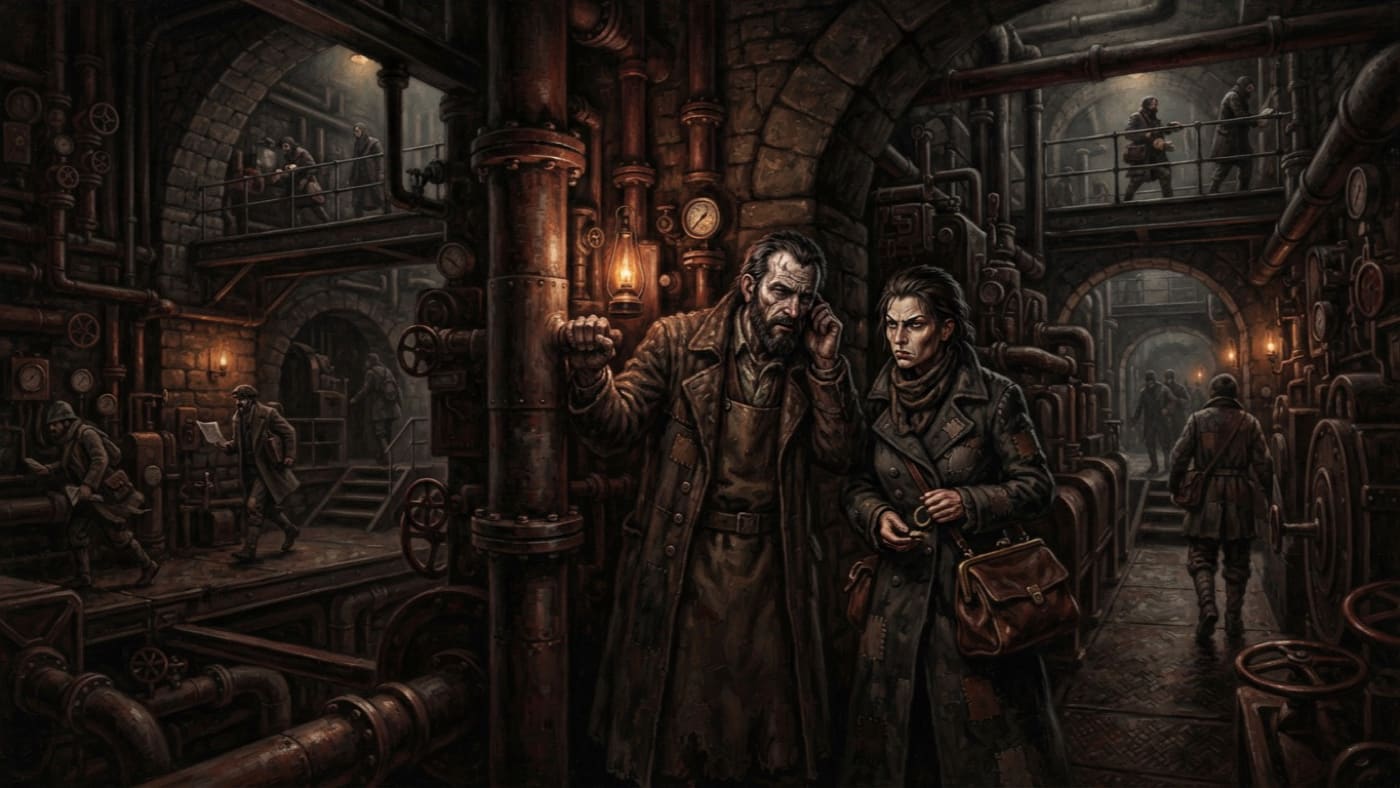
The Bureau of Purity had already spent the word "king" on Jaro. When its clerks needed a noun for the people who act on his knocking, they reached for "court" and filed the matter. The Court of Pipes is that noun. It names the governing circle of [["tap-king-jaro"|"Tap-King" Jaro]] and Mira Slate inside the Underchord Cartel: the pair, their runners, their lookouts in patched valve coats, and the iron through which all of them receive their orders. It has no bench. It keeps no roll. Below the baffles of Bastion-Irongate nobody calls it anything at all. Men say the pipes, the way a parish says the bell, meaning the instrument and whoever has hold of the rope.
The fortress commands the Iron Gates gorge, with the Danube grinding through below it. Inside its stone run the Underchords: maintenance crawls, dead corridors, waste-water channels and pressure galleries that the official plans leave out. The Court's writ holds in the upper and middle reaches. Beneath those, the mountain keeps its own counsel, and Jaro has the sense not to pretend otherwise.
No charter founded the Court, and no date announces it. It began whenever the first man decided that an order tapped on a pipe was safer than an order spoken. It has grown since then out of habit, debt and fear. The procedure is old, and so is the cruelty. Only the brass is new.
#On Signal and Obedience
Above, in the licensed districts of the Gasket Choir, authority is sung. The Choir Magistracy measures it in registered voice, approved stanza, gauge reading and candle flame. Below, authority is struck. A knuckle meets a waste-water pipe. A wrench touches a valve casing. A pressure rod is drawn once along its housing. Three short. Pause. Scrape. Two long. The vibration runs through the iron further than any unheard voice could go, and arrives in a runner's wrist, jaw and back teeth.
Speech below is dangerous in two ways. It can trouble the seals of certain acoustic corridors, which the Magistracy will explain to you at length. It also tells a patrol where you are standing, which the Magistracy prefers not to discuss, since it is the patrol. A tap is still a sound in the iron, and any clerk with his palm on the right pipe can overhear it. What it cannot carry is the sender's accent, his fear, or his location.
The rest is division. No runner of the Court carries a whole instruction. One receives a route. A second receives the price. A third receives the warning. A fourth receives the name of the man to abandon if pressure drops. None of them sees the shape of the act until it has been done, and none can confess more than his quarter of it. The Court does not transmit commands. It distributes them, the way a relic is broken up among parishes so that no single theft can carry off the saint.
The Bureau's cipher clerks have compiled eight glossaries of the tap-code, and the eight disagree. Three taps mean passage in one corridor and debt in the next. A scrape after the second tap has been rendered as "patrol turned left," as "boots off," and, by one exhausted clerk, as "pray." I do not rule out the last.
#On Jaro and the Counterseal
Jaro has not spoken since A.S. 187, fourteen years ago. His file lists three explanations: operational discipline, injury to the voice, and a vow. It declines to choose among them, and I respect the refusal, which is rare in a file. Whatever the cause, he governs with the silence. An order without a voice cannot be traced to a mood, a throat or a place. The pipe knocks and the Court obeys. Whether Jaro is three corridors away or lying under yesterday's rockfall is a question his runners have learned not to ask.
Mira Slate is the other half of the seal. Jaro's taps become a route strip in a runner's glove, rings in a buyer's palm, or a patrol arriving at an empty chamber, and they become these things because Slate has handed them out. Purity calls her associate, courier-master, lover, auditor and executioner. It trusts none of those words, and I trust them less. Records cannot find her in the garrison rolls. That proves only that Records cannot find her. Witnesses agree on two things: she laughs, and the laugh makes no sound.
Which of them commands? Purity has asked for years, with the touching faith of men who think every organisation is laid out like a cathedral's seating chart. The Court works as seal and counterseal. His silence makes an order impersonal, and her presence makes its consequences personal. In the Ledger's experience, neither half is valid without the other.
Purity has mounted three operations against Jaro and has budgeted a fourth that it has not yet found the courage to perform. It has failed against Slate three times. The pipes have recorded no failures against Purity. They are discreet about their victories.
#On Passage, Price, and Debt
What the Court governs is passage. Its runners take failed workers past gate checkpoints, Breath Office desks, Choir auditions and quarantine ropes. They carry oxygen bulbs into the wards and stolen hymn pages to lecterns. Counterfeit voice-licenses travel in waxed cloth and false maintenance permissions in boot soles. The Cartel owns the goods. The Court decides where they go, when they go, what they cost, and who carries which fragment.
The fortress above supplies the customers. A man fails the candle test. His voice tier drops, his heat allocation is withdrawn, and his chamber goes to another man. A quarantine notice is posted, or an inspection announced. Each of these is a lawful act of the fortress, sealed and filed, and each one sends someone down a maintenance hatch with a pouch of brass. The lung-rot of A.S. 199 filled the wards upstairs and the routes downstairs in the same season. The Court did not mourn the coincidence.
Payment is made in gasket-rings, the stamped brass washers of the Valve Quarter. Jaro did not invent this currency. His Court only keeps it in order. Prices move with pressure readings, hymn recalls, seizures and executions, and the pipes announce each change before the buyer reaches the meeting place. The dearest thing the Court sells is the quiet pass: a route memorised in tap-code, split among runners, scratched on leather if it must be, and destroyed once used. Price a pass too cheap and the corridors fill with fools. Price it too dear and the desperate cut their own holes through load-bearing stone. The Court prices against both dangers with the cold arithmetic of a tithe assessor who has to live in the building.
Then there is debt. A man who cannot pay may be carried on account, and below the baffles the pipes remember every account. Some debtors pay later in rings. Some pay in service, carrying fragments for strangers. Some turn up as the fourth fragment of a later instruction: the name to abandon. The Court saves lives and profits from the same desperation, and shows no visible strain in doing both. The Shaft Priory reportedly buys from it, and declines to say which of the two it sees more often.
#On Shared Corridors and Divided Aims
The Counterkey Circle uses the same corridors. Reed and Alen Rill teach that the mountain has been made to sing wrong, and they write forbidden harmonics in gasket grease on black basalt. The Court sells them the grease. It sells them lookouts, warnings, air and route time, as it sells these things to anyone who has brass. Shared tap patterns and shared enemies have persuaded more than one Magistracy clerk that the two groups are a single conspiracy wearing two coats.
They are two coats on two bodies. The Circle wants the mountain changed. The Court wants the mountain standing, its passages open and its customers alive enough to pay. Jaro's patience with the Circle ends exactly where a hymn might bring down a corridor he rents out.
Over all of this lies the ordinary pressure of Morwen. Her known appetite for borrowed faces and stolen voices makes every unregistered person beneath Irongate a suspect. Purity reads the Lower Run intercept in that light. The Court has offered no reading of its own.
INTERCEPT 44-B / LOWER RUN, A.S. 199 Cipher rendering: "Slate laughs. Turn back. The buyer has two faces." Purity reading: Morwenite contamination, counterfeit identity, or common treachery. Unresolved. Patrol proceeded. Patrol recovered: █ of 9.
#On Non-Recognition
The Hush Court is the Magistracy's acoustic tribunal. It is lawful, seated and documented, and it is dangerous to anyone who speaks in the wrong chamber. The Court of Pipes shares the word "court" with it and nothing else.
A Purity indexing clerk filed early Court of Pipes reports under the Hush Court docket series, as a "subordinate acoustic bench of the lower galleries."
Corrected. The Court of Pipes holds no jurisdiction, sits on no bench, and has no recognised sovereignty. The phrase is a working designation for Jaro and Slate's governing circle. The Hush Court was not consulted before receiving a criminal subsidiary. The clerk was not consulted before receiving a transfer.
The present position of the Church on the Court is controlled non-recognition. Purity raids. The Magistracy suppresses in public and consults in private. The Breath Office goes on producing the failed workers whom the pipes then move out of sight, and the Bureau of Doctrine observes. Recognising the Court would mean admitting that the licensed order leaks. Removing it would mean finding somewhere else for the leak to go. The fortress has chosen to do neither, and calls this policy.
The pipes are still knocking as this is written in A.S. 201. Jaro has not spoken. Slate has not been entered in the rolls. Somewhere in the middle Underchords a runner is holding a quarter of an instruction and waiting for the other three.