
#On the Unsealed Departure
The coupler rite is how the Church catches up with a train it failed to bless. Of the three corrections available after a missed departure it is the least loved, and it is the only one performed by hand.
A train that leaves the Warsaw yards without its blessing does not leave unnoticed. A clerk marks the slate in red wax. The wax records a fault in the paperwork and nothing more. It is never carried to the train or pressed to its iron, and no clerk has yet persuaded anyone that a seal on a slate can do a priest's work on a wagon. A correction order goes ahead to the next station by whatever means can outrun the engine. Meanwhile the engine runs north or east, unsealed, carrying grain, shells, men and coal toward bastions that requisitioned all of it the week before.
Freight will not wait while theology finishes dressing. Whatever leaves Warsaw on the northern spur feeds Bastion-Königsberg, and whatever takes the eastern spur feeds Bastion-Brest. A train held back for a forgotten blessing is a train that has not reached the Line. The Rail-Confessor Corps understands this better than any office in the Church, which is precisely why it misses blessings at all.
#On Correction in Motion
The receiving station has three remedies to choose from. It may halt the train completely and perform the departure form properly. That costs minutes the timetable does not have and enrages every dispatcher between the Vistula and the Bug. It may send a priest up onto a platform bridge to pronounce a rolling benediction over the wagon roofs as they pass below. Or it may order the coupler rite.
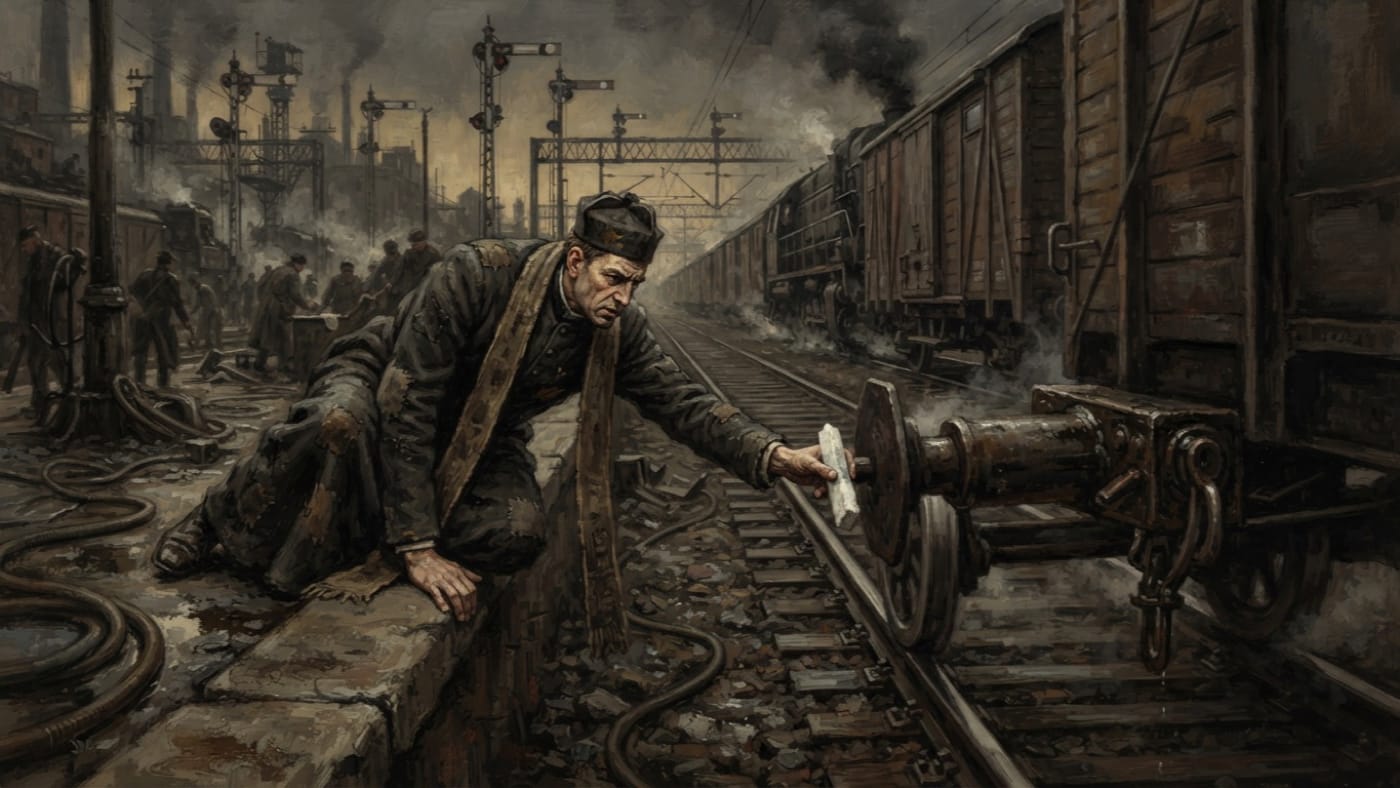
For the coupler rite, a priest stands at the platform edge holding consecrated chalk. He waits for the last wagon, and as the train passes he touches the chalk to its rear coupling.
The documents record nothing beyond that. Whatever words are spoken belong to the officiant and to the files of Rites. No source I have been shown prescribes the shape of the mark, and I have been shown a great many sources, most of them twice. No permitted speed is entered anywhere. What the rite requires is contact, and all of its difficulty lies in that requirement. The train keeps whatever pace dispatch has authorised, and the priest's hand must find the iron at that pace.
No source explains why the coupling chosen is the rear one. I hold an opinion on the matter, and the Bureau has not asked for it.
#On the Authority of the Chalk
The doctrine of the Bureau of Rites holds that a departure made without proper form leaves the train liturgically unsealed, and that unsealed movement through the forward corridor invites attention. Rites has never said whose attention. In the forward corridor, attention needs no introduction.
The coupler rite supplies the departure blessing the train went without, and it supplies nothing else. It does not confess the fireman. It does not absolve the driver or remit what the brakeman said at the junction. Those things belong to the ninety-second form at the platform, and a crew that missed that form remains unconfessed however handsomely its coupling has been chalked. Rites accepts the correction as restoring the form owed to the departure. Rites has never explained how a touch at the last wagon reaches the first. I have learned not to write doctrine on another Bureau's behalf, least of all doctrine that Bureau has wisely left unwritten.
The Guild of Rails rejects the Bureau's causal language. Guild men will not say that an unchalked coupling calls anything out of the dark. With the flat patience of people who maintain track for a living, they will say that unblessed trains have bad luck. The Bureau names a cause and the Guild keeps a tally, and the rite has gone on being performed in the space between the two.
#On the Departure Allowance
Blessings get missed because of arithmetic. Yard Protocol 7-W allows eleven seconds for the departure blessing and ninety for rapid confession, within a total of one hundred and twenty seconds of clerical contact per train. The remaining nineteen seconds belong to the ordinary departure: the cough, the stammer, the sin remembered with one boot already on the step. They are no reserve for corrections and were never drafted as one.
Three masters govern a Warsaw departure. Rites holds the doctrine. Yard dispatch holds the movement. The War priority clerks hold whatever they happen to be shouting about. When priority falls on a train, its blessing may be compressed, shouted, signalled, or performed from a neighbouring platform after the wheels have begun to turn. Sometimes even the shout arrives too late. When that happens the wax is warmed, and somewhere up the line a priest receives an order with his own name written on it.
No source gives the coupler rite a duration. Nobody has put a stopwatch on it, and anyone who stood on that platform with a stopwatch would be watching the wrong hand.
#On Devotional Expenditure
Three fingers have been lost to coupler rites.
The Bureau of Rites enters them as devotional expenditure. The Guild of Rails enters them as predictable idiocy. Both entries are filed and both are correct, and I am obliged to report that the Guild's is shorter.
The Guild has standing to speak. A coupling is the place where two wagons meet under load, and the men who grease it, gauge it, replace its pins and drag its broken halves off the ballast know exactly what it does to anything soft that gets between the irons. Crush injuries are ordinary trade knowledge among the Guild's track crews, recorded in the same flat terms as frost-heave and loose spikes. When a Guild foreman calls the coupler rite idiocy, he speaks as a man who has watched iron close.
The Corps tailor anticipated the hazard. Rail-Confessors wear narrow sleeves so the cloth will not catch on carriage iron. The sleeve protects the cassock, and only the cassock, because the chalk is held in the fingers and the fingers reach past the sleeve. The order was drafted with care, but nobody drafted anything for the hand.
The record counts fingers and does not count priests. It does not say whether three men each gave one finger or a single unlucky priest gave all three across a long career. It names nobody, and it fixes no date or station and describes no wagon. The survey in which the count appears is the survey of A.S. 201. Everything before that is a number in a column.
Rites has made no formal reply to the Guild's description, and it has no need to. Every party already knows its reply: a train that went out unsealed came home sealed, and three fingers is a trifling sum against an unsealed wagon on the Brest spur. The Guild has made no formal reply to that either. Its men go on maintaining the couplings, which is a reply of a kind.
#On the Present Application
As of A.S. 201, 1911 CE, the coupler rite remains a lawful correction for an unblessed departure from Warsaw. It is still performed, still disliked, and still unabolished. Cargo moves up the Northern Corridor from Hamburg to Kanzleiburg, from Kanzleiburg into the Warsaw yards, and on from Warsaw to Brest and Königsberg. Warsaw's eleven thousand workers move that cargo across twelve square kilometres of track and siding, and every one of those workers can count to one hundred and twenty. The trains outnumber the seconds, and sooner or later the seconds run out.
When they run out, the Church corrects the departure. It does not waive it.
A Bureau of War circular stated that departure blessings "may be waived under urgent operational necessity."
Clarified, and the clarification stands. A blessing may be deferred, compressed, shouted, signalled, or performed from a neighbouring platform while the train is already moving. A deferred blessing is owed, and the debt is collected at the next station. War is advised that it may have the train or it may have the waiver, and that the train is the only one of the two Rites will ever grant.
So the remedies stand as they have stood. A station that receives a correction order may halt the train if dispatch can bear it, bless the roofs from the bridge if a bridge is there, or send a priest to the platform edge with chalk in his hand and his sleeve buttoned tight. The Bureau counts each remedy as sufficient, and the Guild counts the fingers.