
#On the Present Survey
This entry surveys conditions currently reported in Kargath's Consuming Cities. It was compiled in A.S. 201 from the only material the Bureau holds on the subject, which is the testimony of refugees. The Consuming Cities are a class of places, and the Codex treats them as one class. They are the urban centres that Kargath has taken and that, by every account to reach us, keep working after they are taken. The Codex gives no list of them here. It gives no count, no capital, no governor and no year in which the first of them fell. The Bureau has none of these things. I will not make them up, which puts me in a minority among the authors of eastern intelligence.
What the Bureau does have is one report, repeated by people who left the east by different roads and at different times. It is a plain report and an unpleasant one: the cities still work.
#On the Work That Continues
The markets open. The bakeries operate. The slaughterhouses run, and the reports insist that they run continuously. That adverb has given more than one copying clerk cause to set down the pen.
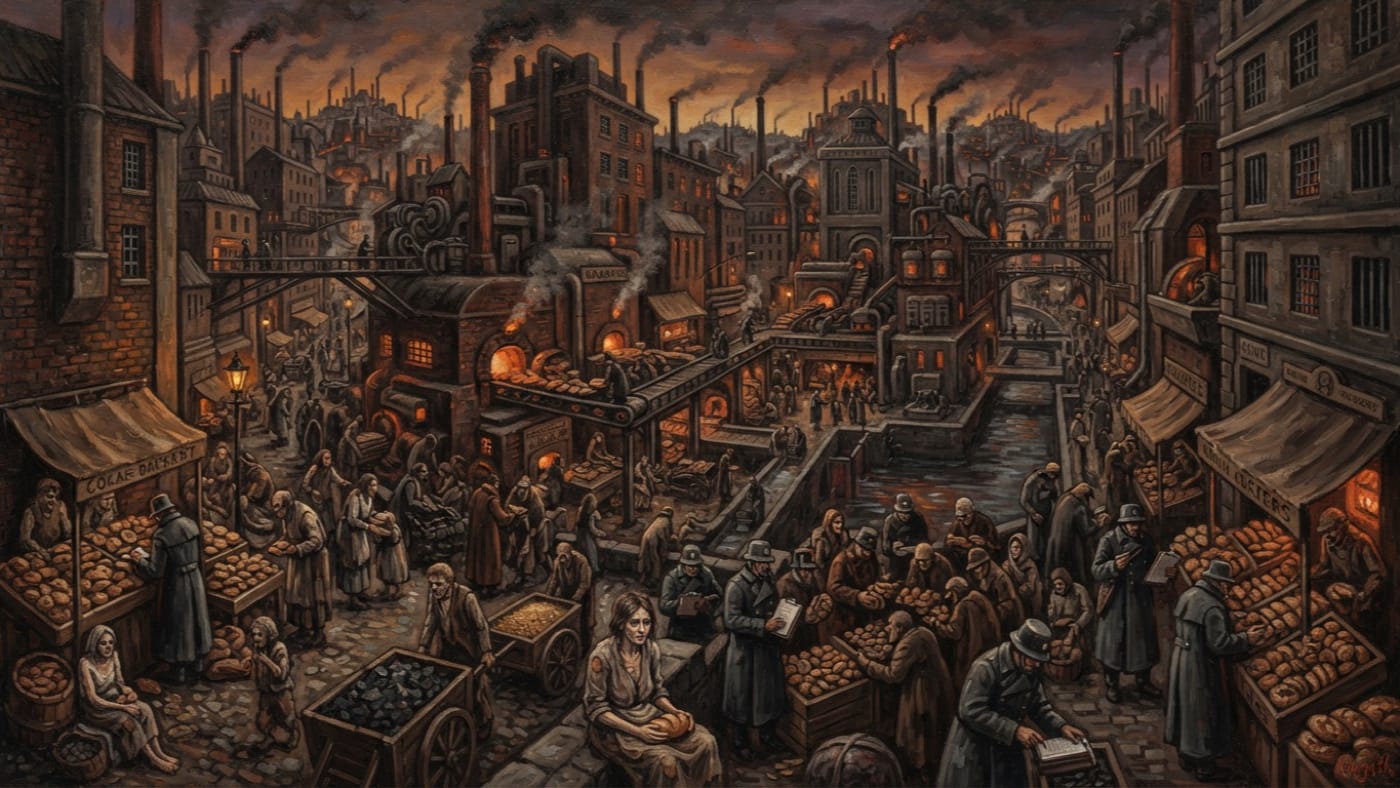
The Theocracy's habit, trained into it by two centuries of war-maps, is to picture a fallen city as a ruin. The gate is burst and the bell-tower is down, and the cartographer's square has been inked over in grey and labelled lost. The Consuming Cities refuse that picture. Their streets are busy. Ovens are lit, stalls are set out, carts go between them, and the killing-floors are sluiced down and used again. To that extent, a captured city in Kargath's territory has kept its trades.
The claim goes that far and stops there. Function means that work is done. It says nothing about who is fed. A city where the bakery never cools and the children are never full still has a working bakery, and the Bureau's instruments would mark it in good order. For as long as the Theocracy has kept minutes, the Bureau of War has judged a city's health by whether its ovens were lit. I recommend, with all the deference my office requires, that the Bureau of War find a second measure.
The refugees do not describe a street plan, a guild register or a civic office, and the Codex does not supply one. Nobody reports who keeps the market-hours, who licenses the ovens or who answers for the slaughterhouses. The trades are reported. Whatever governs them is not.
#On the Currency of Food
Ordinary exchange, the reports agree, has gone. Food has taken its place. Bread pays and meat pays, and what anything is worth is reckoned by the nourishment it carries. In the words of the Bureau's own entry on Kargath, everything is measured by caloric value. The same entry says that the exchange rate is terrible. I keep the phrase because it is exact about the misery and silent about the figures, and the silence is honest. No refugee has brought out a price-table. None has given a rate the Bureau could set in a column, and none has named an office that fixes the value of a loaf. The reader who wants the arithmetic of the Consuming Cities must go without it. Any figure printed here would be my own work, and I have a reputation to protect.
The reports go one step further, and the Codex records it because leaving it out would be cowardice in a dog-collar. Under this reckoning, the value of a human life is said to be what it provides when rendered. A person is entered in the city's accounts as the yield of their body.
The Codex records the principle and nothing more. It does not record who carries the reckoning out, how often, by what procedure, or whether every street and household takes part. The reports do not establish any of that, and the Bureau will not fill the gap with auctions and regulations because its readers expect horror to come with paperwork. What the reports do establish is bad enough. A person is weighed and becomes a figure for provisions in another person's mouth.
There is a resemblance here that I would prefer not to see. The Theocracy also counts its people by allocation. The Theocracy also rations. The Doctrine of Enough, part of which I wrote, also asks a hungry person to accept a measured share as their true measure. It is a resemblance and nothing more. The Synod does not render its faithful, and it is sacrilege to suggest otherwise. I make no suggestion. I note the resemblance and continue.
#On Hunger Amid Production
The cities are always busy. They are always producing, always consuming and always starving. The refugees, who rarely agree with one another, agree on this: the more the cities make, the hungrier they become. The bread is made and eaten and does not answer. The market is full, and the people standing in it grow thinner.
The Bureau of Medicine has no account of the mechanism, and the Codex gives none. Doctrine offers an interpretation, and I label it as one. In the Bureau's sanctioned formula, Kargath is the Sin-General of need that grows with feeding. On that reading, the Consuming Cities are the doctrine built in stone and brick, with provision that only widens the want it was meant to fill. The reading fits the reports. It does not prove them, and it explains no particular oven. A theologian who mistakes a good fit for a finding has started on the road to the Paper Mines.
The people of these cities need to be written about with care, and the Bureau's public materials have not always written about them so. They are not greedy. Doctrine holds, and the Codex repeats, that no demon can take a human being's choice from them. A demon can tempt, deceive and threaten. It can make the bread a person depends on into a chain around them, and it can make the wrong choice look like the only ration on the table. The body can be confined. The will cannot be confiscated. The baker in a Consuming City still decides each morning, and decides it hungry, and frightened, and surrounded by everyone else who has decided the same way. The Codex reports the pressure, the deprivation and the behaviour. It does not declare anyone's choice already made for them. If the Bureau ever does declare it, it will have handed the eastern cities to the enemy with its own seal.
The other parts of Kargath's dominion show the same hunger in other forms. There is the bare grey ground of the Blightmarsh, the radiating need of the Famine Pits and the poisonous plenty of the Abundance Fields. Each has its own entry and its own witnesses. None of them is evidence for the cities, and none of them is the cities' capital. The Consuming Cities are the form his hunger takes once it has a market to run.
#On the Reports Received
All Bureau intelligence on the Consuming Cities comes from refugees. There is no survey team, no agent's deposition and no plate drawn from life. Everything is the account of a person who lived inside and later got out.
The Bureau has stated in its entry on Kargath why it is uneasy about these witnesses. They come from his territory, and they have eaten what was there to eat. The Bureau holds that food from that territory may change the person who eats it, and that the change is not always visible from the outside. The concern is reasonable. It is also a convenient position for an institution to hold, because it lets the Bureau doubt every unwelcome account while relying on it whenever it needs to.
The situation is this. The Bureau has nobody else to ask. It has to depend on witnesses it distrusts, and it distrusts them for reasons that cannot be tested at a writing-desk. It cannot confirm what they say. It cannot set what they say aside, either, because without them the eastern cities would be blank squares on the map. The Codex holds both positions at once, which is uncomfortable and correct. These reports are not certain, and the Codex does not treat them as invented. They are what came out of the east.
This should be said plainly, since the public materials have sometimes said otherwise. To call a body of testimony unreliable is to make a judgement about how far it can be used as evidence. It is not an accusation against any refugee. It is not a medical diagnosis, and it does not exempt the Synod from feeding the person who gave it. Anyone who reached our lines starving and told the clerks what they had seen has met their side of the bargain. Whether the Bureau has met its side is a matter for another ledger.
#On the Present Condition
The finding of this survey is short. It is enough.
According to refugee reports, cities in Kargath's territory keep operating after their capture. Their markets open, their bakeries bake and their slaughterhouses run without stopping. Food has replaced ordinary exchange, and caloric value has replaced every other measure, including the measure of a human life. Hunger in these cities persists and grows worse, however much they produce. The Bureau doubts the witnesses and has no others.
The Codex makes no claim about how many such cities there are, where their borders lie, when they fell or who keeps their ledgers. Readers on the walls of Bastion-Constantinople, who look east every morning and see smoke above the far side, may take this as the Bureau's answer to the question they keep asking. Yes, there are ovens over there. No, the people are not fed.