
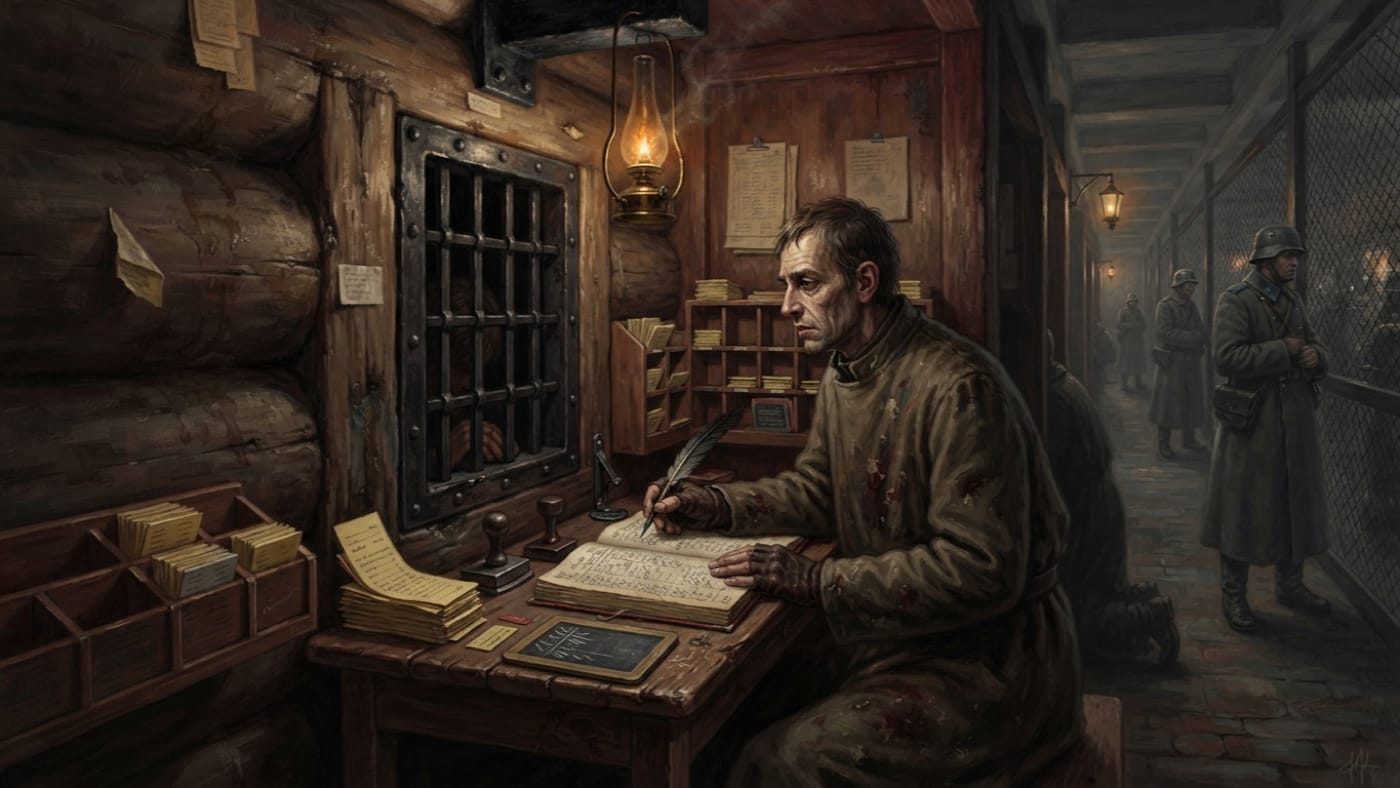
#On the Station of the Scribe
A crossing at Bastion-Brest begins with a mouth and ends with a stamp. Between the two sits a Confession Scribe in wax-stained gloves. The sacred economy of the Brass Ribs depends on what that Scribe hears, what that Scribe writes, and what that Scribe agrees to forget.
The Confession Scribes keep the Confessional Lanes of the bridge-fortress over the Bug. The house is half monastery and half office. It keeps hours, keeps silence when silence pays, and keeps books. Its public charge is the recording of souls for purity. Every traveller who means to cross the Ribs speaks into a booth. The speech becomes ink, the ink becomes a file, and the file decides whether a provost lets a body pass or turns it back into the mist.
The lanes are administered by Scribe-Mother Hal. Brest knows her for gentle cruelty, which in practice means a superior who lowers her voice before she ruins you. Under her, the Scribes hold the one thing every other office on the bridge needs and none can easily take from them: access to the booths.
No founding charter for the house has reached my desk, and I have found no founder's name carved anywhere I was allowed to look. The Scribes exist the way the lanes exist, as a habit that hardened into a necessity. The Bureau has learned not to ask who lit the first candle.
#On Speech Entered as Passage
The booth is narrow, wooden and wet. River air has swollen the wood so badly that the shutter latch has to be struck rather than lifted. Candle smoke gathers under the roof. The penitent kneels behind a screen. The Scribe sits behind the grille with the confession book open and keeps to hand a counted folio of receipt blanks, the stamp, a tally slate, and the rubric cards that reduce human wickedness to a manageable number of drawers.
The sequence is older than anyone now working it. The Scribe checks the traveller's name and prior papers. The traveller speaks. Through damp oak and the shuffling of the queue, the Scribe hears the sin, or believes so, and selects its category. Penance is assigned and the confession tithe collected. The receipt takes its stamp with a sound like a dropped hymnal. The sin enters the book, indexed against the traveller's identity file, and the tally slate takes one more chalk stroke.
Then the paper moves on. Crossing at Brest requires a name, a confession receipt, the proper seals and an absolution token. The Bridge Tribunal checks receipts, and the Gun-Cantors verify tokens. None of those officers heard the confession. They read what the Scribe made of it.
Repetition is where the danger lies. A sin confessed once is a mark in a book. When the same sin returns under the same name, it becomes a pattern, and at Brest patterns carry consequences: first lane denial, then labour sentences on the decking or in the dredge. The traveller never sees the index, but the Scribe does. A man who has stolen bread three winters running learns quickly which booth hears him kindly. The Scribe learns just as quickly what kindness is worth.
#On Edited Sins
The Scribes have three instruments: ink, omission, and the coded margin. Omission costs least and is hardest to audit. A sin never written leaves no stain. A sin written under a milder rubric leaves a clean stain, which is worse, because it passes. Coded marginalia let a Scribe record what the official text declines to say, for a later reader, a later sale or a later favour.
Brest has words for the goods. In the lanes an edited confession is wax guilt. Under the deck, the smugglers call a prewritten one sin-scrip. The two terms meet at the grille like buyers at a fish stall.
The confession tithe is lawful and mandatory, and I have no complaint against it. Money for choosing minor over escalatory, for forgetting a second offence, or for a transcript copy filed with a merciful smudge across one line is another matter entirely. The Bureau's own description of the house says so bluntly: its real business is the hoarding of secrets and the sale of edited sins. The same description calls the house allied with the Bureau and secretly trading with smugglers. It manages both loyalties without visible strain.
The lanes describe Young Scribe Lio as too curious. Curiosity in an archive of other people's sins is either a vocation or a symptom, and his file does not say which.
#On Assistance Within the Lanes
The Blank-Sheet Circle has troubled the Tribunal since at least A.S. 196, by the Tribunal's own reckoning. Its trade needs three things. The first is paper, which the Pylon Warrens supply out of river salvage. The second is dies, and for those it has Irena Vale, dismissed from the Crossing Bureau's stamp room in A.S. 197, who brought out die knowledge and wax impressions in the folds of her apron. The third is the lanes.
The lanes are where the copied seal reaches its limit. Brest's 214 booths stand along single-direction corridors, with a Scribe stationed at every third booth and a provost patrol at every sixth. The bridge's architecture leaves three alternative routes: climbing, swimming and dying. A duplicated die can press a convincing mark into wax. It cannot put a receipt into a booth book, against a booth tally, under the hand of a Scribe on duty. Vale's craft satisfies the guard who looks at the seal, but only the Scribe can satisfy the ledger that stands behind the guard.
The Tribunal reconstructs the method like this. A client is sent to a particular booth at a particular hour. The Scribe on duty processes a prewritten safe sin, one of hundreds of identical rote offences heard every day, and applies valid crossing authority to a paper carrying a fictitious identity. Then the client walks the lanes like anyone else, past the same provosts, through the same gatehouse, as a named person whose name is fiction. The corridor is the ordinary one, and the forgery lies in the hand that stamped the paper.
Judge Elsbeth Krail has therefore concluded that the Circle must have confederates among the Confession Scribes.
Scribe-Mother Hal has sent the Bridge Tribunal three separate memoranda asserting that her scribes are "doctrinally sound and administratively reliable." The Tribunal has also received a report from the Bureau of Shadows. It states that at least two scribes of the North Lane were observed accepting packages from persons who had entered the lanes without confession receipts and left without absolution tokens.
The report does not record what the packages contained or name the scribes. It does not say whether Hal knew. The Tribunal holds its file on the suspected confederates under its own judicial seal, and Hieromnemonic override does not reach Tribunal seals.
#On the Voice and Its Withdrawal
A Scribe's evidence is a voice heard through wet wood. That voice is muffled by the screen, half-drowned by the queue, and usually reciting a formula a thousand other mouths have already recited that week. Every Scribe identification ought to be weighed with this in mind. One identification has been withdrawn.
During a safe-sin processing sequence, a Confession Scribe named in no public record identified the voice behind the screen as Irena Vale's. Three hours later the same Scribe heard the same voice whisper from the shutter and withdrew the identification.
Witness identification, Confessional Lanes: the voice behind the screen during the safe-sin sequence was that of Irena Vale.
Withdrawn by the witness, after the same voice was heard whispering from the shutter three hours later. The identification does not establish Vale's presence in the lanes, the hour of any crossing, or the witness's own conduct. Vale remains unapprehended.
The shutter is the trouble. By the confirmed record, since A.S. 199 the Confession Echo has returned sins once spoken into Brest's booths as whispers on the deck. Candle flames bend toward the booths, and ink on the stamps beads. Booth 77 goes further and returns confessions before anyone has made them. A Scribe who hears a voice now has to ask a question no rubric card answers: is the speaker here, or was the speaker here once?
The Tribunal blames the nameless crossings. In its account the confession system is a spiritual filter, the unrecorded souls have damaged it, and the returning sins are the damage. The Bureau of Doctrine's Northern Theater office has endorsed the theory, and it remains under sustained review. Two facts sit badly with it. The Circle's crossings began at least three years before the Echo did, and nineteen arrests have not quieted the booths. Meanwhile the lanes apply salt-wax to booth seams and ring shock bells to break the loops. The Bureau of Purity co-seals the standing order, and the Scribes go on listening.
#On the Present Administration
As of A.S. 201 the lanes are still processing. Nothing crosses the Brass Ribs lawfully without a Scribe's stamp, and no one has proposed a replacement Brest could survive. Krail's folios record nineteen Circle arrests. That figure counts arrests, and the folios do not say how many, if any, of those arrested wore wax-stained gloves. Hal still administers the house. Her memoranda are still on file. The North Lane is still staffed.
The Scribes therefore remain indispensable and unconfirmed, the house the bridge cannot do without and cannot vouch for. Hal's reliability rests on her assurances, and the Shadows' report rests on what the Shadows saw. The number and names of any cooperating scribes rest under a seal that I do not control.