
#On the Alarm
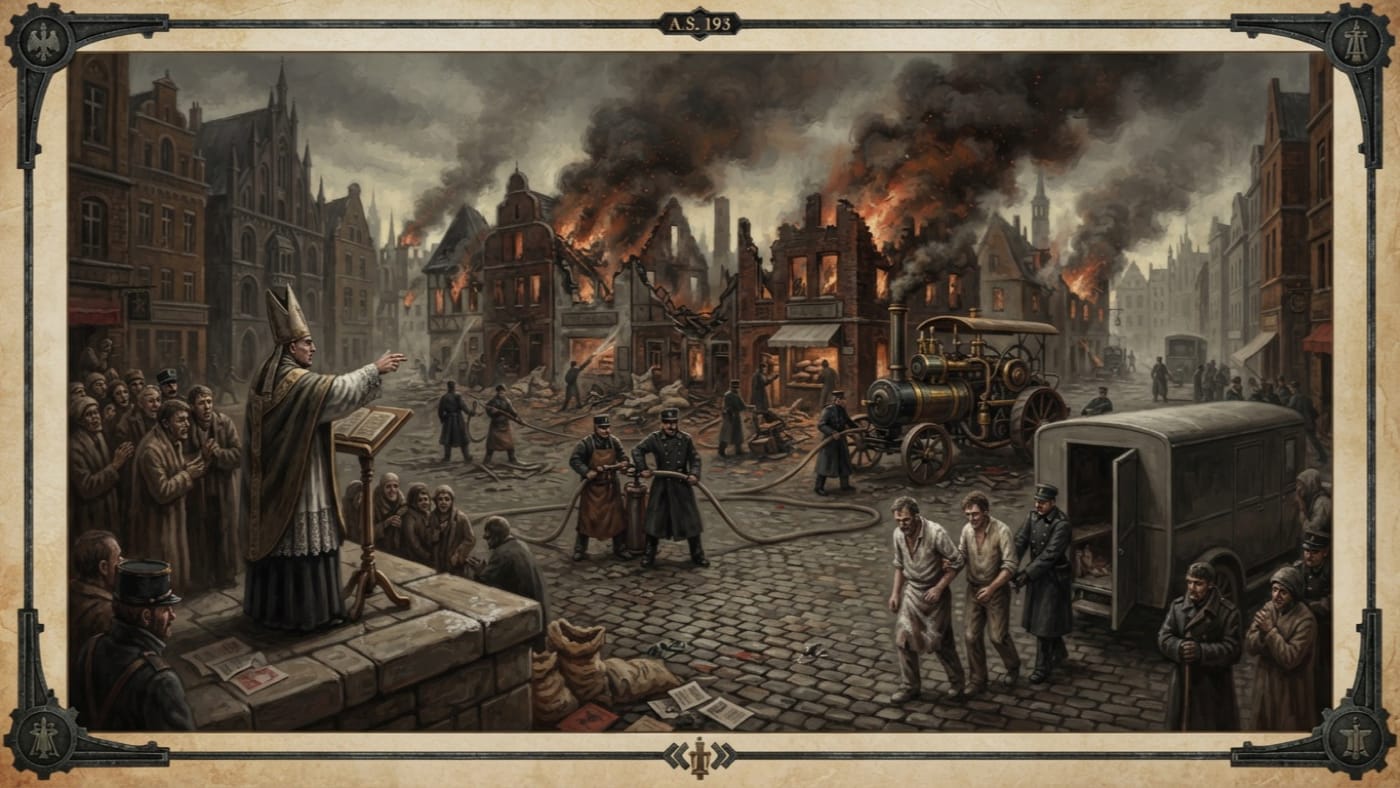
In A.S. 193, the city of Cologne declared that a Blightbearer had entered its flour. None had. The flour had gone mouldy, as flour will when mortals store it in a river city with damp cellars and a long memory for rain. The finding of ordinary mould came eventually. Before it came, six bakeries had been burned and two innocent millers interrogated. A bishop had also recommended fasting to a population whose ovens were partly ash.
I was not present. I had no need to be. The file reached the archive the way such files always do: thin where it should be thick, eloquent where it should be silent, and certain about everything except the cause.
Cologne sits in the Rhine Heartlands, well behind the Sagittal Line, among archive-banks, vault finance and ecclesiastical offices that keep excellent minutes. It is a city of seals and counting-houses. It had little practical acquaintance with famine-carriers. A city that has never met the enemy can find him anywhere, even in a flour sack.
#On the Famine Feared
In fairness to the frightened, who rarely receive any, I record that the fear had a real object.
Kargath's Blightbearers are the most patient servants of the Sin-General of Gluttony. They do not eat what they ruin. They carry hunger the way a thurifer carries smoke down the nave, and wherever they pass the crop rots in the furrow, stored grain sweats and blackens, water turns brackish, beasts sicken, and the soil forgets how to nourish. They are starving the whole time. Kargath grants them no meal and sends them out as weapons against everyone else's.
Worse than spoilage is the counterfeit. A granary a carrier has crossed may still look full. The sacks keep their weight and the bread keeps its shape. The eater grows faint within the hour and comes back for a second bowl, then a third. The Bureau of Medicine calls this external emptiness. The phrase is handsome enough to be cut into a lintel, and it is the reason a frightened quartermaster stops trusting his own inventory.
Genuine carriers give signs that any frontier ration officer knows: famine-salt crusted at the eyes, a sour-grain stink that arrives before the body does, rats gone silent in the walls, dogs that will not bark. Their theatres are the Blightmarsh boundary and the approaches to Bastion-Constantinople. There, suspect stores are burned under standing order and counted afterward. Confirmed western incursions are rare, rare enough that each alarm brings a requisition and three contradictory pamphlets from the Bureau of Purity.
The surviving account of Cologne mentions none of those signs. It mentions flour: spoiled flour in a city that had read the eastern circulars closely and decided that a warning written for the ravelins of Constantinople applied to a bakehouse beside the Rhine.
#On the Six Bakeries
Six. That number is the firmest ground in the file, and I stand on it.
A bakery is a modest building and a large institution. Its oven took a mason a season to set and the baker a decade to understand. It has troughs, peels, proving cloths, a flour loft, and a slate of small debts owed by half the street. It feeds the parish before the parish has finished morning office. Burn one bakery and the neighbourhood buys its bread two streets over. Burn six and two streets over begins to run out.
The eastern posts have an order painted above their ration stores: when the food is full and the men are hungry, burn the food. It is a sound order. It was written for a known enemy whose trace had been found, and for garrisons that can draw replacement stores from a depot. Carried west into Cologne, it turned against its own reasoning. The men were not hungry. The flour was only spoiled, and spoiled flour is thrown out. A sack goes in the midden, or at worst a loft is emptied. Six fires removed the ovens that would have baked the replacement loaves.
I do not know who gave the order, and the account does not say. I will not supply a name just because the reader would like someone to despise. I have the outcome. Someone with authority saw spoiled flour and reached for the frontier remedy. Others with authority let the remedy proceed until there was nothing left to burn.
Fire appeals to an office because it produces a result that can be written up the same afternoon: six premises cleansed. The entry looks like diligence and reads like diligence. In the whole history of the Church, nobody has audited ash for accuracy.
#On the Millers and the Fast
Two millers were interrogated, and they were innocent. Those two facts belong in the same sentence for good, so I have put them there.
In a flour alarm the miller is the obvious suspect, in the way a sexton is the obvious suspect when a bell cracks. The grain passes between his stones, his mark is on the sack, and he was the last man to handle the stuff before the city decided it was cursed. A carrier, by definition, is something that grain passes through on its way to harm. So is a mill. The resemblance was grammatical, and it was enough.
The file does not say what the millers were asked, for how long, or by whom. It records no confession and no sentence. I will not add torments to make the account more readable. Being interrogated is indignity enough for men whose offence was grinding the city's grain.
Then there is the bishop. He goes unnamed here, as he goes unnamed in the account, and I will not enlarge him with a biography he has not earned in these pages. He recommended fasting as a civic precaution. It had the austere beauty ecclesiastical counsel has when it costs the counsellor nothing. If the bread was cursed, abstain from bread. If it was not, abstain anyway, for the good of the soul. Either way the city's stomach would be at its prayers.
He was applauded.
The applause lasted until the bakers' guild made an observation. It came with the patience of men who rise in the dark to light ovens. A fast earns merit when it is chosen. A city that has just burned its bakeries has not been offered much choice. The guild's point was that fasting after the ovens were gone had lost the splendour of voluntary piety. A loaf has to exist before anyone can nobly refuse it.
I record the guild's objection as theology, because it is better theology than the sermon. The Bureau of Doctrine has long taught that the worth of abstinence lies in the will. It has spent less time on the case where arson has made the decision for the will.
#On the Correction
The cause was mould: ordinary mould, the Creator's own provision for returning bread to dust, which needs no Sin-General to administer it. It grows in damp lofts up and down the Rhine in any wet year. Kargath has never been required to sign for it.
The finding was correct, and it arrived after the fires. That is the usual order of things. A diagnosis waits for a sample, and a sample waits for someone calm enough to take it. The alarm needed only a smell, a rumour and a reader of circulars. In Cologne the alarm moved first.
A.S. 193, Cologne: suspected Blightbearer contamination of civic flour stores.
Corrected. The spoilage was ordinary mould. No Blightbearer figures in this incident except as the suspicion that set it off. The two millers questioned were innocent. The six bakeries were burned on a false attribution. The incident is to be filed under civic error and removed from any reckoning of western carrier incursions, which are rare and remain so.
The Blightbearer is a real enemy, as Bastion-Constantinople can attest. It is an eastern one. A city that wants to honour the frontier warnings should first learn what the frontier is actually warning against.